


Volkswagen just opened a new front in its global sales war, and the supply line runs straight through Beijing.
The German automaker announced its entry into Uzbekistan this week, but the real story isn’t the new market. It’s the logistics behind it. For the first time, Volkswagen is managing an entire export market through its Chinese operations, shipping China-built vehicles to Central Asia.
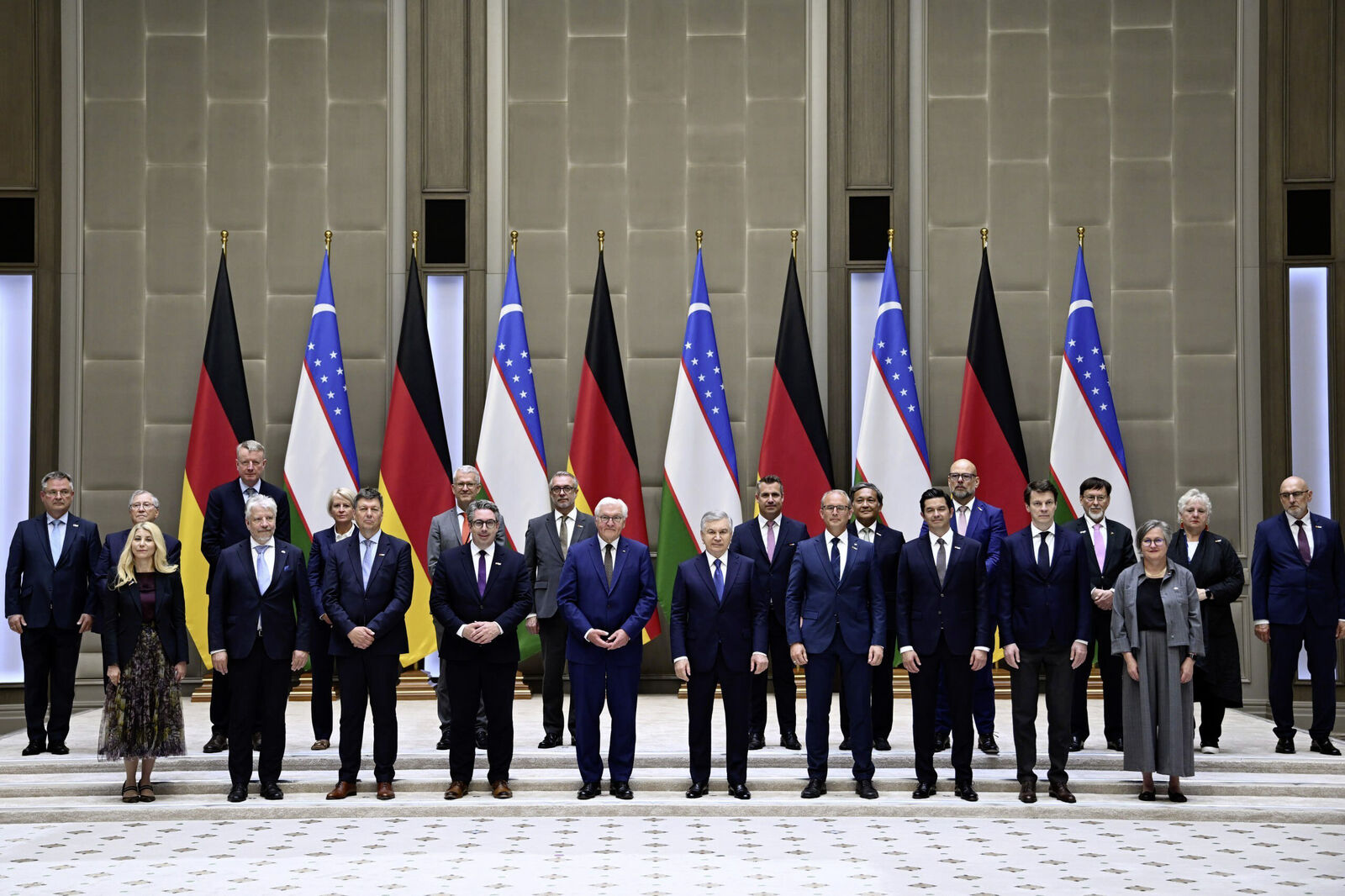
German president Frank-Walter Steinmeier showed up in Tashkent to bless the arrangement alongside Uzbek president Shavkat Mirziyoyev. That level of political theater tells you this is about far more than selling Tiguans in Tashkent.
The model lineup underscores the point. Volkswagen is launching with the Tiguan L Pro, Passat Pro, and Teramont Pro, all China-market variants, plus vehicles from Jetta, the China-only sub-brand VW created to compete in price-sensitive segments. None of these roll off a line in Wolfsburg or Chattanooga.
Uzbekistan might look like a minor play on the map, but the numbers tell a different story. The country’s 38 million people bought over 461,000 vehicles in 2025, more than double the volume from 2021. That kind of growth rate gets attention in boardrooms where European demand has gone flat and the American market is a tariff minefield.
Volkswagen plans 13 dealer locations by year-end, with that number nearly doubling by 2028. A semi-knocked-down assembly plant is being built in Tashkent with local partner Alyans Auto, expected to start operations before the end of this year. SKD plants are the classic beachhead strategy: ship partially assembled vehicles, bolt them together locally, build political goodwill and eventually deepen the manufacturing footprint.
Martin Sander, VW’s sales chief, called it “an important pillar of our global sales strategy.” He also dropped the broader hint: Southeast Asia, the Middle East, the CIS region, and selected African markets are all under evaluation for similar treatment.
That’s the pattern worth watching. Volkswagen spent decades and billions building out its Chinese manufacturing base, including joint ventures that now produce vehicles at scale and at costs European plants cannot touch. With Chinese domestic sales under relentless pressure from BYD, NIO, and a dozen other local EV makers, those factories have capacity to spare. Exporting China-built VWs to emerging markets turns a liability into leverage.
It also creates an awkward optic. Volkswagen is simultaneously cutting thousands of jobs in Germany, closing or shrinking plants, and negotiating painful concessions with unions, while routing new growth through Chinese production. The company would argue these are different vehicle segments for different markets, and they’d be technically correct. But the trajectory is unmistakable: China is becoming VW’s export hub for the developing world.
Robert Cisek, CEO of Volkswagen China Passenger Cars, was front and center at the Tashkent launch. His presence wasn’t ceremonial. He’s the one running the operation. When your new market expansion is managed out of Beijing, not Wolfsburg, the org chart is saying something the press release won’t.
Uzbekistan today, Central Asia tomorrow, Africa and Southeast Asia after that. Volkswagen is building a parallel distribution empire powered by Chinese factories and Chinese-spec vehicles, aimed at fast-growing markets where European-spec cars would be overpriced and underspecified. It’s pragmatic. It’s arguably necessary. And it rewrites the map of where Volkswagen actually makes its future.
Share this Story