



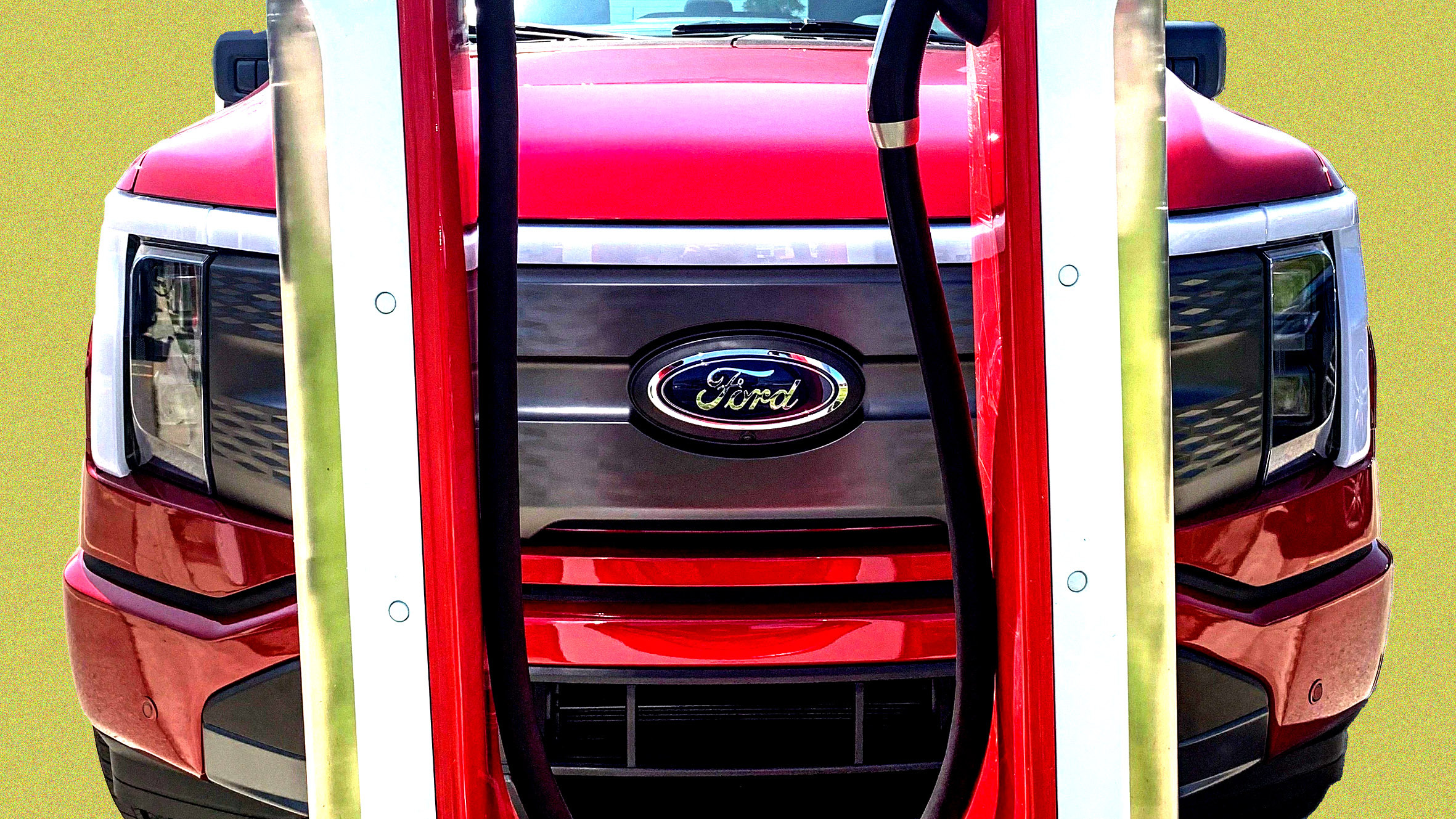
Two weeks ago, Ford was the automaker that lit $19.5 billion on fire chasing electric vehicles it couldn’t sell fast enough. Today, it’s an energy storage company that happens to make trucks, and investors can’t buy shares fast enough.
Ford stock has surged 28 percent since the company launched Ford Energy, a subsidiary that takes idle battery production capacity and redirects it toward utility-scale energy storage. The customers aren’t drivers anymore. They’re power companies, industrial operators, and the server farms running AI workloads.
The irony is thick enough to cut with a torque wrench. The same battery lines in Michigan and Kentucky that bled red ink under Ford’s Model e division are suddenly looking like gold mines. Someone finally found buyers willing to pay for the cells without needing a windshield attached.
At the center of this story sits CATL, the Chinese battery giant that dominates global cell production. Ford licenses CATL’s technology to manufacture cells domestically, a deal that gives Ford access to the best battery chemistry in the world. In return, CATL gets a legitimate presence inside the United States without the political baggage of building its own plants on American soil.
Ford plans to deploy at least 20 gigawatt-hours annually for energy storage. The first concrete deal came in mid-May: a five-year agreement with renewable energy developer EDF for up to 4 GWh per year, totaling 20 GWh over the contract’s life. It’s a real number with a real customer, which is more than most energy pivot stories offer.
But one deal doesn’t fill a factory. James Picariello, head of US autos research at BNP Paribas, put it plainly. Ford needs roughly five more agreements of similar scale within the next twelve months to credibly hit that 20 GWh annual target.
Late last year, Ford disclosed the $19.5 billion write-down after pulling back from battery joint ventures with SK On and LG Energy Solution and scaling down its EV ambitions broadly. That was supposed to be the obituary. Instead, the excess capacity those abandoned plans left behind became the raw material for Ford Energy’s pitch.
Wall Street’s enthusiasm here tells you something about where the money sees real demand. Grid-scale battery storage is exploding as utilities scramble to support renewable energy gaps and data center operators face power constraints that threaten to bottleneck the AI boom. Ford didn’t plan to be in this business. It stumbled into it because its EV strategy collapsed.
The question nobody in Dearborn wants to answer honestly is whether Ford Energy is a genuine long-term business or a clever way to dress up stranded assets for a stock market that rewards narratives over fundamentals. A 28 percent rally on one subsidiary announcement and a single customer contract suggests investors are pricing in a future that hasn’t been built yet.
Ford has the cells, the factory floor, and the CATL partnership. What it doesn’t yet have is enough signed contracts to prove this pivot scales beyond a promising pilot. The next twelve months will determine whether Ford Energy is a real business or just the most creative write-down recovery in Detroit history.



Share this Story