
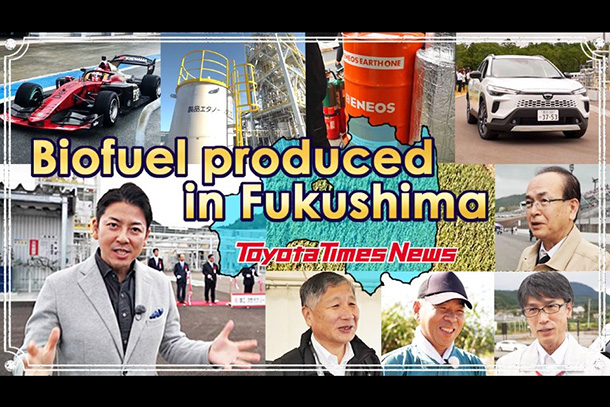


Japan’s top open-wheel racing series opened its 2026 season in April with every car on the grid burning fuel nobody thought possible four years ago. Super Formula machines, topping 300 kph, are now running on E10 gasoline blended with bioethanol grown and produced in Fukushima Prefecture — on land that has sat idle since the 2011 nuclear disaster.
That’s not a typo. The fields surrounding the Fukushima Daiichi Nuclear Power Plant, abandoned for more than a decade, are now growing the plant feedstock for racing fuel.
The project traces back to 2022, when a seven-company consortium called the Research Association of Biomass Innovation for Next Generation Automobile Fuels set up shop in Namie, Fukushima. Toyota is among the members. The work started with something as basic as choosing which crops to grow. Four years later, the biofuel those crops produce is powering the fastest domestic racing series in Japan.
A production research facility went operational in 2024 in Okuma — the same town where the crippled nuclear plant sits. The location was no accident. This is a public-private partnership designed to do two things at once: prove that bioethanol can function as a legitimate low-carbon alternative to petroleum gasoline, and channel economic activity back into a region still scarred by catastrophe.
Bioethanol itself is nothing new. Brazil has run its passenger fleet on sugarcane-derived ethanol for decades. The United States blends corn ethanol into most of its pump gasoline.
But Japan has historically imported nearly all of its fuel, and domestic biofuel production at scale has never gained serious traction. Growing feedstock on contamination-zone farmland and converting it into racing-grade fuel is a distinctly Japanese answer to a global problem — part industrial policy, part regional reconstruction.
The E10 blend used in Super Formula contains 10 percent bioethanol by volume. That’s a modest ratio, but the point isn’t the percentage. It’s the proof of concept.
Running at sustained high RPM, under extreme thermal loads, at speeds above 300 kph, is the most punishing validation test any fuel can face. If it works in a Super Formula car, it works in a Corolla.
Toyota has been pushing the idea that carbon neutrality doesn’t require a single technological path. Chairman Akio Toyoda has said repeatedly that the answer isn’t choosing between battery-electric vehicles and internal combustion but preparing multiple options. Biofuel fits neatly into that argument because it lets existing engines and existing infrastructure stay relevant while cutting net carbon emissions through the plant growth cycle.
The consortium’s timeline is telling. From crop selection in 2022 to facility construction in 2024 to race-day deployment in 2026, the entire arc took four years. That’s fast by fuel-development standards, and it suggests the group had political tailwinds as well as technical ones.
Fukushima’s recovery has been a national priority since the earthquake and tsunami, and any project that puts those idle hectares back into productive use carries weight in Tokyo.
Whether this scales beyond motorsport is the obvious next question. A few thousand liters of E10 for a racing season is a rounding error against Japan’s annual fuel consumption. But the consortium now has data, a working supply chain, and a compelling origin story rooted in one of the country’s worst modern tragedies.
The cars are fast. The fuel works. The farmland is no longer empty. Sometimes a proof of concept proves more than just the concept.




Share this Story