
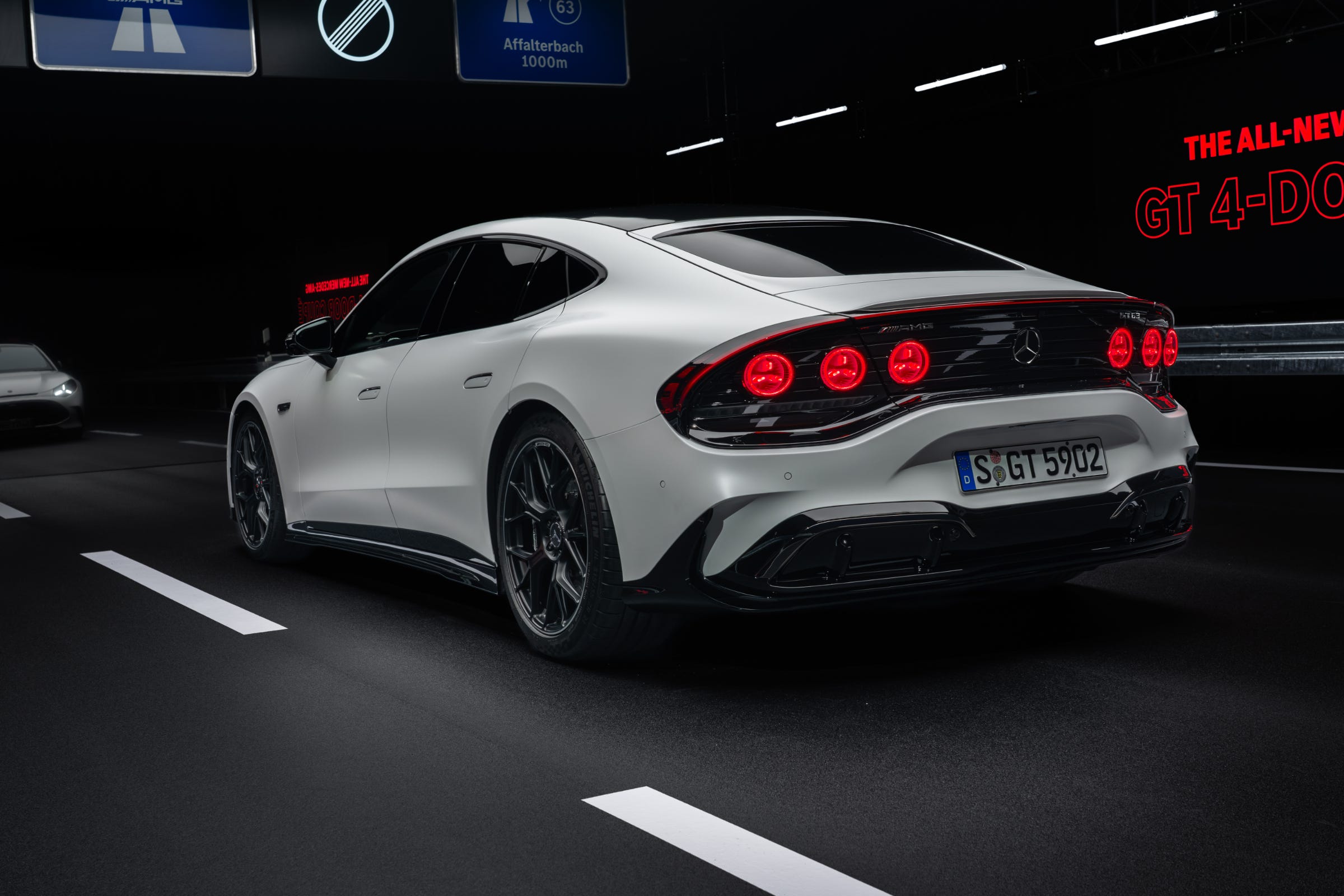


Mercedes-AMG hired professional musicians to create the synthetic exhaust note for its first ground-up electric car. The result was, in CEO Michael Schiebe’s words, “completely disappointing.”
That admission, delivered at the launch event for the 2027 Mercedes-AMG GT 4-Door Coupe, is the most revealing detail about where the industry stands on the question of electric-car soul. AMG didn’t just want a sound. It wanted its sound, and the outside talent couldn’t deliver it.
The GT 4-Door Coupe is AMG’s first EV built from scratch, and it arrives with a feature called AMGForce S+ mode that turns the silent grand tourer into something that sounds, shifts, and vibrates like a twin-turbo V-8 coupe. Speakers embedded in the headlights and cabin generate a dynamic exhaust note tied to throttle position. A simulated gearbox lets drivers paddle-shift through fake cogs, and the seats pulse with a vibration pattern that mimics a V-8 at idle.
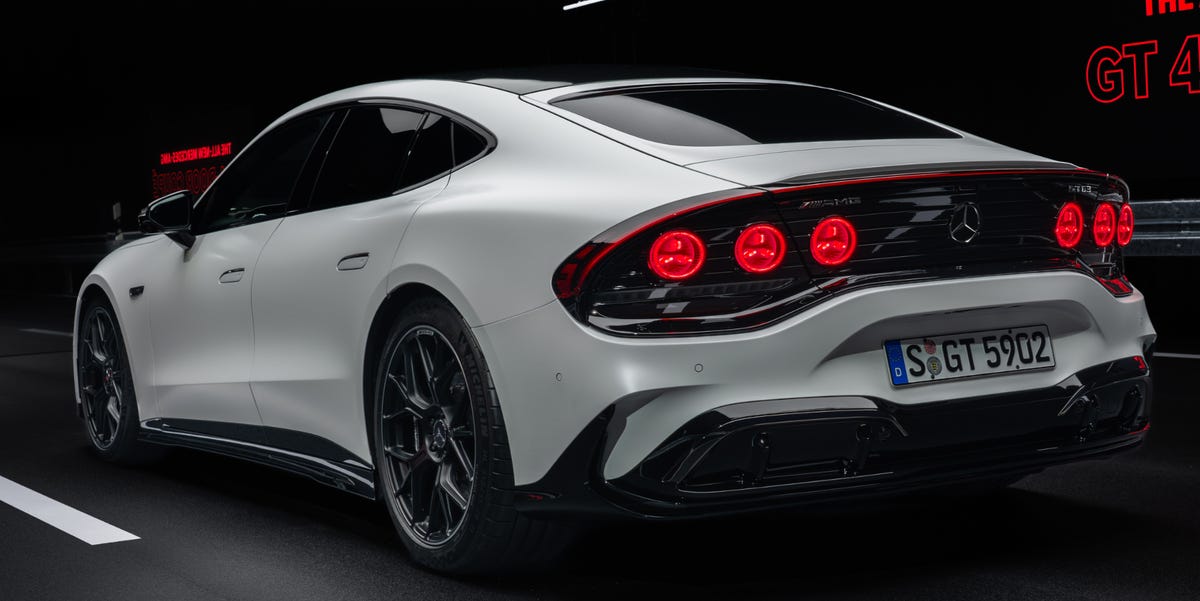
The technical backbone is a real-time mixing engine that draws from more than 1,600 sound files, dynamically remixed to match driving behavior at any given moment. By any measure, that is an extraordinary amount of engineering effort devoted to pretending the car is something it is not.
Schiebe was blunt about the first attempt. Music industry professionals took the car to AMG’s Immendingen proving ground and came back with something polished but generic. “It was cool, but it had nothing to do with the history and heritage of Mercedes-AMG,” he said.
The fix was to bring in the engineers who developed the exhaust and powertrain for the C190-generation AMG GT and its 4.0-liter V-8, pairing decades of combustion knowledge with younger sound designers who understood digital composition.
The result, Schiebe claims, is something competitors can’t easily replicate, precisely because it requires institutional memory of how a real AMG V-8 breathes, barks, and overruns. “You need to have the history right,” he said.
Hyundai got there first with the Ioniq 5 N’s simulated shift points and synthesized noise, but AMG is betting that authenticity of origin matters. A fake V-8 note designed by the people who built real V-8s carries more weight than one composed from scratch by outsiders.
AMG is arguing that its combustion heritage is a competitive moat even in an electric future, that the decades spent tuning flat-plane cranks and hand-built engines translate directly into software calibration. Whether buyers will pay a premium for provenance in a sound file remains an open question.
What’s undeniable is the scale of the commitment. This isn’t a toggle-on gimmick buried in a menu. AMGForce S+ transforms the instrument cluster into a tachometer, adds gear-position logic to the powertrain, and choreographs haptic feedback through the seat foam.
Mercedes wants this to feel indistinguishable from driving a combustion AMG, which is a strange goal for a company that simultaneously insists the electric future is inevitable.
Schiebe framed the feature as a bridge for hesitant buyers. We also saw the risk that customers would not actually adopt electric cars,” he said. The fake V-8 isn’t just theater. It’s a sales tool, engineered to ease the transition for loyalists who associate AMG with noise and fury.
If the electric powertrain is genuinely superior — faster, smoother, more efficient — why does it need to cosplay as the thing it replaced? AMG’s answer is that emotion sells cars, and for now, the emotion customers want still sounds like eight cylinders firing.
The 2027 GT 4-Door Coupe will test that theory with real money on real dealer lots. The engineering is impressive. The question is whether the best fake V-8 ever made is a monument to the past or a lifeline to the future.

Share this Story