
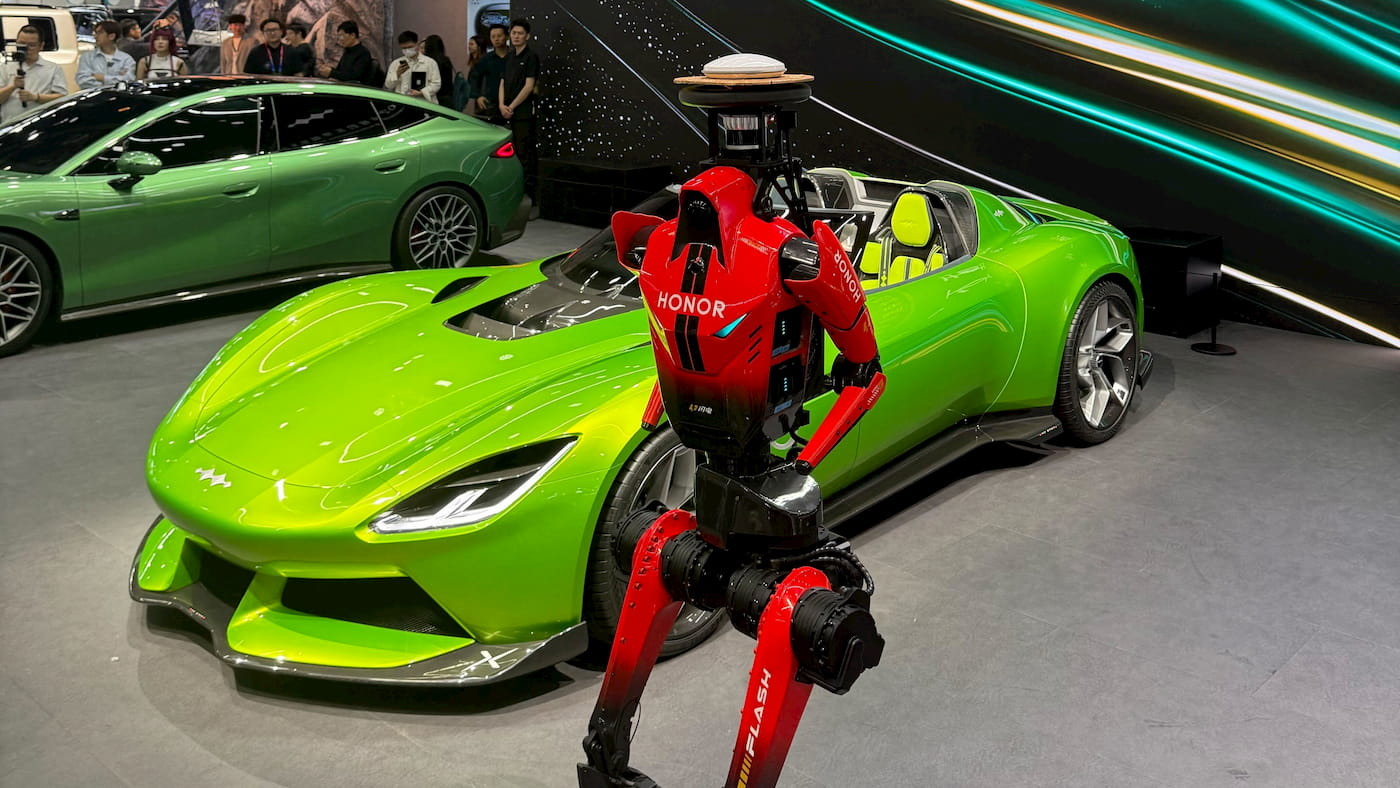


More than 1,400 vehicles spread across 150,000 square meters of exhibition space. Two side-by-side venues covering more than 50 football pitches. The 2026 Beijing Auto Show opened Friday to industry professionals and media, and the message was unmistakable: the global auto industry’s center of gravity has shifted east.
The mega stages belonged almost entirely to Chinese brands. BYD and battery giant CATL commanded the prime real estate while traditional heavyweights like BMW and Mercedes were pushed into sweeping but secondary hall positions. That’s a reversal that would have seemed absurd a decade ago, when foreign nameplates owned the Chinese market.
XPeng CEO He Xiaopeng drew cheers unveiling the GX, a 5.2-meter six-seat electric SUV loaded with AI tech and aimed squarely at the luxury segment. He promised humanoid robots this year and eventually mass-produced flying cars. A few years ago, that kind of talk would get you laughed out of Detroit. In Beijing, it draws investment.
Xiaomi’s Lei Jun showed off the Vision Gran Turismo concept, reinforcing the smartphone giant’s determination to be taken seriously on four wheels. The company has gone from zero to credible EV contender in roughly two years. That’s a timeline that would paralyze any legacy automaker’s product planning committee.
Dozens of attendees queued to climb aboard a 10-seat air taxi from AutoFlight, a Chinese aviation startup. It’s part of Beijing’s broader push to dominate the low-altitude economy, a sector Western regulators are still figuring out how to classify.
The foreign brands that remain relevant in China are doing so by surrendering to collaboration. BMW has partnered with CATL. Audi is using Huawei’s driving assistance systems. Volkswagen is co-developing EVs with Guangzhou-based XPeng.
XPeng President Brian Gu put it plainly: companies are “leveraging their respective strength to collaborate with China,” and he expects the trend to accelerate.
Gu has his sights on Europe and the Gulf states. Europe accounted for half of XPeng’s global sales in 2025, and local production has already begun there. Asked about Trump’s tariffs, he offered only that the U.S. market “remained an important one.” The diplomatic non-answer spoke volumes.
The domestic battlefield is equally ruthless. Independent analyst Lei Xing identified at least eight new EV brands from Chinese automakers that have launched in just the past two years. Trade-in schemes offering massive discounts have flooded the market, a price war so fierce that Chinese officials last year called for tighter monitoring and better long-term regulation of competition.
Roomy SUVs are the new growth category, targeting customers who prioritize seating and comfort. China has become what Lei Xing called “a customer retention and replacement/upgrade-driven market.” The land grab phase is over. Now it’s about keeping buyers in the ecosystem.
Rising global oil prices linked to the Middle East conflict are adding tailwind. As petroleum costs climb, the economic case for EVs sharpens. No country is better positioned to supply them than China.
For Chinese auto enthusiast Dai, a 30-year-old influencer roaming the show floor, the verdict was simple. “In comparison, foreign brands seem to have a weaker presence and less visibility,” he said.
He’s not wrong. The show floor told the story in square meters and LED screens and crowd density. The brands that once defined aspiration in the world’s largest auto market are now scrambling for relevance, partnering with the very companies that displaced them. Beijing isn’t just hosting the world’s biggest auto show. It’s hosting the industry’s new permanent power structure.
Share this Story