
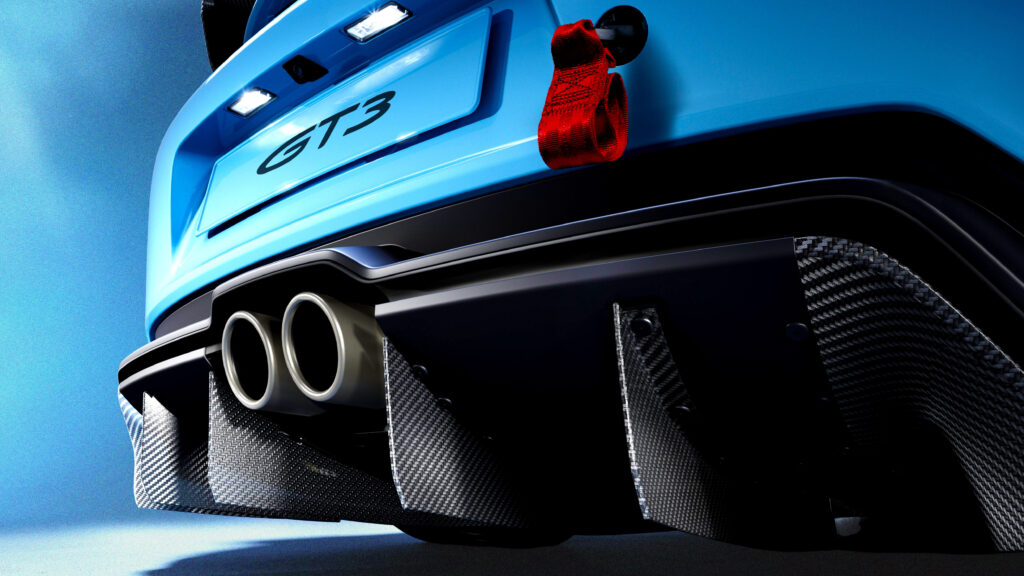


“It might be.” Two words from Andreas Preuninger, the man who has shaped every modern Porsche GT car, and suddenly the most sacred naturally aspirated engine left in the sports car world has an expiration date stamped on it — at least in Europe.
Speaking to Car and Driver, Porsche’s GT boss acknowledged that the 4.0-liter flat-six powering the 911 GT3 can survive in Europe for “probably only a few years without any substantial changes.” The culprit isn’t engineering fatigue. It’s regulation.
The EU demands automakers slash fleet CO2 emissions by 55 percent versus 2021 levels by 2030, then by a staggering 90 percent by 2035. For a company selling high-revving, naturally aspirated track weapons, those numbers are a slow-motion guillotine.
The twist: America gets a reprieve. Preuninger confirmed that more lenient U.S. emissions rules will let Porsche keep the NA engine stateside “for quite some time.” So the GT3’s signature 9,000-rpm wail lives on — just not everywhere.
This creates an awkward split. The GT3 has always been a singular global product, one car built to one uncompromising standard. The idea that European buyers might get a turbocharged version while Americans keep the pure motor turns the GT3 into two philosophically different machines wearing the same badge.
Building region-specific GT3 variants would be expensive, and Porsche’s wallet is already under pressure from multiple directions. The company reversed course on the 718, bringing back combustion-powered Boxster and Cayman models after originally planning an all-electric replacement. It’s also developing a new combustion Macan successor alongside the electric one it already launched.
A three-row flagship SUV is in the pipeline too. That’s a lot of simultaneous engineering programs for a company Porsche’s size.
Forced induction in a GT3 isn’t heresy — it’s history repeating. Turbocharging was once the dominant technology in Porsche’s racing programs, and the 911 Turbo has always coexisted alongside the GT cars. But the GT3’s identity has been defined for over two decades by its willingness to chase revs instead of boost.
That screaming top end, that mechanical directness, that feeling of an engine that rewards commitment rather than relying on compressed air — it’s the entire reason the car commands a cult following and dealer markups that border on the obscene.
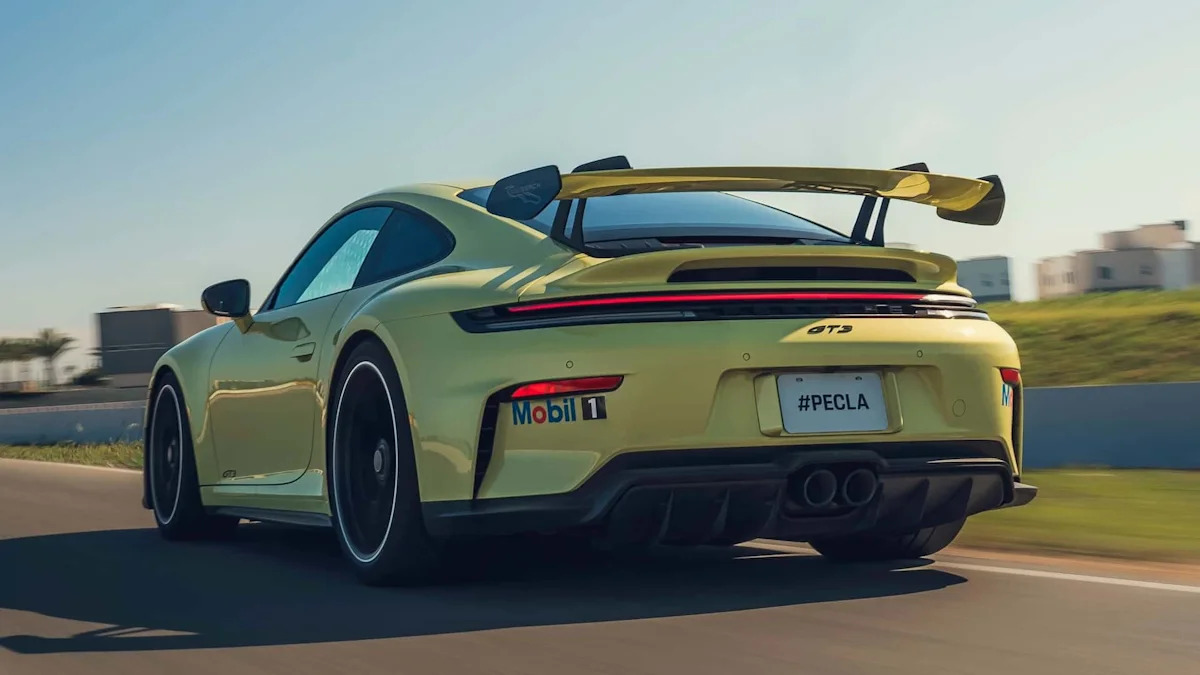
Preuninger knows this better than anyone. He built the religion. Now he’s being asked to negotiate with the regulators who want to tear down the church.
The 992.2 GT3 currently on sale is almost certainly the last of its kind in naturally aspirated form for Europe. Beyond this generation, the math simply doesn’t work under EU fleet targets unless Porsche offsets the GT3’s emissions with enough EV sales elsewhere in its lineup. That strategy depends on Taycan, electric Macan, and future battery-powered models selling in serious volume.
Porsche has stated the 911 will be its last combustion model, surviving deep into the 2030s. Hybrid assistance is already creeping into the lineup. A turbocharged or hybrid-assisted GT3 isn’t a question of if but when, and the answer for Europe appears to be soon.
For American buyers, the window stays open a while longer. The 4.0-liter flat-six spinning to its redline with nothing but throttle bodies and atmospheric pressure feeding it is one of the last mechanical experiences the internal combustion era will produce. Preuninger’s two-word answer — “It might be” — was delivered with the resignation of a man who has spent his career fighting for purity and knows the next fight may be unwinnable.

Share this Story