
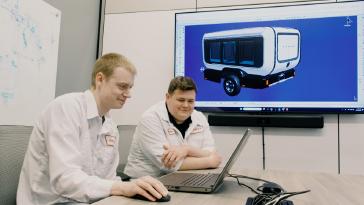


Honda just dropped two videos about its U.S. design operation, and buried inside the corporate polish is something genuinely unusual: a major automaker positioning a towable travel trailer as a flagship statement of its future direction.
The Honda Base Station Prototype, first shown earlier this year, is an entirely new travel trailer concept designed to, in Honda’s words, “democratize outdoor adventures.” That’s a bold claim from a company that built its American reputation on Civics and Accords. But Honda is clearly treating this thing as more than a side project.
It got its own dedicated behind-the-scenes design video, produced with the same weight and reverence the company typically reserves for a new vehicle platform.
The first video is broader, showcasing how designers at Honda Development & Manufacturing of America translate what they’re hearing from younger buyers into actual products. The second zeros in on the Base Station Prototype specifically, walking through the design inspiration and intent. Together, they paint a picture of a company that sees its next-generation customer not behind the wheel of a sedan, but hitching a trailer to something and heading off-grid.
Honda has run R&D operations in the U.S. for over 50 years, starting with a California research facility in 1975. Today it operates 21 facilities across the country handling everything from styling to prototype fabrication. That infrastructure exists primarily to develop cars.
The fact that it’s now being used to develop lifestyle products and outdoor gear signals a strategic pivot that goes well beyond a concept sketch on a wall.
This isn’t happening in a vacuum. The overlanding and outdoor recreation market has exploded in the past five years. Airstream, Winnebago, and a swarm of startups are chasing buyers who want adventure-ready equipment that doesn’t require a Class A motorhome budget.
Honda sees an opening, and it has something most of those competitors lack: a massive engineering apparatus, brand trust built over decades, and a distribution network that reaches every corner of America.
The risk is real, though. Honda’s name means something very specific to American consumers. It means reliable transportation.
Stretching that identity into towable recreation products requires customers to accept Honda as a lifestyle brand, not just an automotive one. Toyota tested similar waters with its TRD Pro lineup and overlanding accessories, but it stayed within the vehicle itself. Honda is stepping outside the vehicle entirely.
There’s also the question of production commitment. Prototypes get lavish video treatments all the time and then vanish. Honda hasn’t announced pricing, a production timeline, or even confirmed the Base Station will be built.
The videos are framed as part of an “ongoing design journey,” which is corporate language that preserves maximum flexibility to walk things back.
Still, you don’t dedicate two professionally produced films and a full press cycle to something you’re not serious about. Honda is testing the market’s appetite in public, using these videos as a soft gauge of consumer interest before committing manufacturing dollars.
Fifty years of U.S. R&D built Honda into one of the most trusted names in the American driveway. Now it wants into the campsite. Whether the Base Station Prototype actually reaches production will reveal how far Honda is willing to stretch, and whether its customers are willing to follow.
Share this Story