
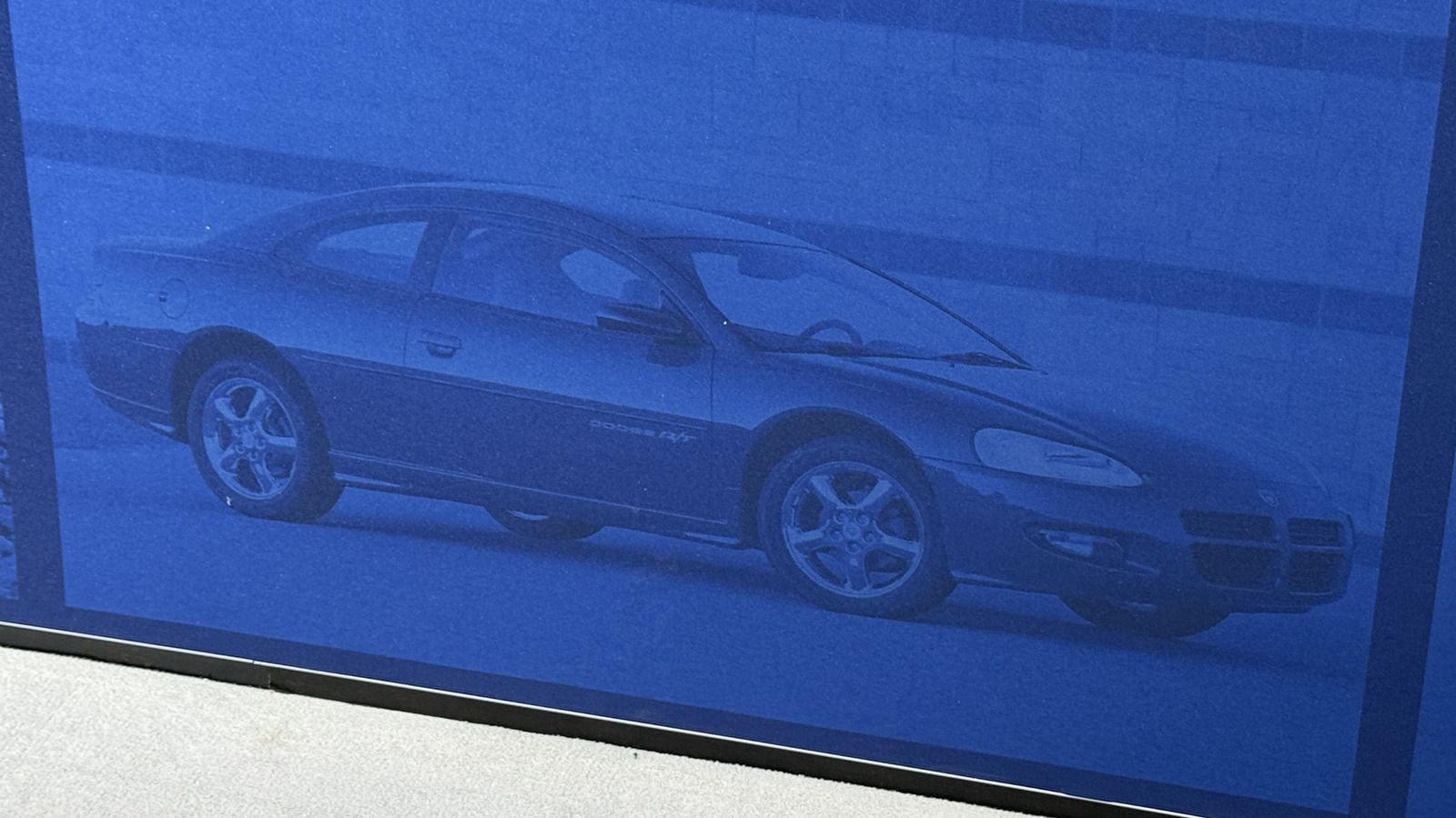


Somewhere in the bowels of Stellantis’s marketing department, a person with access to a printer and no access to good judgment slapped a 2002 Dodge Stratus R/T Coupe onto a massive heritage wall at the 2025 New York International Auto Show. It sits there now, twice actually, on mirrored walls flanking a corridor that funnels visitors toward the Chrysler booth under the banner “Every Mile Carries a Memory.”
The wall features roughly 25 photos of historic Mopar products. The Willys Jeep is there. The Chrysler Town & Country. The Dodge Charger. Vehicles that actually shaped something, that mattered to somebody, that moved American automotive culture forward by at least an inch. And then there’s the Stratus, a car whose most enduring cultural contribution is being the punchline of a Will Ferrell sketch on Saturday Night Live from 1998.
Stellantis built this display as part of the “America 250” celebration, tying the company’s heritage to the nation’s upcoming semiquincentennial. It’s the kind of corporate patriotism that works only if every car on the wall earns its spot. The Stratus does not earn its spot.
The second-generation Stratus R/T Coupe was not a great car when it debuted. It is not a collectible car now. Only one has ever crossed the block on Bring A Trailer, a clean R/T that sold last November for $4,700.
A near-museum-quality Stratus Coupe with a manual transmission and just 6,000 miles currently sits at a Pennsylvania dealership asking $10,900. If any real nostalgia existed for this thing, that number would double overnight.
It doesn’t exist because the Stratus R/T Coupe was barely a Chrysler product to begin with. The sedan was a genuine Chrysler effort, unremarkable as it was. The coupe rode on Mitsubishi’s ST-22 platform, the same bones underneath the Eclipse.
It was built at the Diamond-Star Motors plant in Normal, Illinois, the same facility that produced the Eclipse, Plymouth Laser, and Eagle Talon. Under the hood sat either a 2.4-liter Mitsubishi four-cylinder or a 3.0-liter Mitsubishi V6. The interior was Mitsubishi. The drivetrain was Mitsubishi. About the only thing Chrysler contributed was the radio and the badge.
Two hundred horsepower from an R/T model. That’s what Dodge was offering in 2002, and that’s what Stellantis is now celebrating on a heritage wall alongside vehicles that genuinely defined eras.
The real mystery isn’t the car itself. Forgettable products roll off assembly lines every year and vanish into used-car lots within a decade. The mystery is the process.
Someone at Stellantis selected these images deliberately. Someone approved the layout, printed the graphics, shipped the panels to the Javits Center, and bolted them into place. At no point did anyone in that chain pause and ask whether a rebadged Mitsubishi that made less power than a modern Camry belonged next to the Jeep that helped win World War II.
Stellantis has no shortage of heritage to draw from. Dodge alone could fill ten walls with the Viper, the Demon, the Daytona, the original Charger, the Power Wagon. Chrysler has the 300 letter cars, the Turbine, the Airflow. Jeep’s catalog is essentially a national monument. The company had options. It chose the Stratus.
The New York Auto Show draws families, enthusiasts, and kids seeing dream cars for the first time. Most of them will walk past Stellantis’s heritage corridor and never notice the Stratus hiding among legends. But some will. And for those unlucky few, the damage is done.
You cannot unsee a Dodge Stratus R/T Coupe presented as historically significant. You can only process it, accept it, and move on, the same way buyers did in 2002, usually toward a different dealership.

Share this Story