
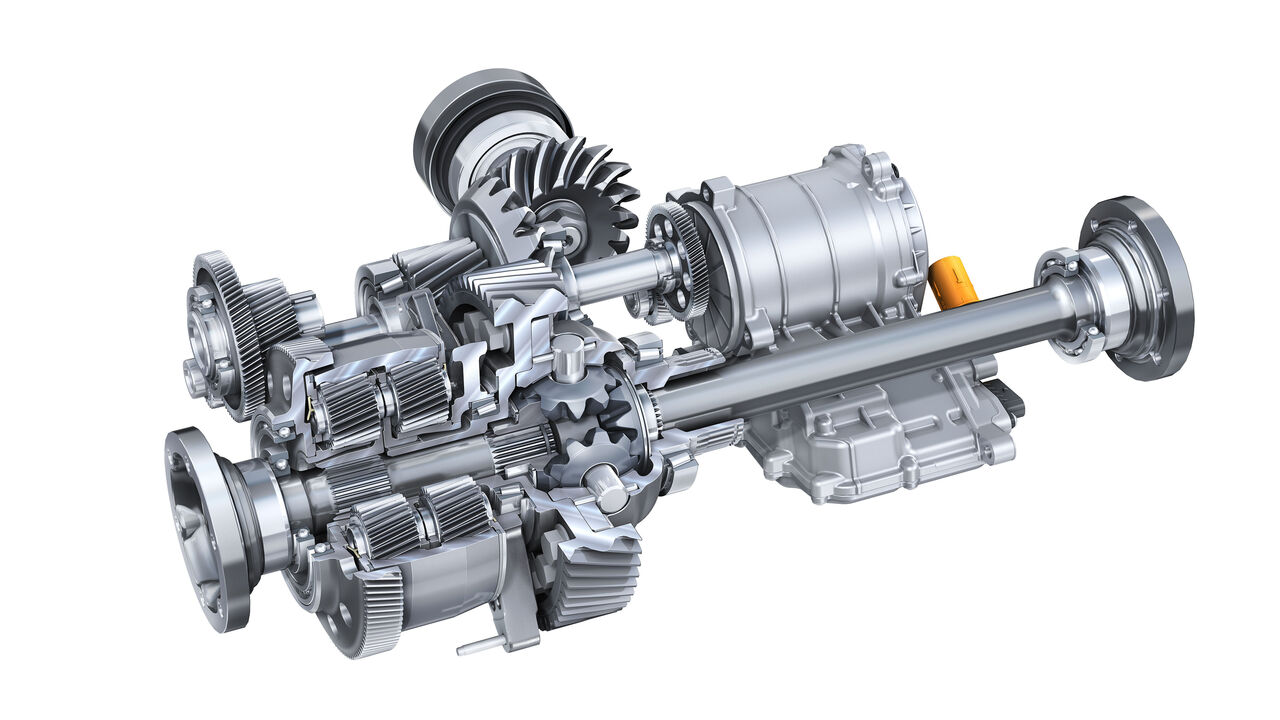


Audi just buried a quietly revolutionary piece of hardware inside the new RS 5’s rear axle. It’s an 8 kW electric motor, roughly the output of a decent lawnmower, and it might be the most consequential change to quattro all-wheel drive in a generation.
The system is called quattro with Dynamic Torque Control, and it represents a world first in a production car: electromechanical torque vectoring at the rear transaxle. Forget the clutch-based torque splitters that have defined performance AWD for the past two decades. This one uses a permanently connected, water-cooled 400-volt electric motor producing just 40 Nm to shuffle up to 2,000 Nm of torque difference between the left and right rear wheels. It does it in 15 milliseconds, roughly a tenth of a blink.
The math deserves a second look. A motor making 40 Nm is leveraging overdrive gears and planetary gear sets to command a 2,000 Nm torque delta. That’s a multiplication factor of 50.
The engineering is elegant. An actuator bolted to the left driveshaft and the differential carrier uses mechanical advantage to redirect power flow through a conventional low-lock diff. It’s a torque amplifier hiding inside what looks, from the outside, like a standard rear axle housing.
The critical distinction from older systems is what happens when you lift off the throttle. A clutch-pack torque splitter can only distribute torque when the engine is pushing. No drive torque, no vectoring.
Audi’s electromechanical setup doesn’t care. It vectors under braking, off-throttle, mid-coast, any operating state. That permanence changes the car’s personality from something that reacts to something that anticipates.
That anticipation is managed by the RS 5’s HCP1 central computing platform, which reads steering inputs and distinguishes between a driver correcting oversteer and a driver initiating a fast turn-in. Different intentions, different responses, processed and executed before the tires have finished changing direction.
The RS 5 itself is a modular plug-in hybrid, a sentence that would have been unthinkable on an RS-badged Audi five years ago. Combined fuel consumption runs 3.8 to 4.4 liters per 100 km in the weighted cycle. On a dead battery, that balloons to nearly 10 liters.
The CO2 class drops from B or C to a flat G. The gap between those two numbers tells you this car lives a double life, and the torque vectoring system lives comfortably in both.
Available in sedan and Avant body styles, the RS 5 pairs this rear-axle trickery with electronic differential lock and brake torque vectoring at the front, plus twin-valve adaptive dampers calibrated to work with the rear vectoring. Audi’s drive select modes span from neutral and balanced to rear-biased and aggressive. In practice, the car can feel like a composed grand tourer or a tail-happy weapon depending on what the driver selects.
The real story isn’t the RS 5 itself. It’s where this technology goes next. An 8 kW motor and a clever gear arrangement that fits inside an existing transaxle envelope is inherently scalable.
If Audi can bolt this to an RS sedan, it can bolt it to anything on the PPC platform or beyond. BMW’s M xDrive uses clutch packs. Mercedes-AMG’s 4MATIC+ uses clutch packs. Everyone uses clutch packs.
Audi just stopped.
That tiny motor in the back of the RS 5 isn’t a headline feature. It’s a proof of concept disguised as a production part, and it makes everything else on the market look like it’s waiting for an update.


Share this Story