
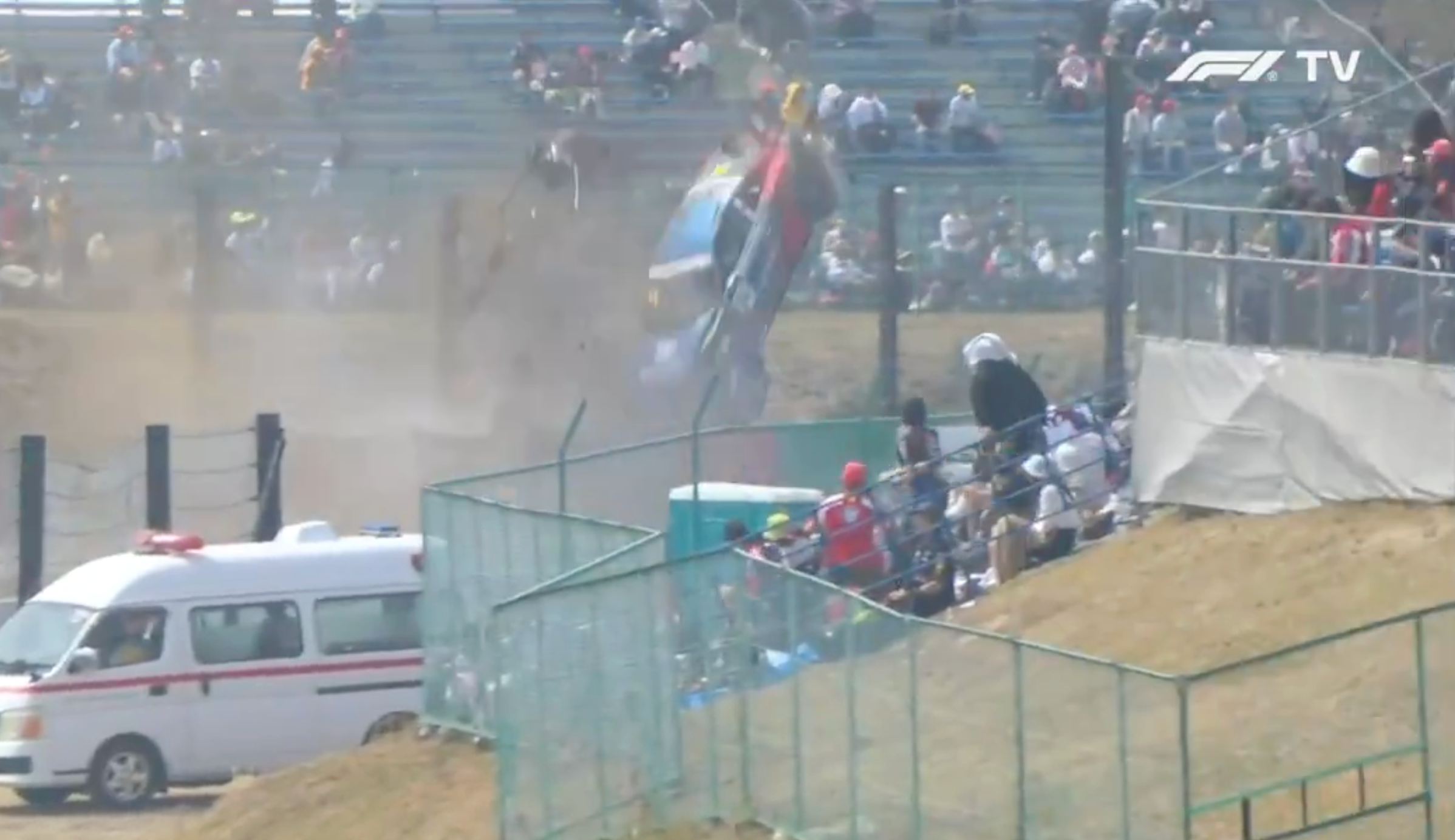


A Porsche 911 GT3 Cup car barrel-rolled over a catch fence at Suzuka on Saturday, one of the more violent support-race crashes in recent memory at the Japanese circuit. The driver, Masa Taga, walked away. The fence did not fare as well.
The incident happened during the opening round of the 2026 Porsche Carrera Cup Japan season, run as a support event ahead of the Formula 1 Japanese Grand Prix. Taga, driving the No. 84 CREF Motor Sport entry, was battling near the back of a three-car scrap approaching the high-speed 200R section when contact sent his car airborne.
The sequence was ugly. Taga’s Porsche caught a lip — likely a curb or grass edge — after the initial hit and launched into a barrel roll that carried it up and over the catch fencing. The car came to rest on the banking beyond the barrier, its bodywork shredded and the fence mangled beneath it.
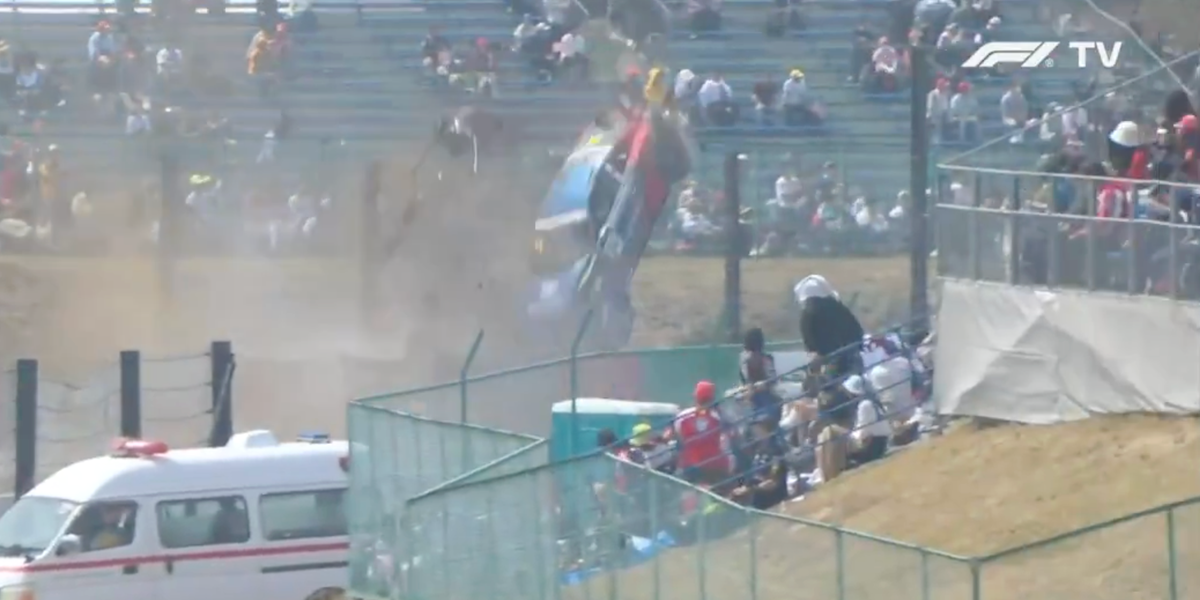
Ahead of Taga, Jule Kazuki Treluyer in the No. 9 Bingo Racing car and Hiro in the No. 16 NRG entry had been fighting through Turn 10. When Hiro’s car faded, Taga moved to challenge, and the two made contact. That was all it took.
The red flag came out immediately. Taga reportedly climbed from the wreckage without serious injury — remarkable given the violence of the impact and the fact that his car cleared infrastructure specifically designed to prevent exactly that outcome.
The damage to the catch fence at Turn 12 forced the FIA to delay the Formula 1 formation lap by ten minutes. The governing body confirmed to media that barrier repairs were ongoing and that pit lane timing for reconnaissance laps would also be pushed back. The formation lap eventually commenced at 14:10 local time.
Ten minutes doesn’t sound like much. But any delay to an F1 race start caused by a support event gets attention at the highest levels of the sport’s safety apparatus, and rightly so. Catch fences exist as the last line of defense between a wayward car and whatever — or whoever — sits on the other side. When a car clears one entirely, questions follow.
Suzuka’s 200R is one of the fastest corners on the calendar, a sweeping left-hander taken at enormous speed even in GT3-spec machinery. The combination of velocity, elevation change, and proximity to barriers has always made this stretch of the circuit unforgiving. A car going over the top rather than being contained by the fencing exposes a gap between what the infrastructure is rated for and what actually happens when physics takes over.
Porsche Carrera Cup cars aren’t lightweights, either. A 911 GT3 Cup tips the scales around 1,260 kilograms. Getting that mass airborne and over a fence requires tremendous energy — energy that was supposed to be absorbed, not redirected.
The FIA will almost certainly review the incident. Whether it leads to changes at Suzuka’s fencing specifications or run-off geometry remains to be seen, but the footage circulating on social media leaves little room for complacency. A car ended up somewhere no car should ever be.
Taga’s escape without serious injury is the headline that matters most on Saturday. But the image of a Porsche sitting on the wrong side of a catch fence at one of motorsport’s most celebrated circuits is not one the sport can afford to simply file away. Suzuka has always demanded respect. It just issued another reminder of why.




Share this Story