
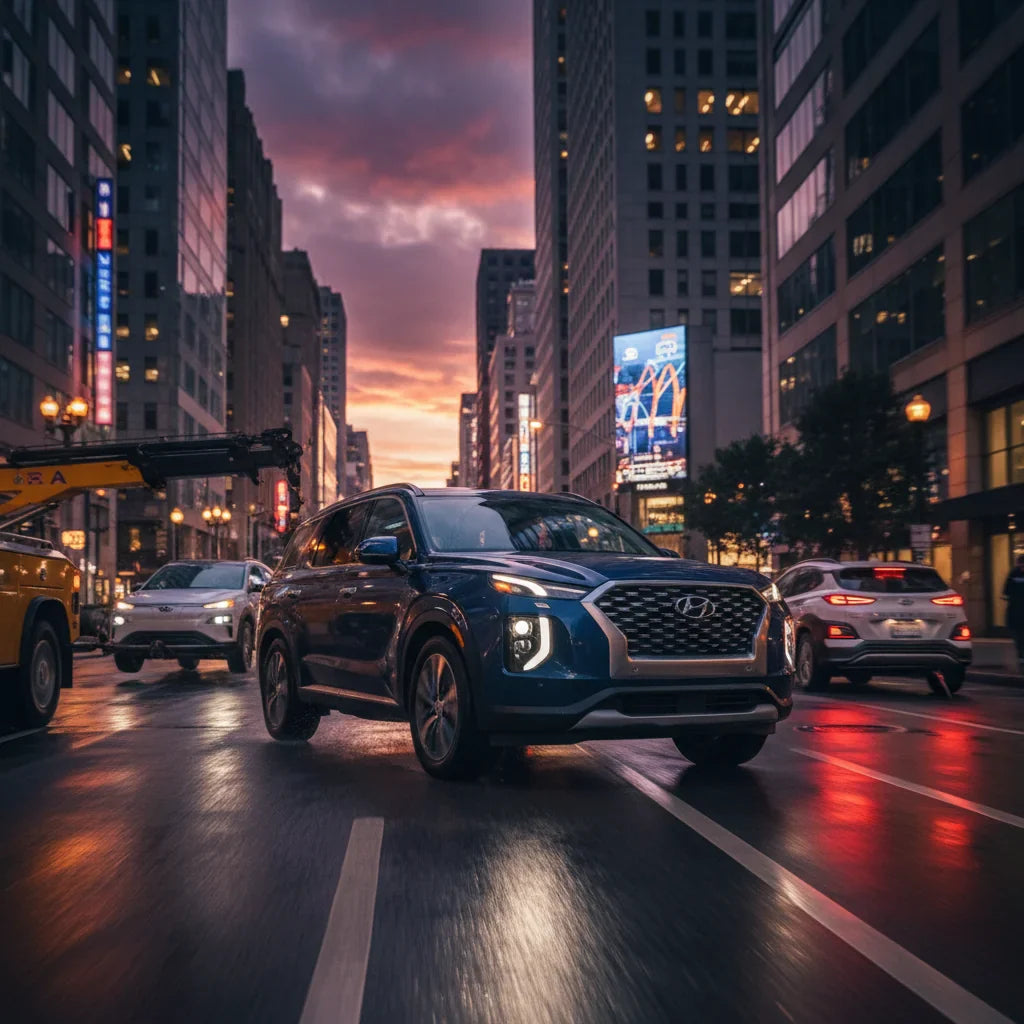


A Hyundai Palisade driver tried to throttle out of a wheel-lift tow in a video that’s burning across social media this week. The clip runs about 20 seconds. It feels longer.
The SUV guns it, tires howl, smoke curls off the pavement, and the tow truck doesn’t budge. Physics delivered the verdict before the driver’s foot even hit the floor.
The footage, which surfaced around March 15, shows the kind of roadside panic that turns a bad parking situation into a four-figure repair bill. The Palisade’s all-wheel-drive system, its electronic parking brake, its stability control — every system designed to keep that 4,500-pound crossover safe on the highway became an accomplice to its own destruction the moment two wheels left the ground.
That’s the part people miss when they watch these clips and laugh. Modern crossovers are engineering marvels in their intended environment. Rip them out of context — say, hoist one axle onto a wheel-lift while the driver mashes the gas — and every smart subsystem turns stupid at the same time.
Stability control reads insane wheel-speed differentials and cuts power. The electronic shifter may not respond the way a panicked hand expects. Auto-hold can lock the wrong axle.
And the AWD system’s clutch packs and center differential, designed to shuttle torque smoothly across four planted tires, start cooking themselves when two of those tires are spinning against air and steel. Hyundai’s HTRAC system is capable hardware. It was never meant for a cage match with a hydraulic boom.
Tow operators have leverage — literally. A wheel-lift rig uses the truck’s own mass plus hydraulic force to control the hooked vehicle’s direction. The Palisade’s 291-horsepower V6 is just noise against that equation.
Throttle input, as one veteran tow driver once told me, is “a loud opinion, not a vote.”
The viral moment raises a practical question nobody in the comments section seems to be asking: what should you actually do if you walk outside and your car is mid-hook?
Step one is the hardest. Don’t get in the car. A partially lifted vehicle is mechanically unstable, and you can’t see the geometry from the driver’s seat.
The angle is wrong, the weight distribution is wrong, and one slip off the lift forks puts 4,500 pounds on a trajectory you can’t predict.
Step two: document. Phone out, camera rolling, time-stamped photos of the tow setup, the straps, which axle is raised, and the condition of your bumpers and underbody. That footage is worth more in a damage claim than any amount of tire smoke.
Step three: talk, don’t throttle. Ask who ordered the tow. If it’s a private-property situation, many jurisdictions allow a drop fee — cash or card, paid on the spot, car back on the ground, everyone goes home.
Fighting a lawful tow can escalate to obstruction charges in some cities. The math favors the drop fee every time.
And if you drive an AWD crossover — Palisade, Telluride, Highlander, any of them — insist on a flatbed or rear dollies. Two-wheel towing an AWD vehicle without disconnecting the driveline or lifting all four wheels is a fast path to differential damage, transfer case failure, and warranty headaches that no service advisor wants to untangle.
The Palisade in the video almost certainly left that encounter with scorched tires, stressed driveline components, and possibly warped brake hardware. The tow truck left with a good story.
Every few months one of these clips surfaces, and every time the lesson is identical. A tow truck is not a negotiation. It is a physics problem. And the physics are settled before you turn the key.


Share this Story