
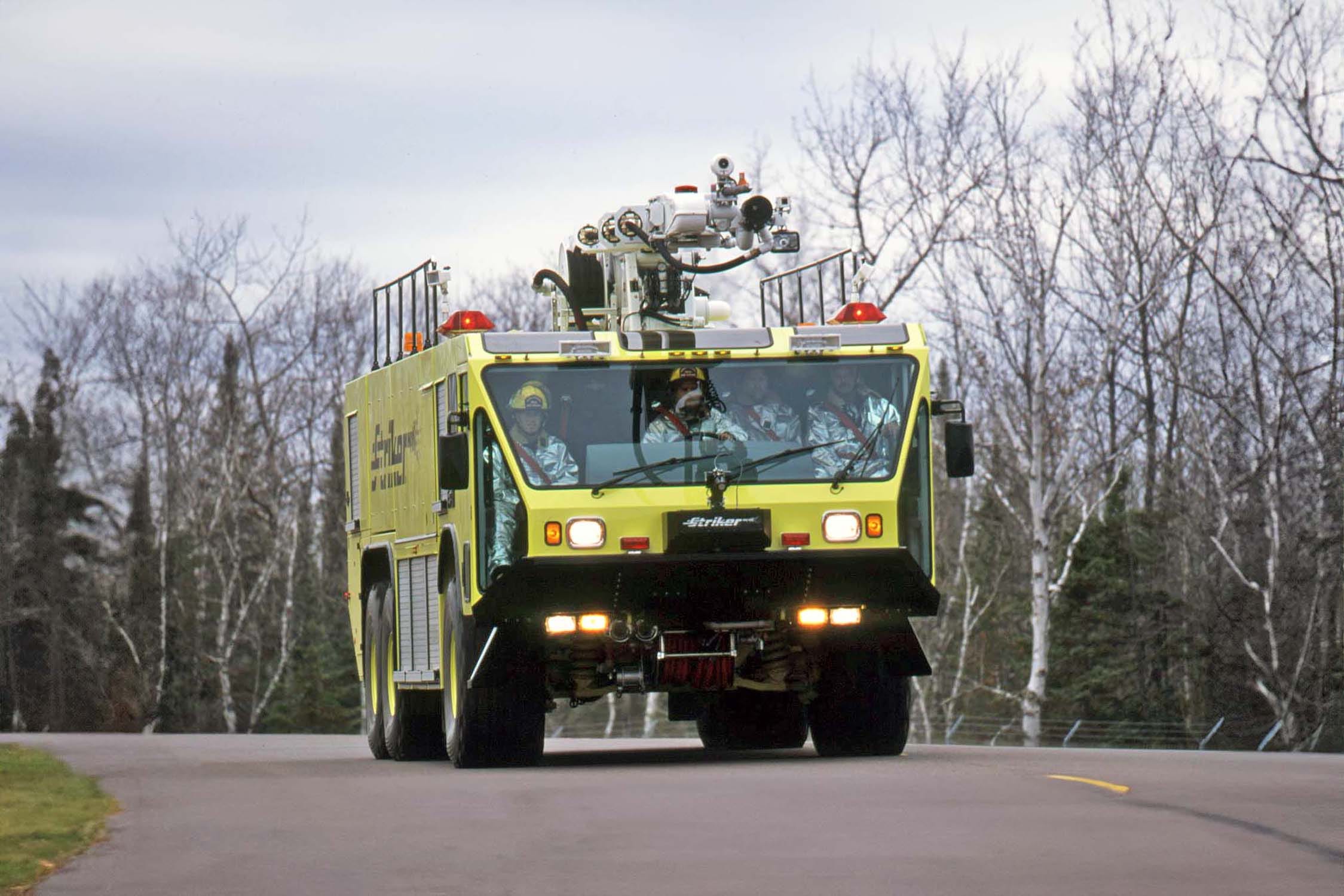


Forget supercars. Forget hypertrucks. The most absurdly capable vehicle on wheels is the one you’ll only ever see screaming across an airport tarmac with its roof turret blazing.
The Oshkosh Striker 3000 is a 40-ton, six-wheel-drive firefighting beast purpose-built to reach a downed aircraft before anyone inside runs out of time. It costs $675,000 fully loaded, carries 3,000 gallons of water and 420 gallons of foam concentrate, and can flatten chain-link fences and small trees without breaking stride. Think of it as the Porsche 959 of firetrucks, except it weighs roughly 53 times as much.
Under the rear-mounted engine cover sits a 15.8-liter Caterpillar inline-six diesel producing 650 horsepower and a planet-shifting 1,950 pound-feet of torque at just 1,400 rpm. The FAA mandates that Aircraft Rescue Fire Fighting trucks hit 50 mph in 35 seconds and reach the midpoint of any runway within three minutes of an alarm. The Striker meets those marks while hauling enough extinguishant to drown a neighborhood pool.
The engine lives in the back for a reason. “You don’t want the motor in front,” says Capt. Rex Weber of the Minneapolis-St. Paul International Airport Fire/Rescue Department, “because the action up there is gonna be warm.” The roof-mounted radiator, big as a king-size mattress, draws cooling air from above through a hydraulic fan, letting the truck idle for hours in 125-degree heat without complaint.
Its arsenal is what truly sets the Striker apart. A roof-mounted turret called the Snozzle sits atop a cherry picker with 50 feet of vertical reach and pumps 1,200 gallons per minute. A bumper turret adds another 300 gpm.
And then there’s the piercing nozzle — a 44-inch carbon-steel lance tipped with over 140 holes that can punch clean through aircraft fuselage, masonry, clapboard, or stainless-steel railway tankers. Once inside, it sprays extinguishant in a 20-foot circular gush.
At the tip of the Snozzle hangs a camera that transmits both color and infrared imagery to the cockpit, sensitive enough to determine whether an aircraft has just landed simply by reading tire heat. Its real job is scanning fuselages for hidden cargo fires before anyone cracks open a hatch.
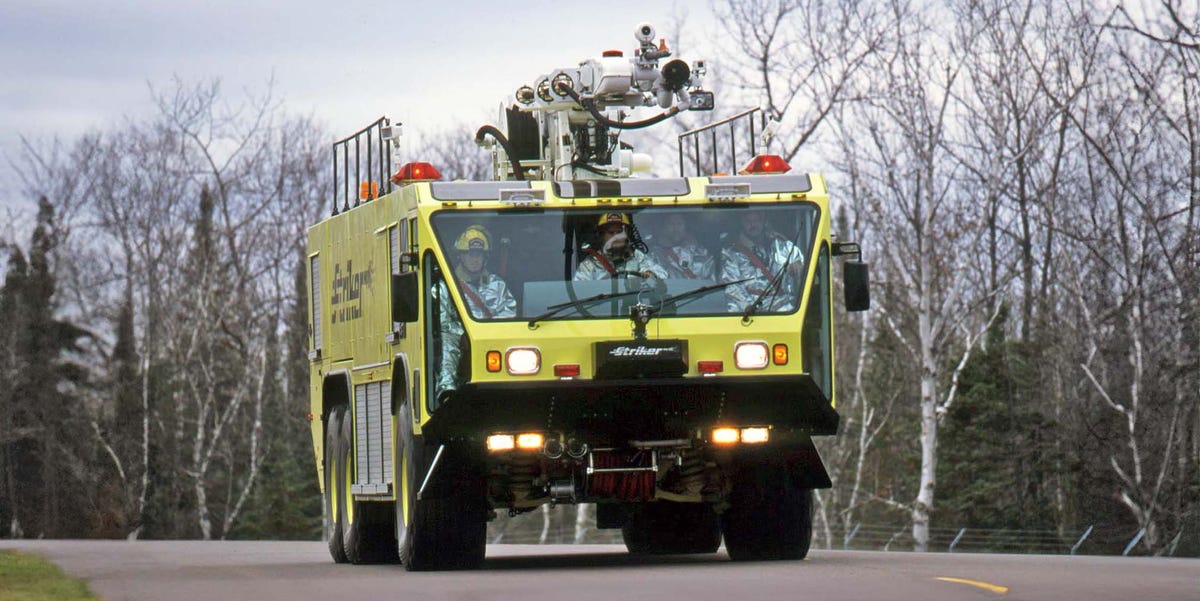
Driving the thing is surprisingly civilized. A push-button six-speed automatic handles gear changes. Eighty square feet of glass gives the operator a panoramic view of whatever catastrophe is unfolding ahead.
With 17 inches of wheel travel, the ride approaches something almost car-like. The driver sits dead center in the cab, though, meaning a third of the truck hangs into the oncoming lane on public roads. The steering requires 5.5 turns lock to lock, even with seven degrees of rear-wheel steer to tighten the turning radius.
Approaching a crash scene, ARFF crews drive with the wind at their backs to avoid smoke, pick through burning debris fields, and activate three undercarriage sprinklers to keep the tires from melting. If the fire gets intense enough, a “Deluge” button bathes the Striker’s own windshield and nose in cooling water. “My idea of the perfect distance,” Weber deadpans, “is when you melt the turn-signal lenses.”
Most airport firefighters go entire careers without facing the catastrophic blaze they train for. They’ll handle engine fires, brake fires, smoke-in-the-cockpit calls, and emergency standbys when landing gear refuses to deploy. Municipal departments regularly borrow ARFF trucks for stubborn fuel fires too — Oshkosh-built rigs from National Airport pumped foam at the Pentagon for five consecutive hours after September 11.
Oshkosh builds four-wheel and eight-wheel-drive variants ranging from $350,000 to $1 million. Most Strikers last 15 years and retire with fewer than 30,000 miles on the odometer, replaced not because they’re worn out but because firefighting technology has moved on.
The standard color is officially called Safety Lime Yellow. The crews who drive them call it “phlegm.”



Share this Story