
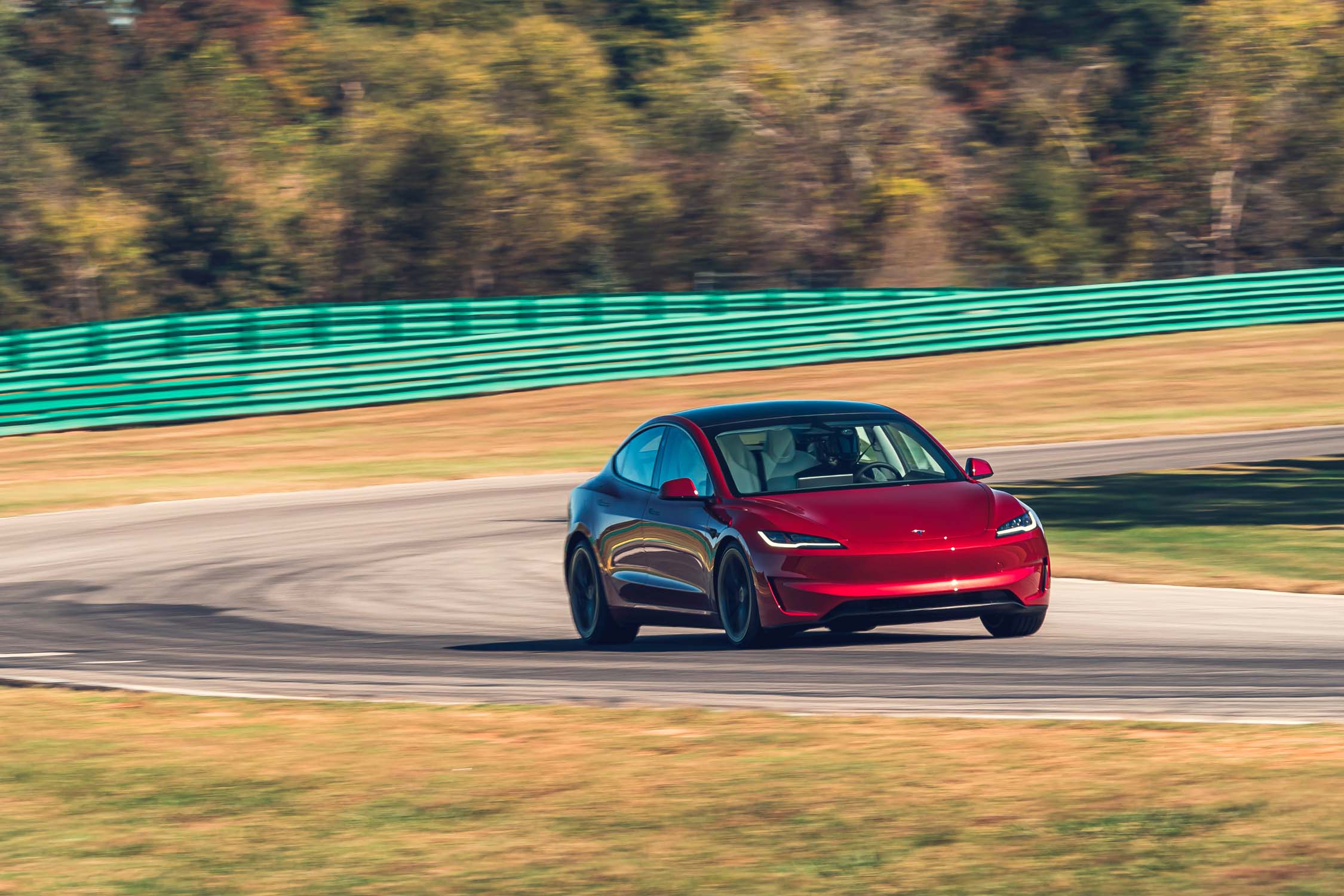


The Tesla Model 3 Performance just did something no electric vehicle under six figures has managed at Virginia International Raceway. It broke the three-minute mark. Car and Driver’s annual Lightning Lap event, now in its 19th year, saw the 510-horsepower sedan rip a 2:58.4 around VIR’s punishing 4.1-mile Grand Course, dethroning the Hyundai Ioniq 5 N as the fastest sub-$100K EV to ever lap the circuit.
But there’s a catch, and it’s a big one. The Model 3 Performance can only sustain its full fury for essentially one lap before its 80-kWh battery pack starts waving a white flag.
The team at Car and Driver spent most of their track time in Track mode with standard powertrain endurance settings, carefully monitoring battery, brake, and motor temperatures between charging sessions. They turned just one hot lap at a time, treating each run like a qualifying effort rather than a race stint. Executive editor K.C. Colwell drew a sharp comparison to the turbo-era Formula 1 qualifying specials of the 1980s — machines built to deliver everything for a single screaming lap, consequences be damned.
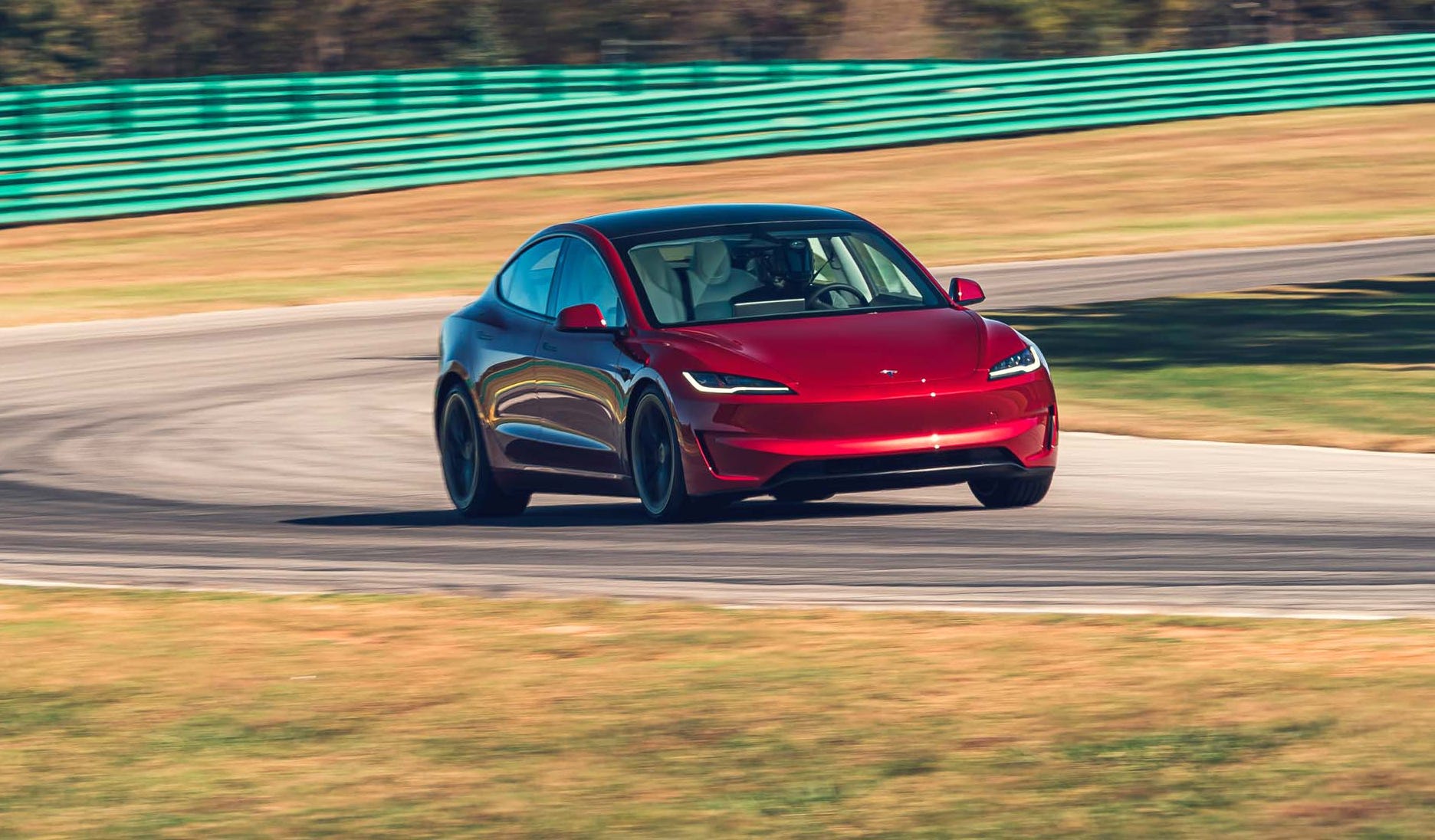
On that one glorious lap, though, the Model 3 Performance delivered. The car entered the Climbing Esses at 130.0 mph, requiring barely a lift to get the front end to rotate into the first left-hander. Anything more aggressive unsettled the chassis in ways that made even experienced drivers uncomfortable.
That high-speed instability is where the Ioniq 5 N, despite being slower overall, showed its engineering chops. Colwell described Hyundai’s hot hatchback as “buttoned down and knife-edge sharp” through the fast stuff, while the Tesla was “as erratic as the Detroit Lions offense.” In slower, medium-pace corners, the two cars were essentially dead even.
The Model 3’s steering didn’t win any friends either. It’s responsive to small corrections, which matters when you’re threading a 4,035-pound sedan through 24 corners at the limit, but the actual feel through the rim is largely absent. Regenerative braking, cranked to 100 percent per Tesla’s own recommendation, served as a surprisingly effective tool for scrubbing speed before turn-in.
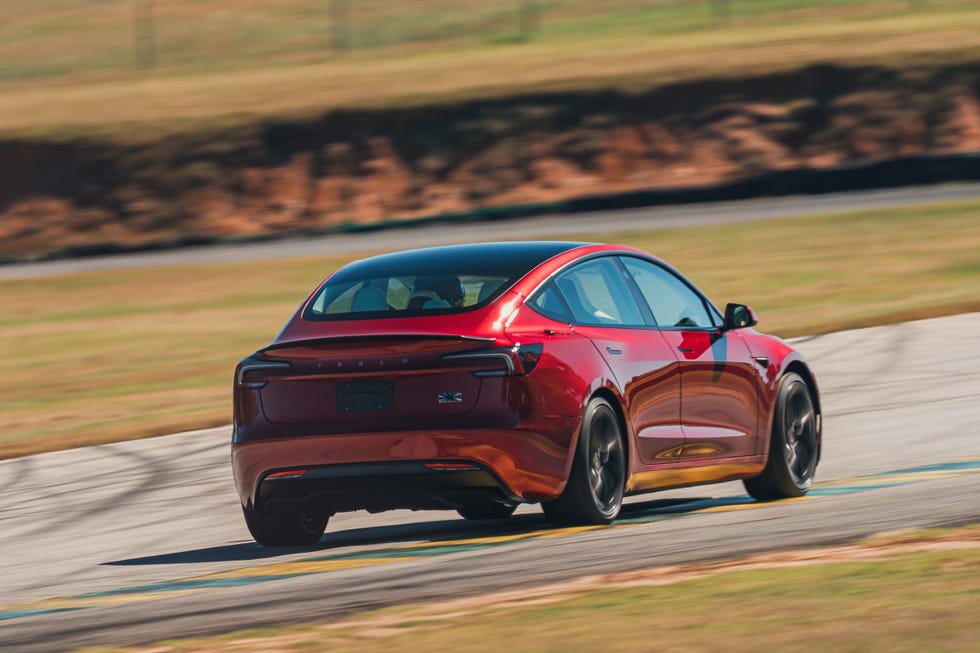
The drama came right at the finish line. Just before crossing on its fastest lap, thermal warnings kicked in and triggered a reduced-power mode. The car crossed the stripe 9 mph slower on the Front Straight than it had been at the start of the same lap. The battery was already giving up the ghost.
Colwell noted the car could probably string together several laps at a Volkswagen GTI’s pace, but asking it for repeated hero runs simply isn’t in the cards. At $64,630 as tested, the Model 3 Performance undercuts its competition dramatically. For context, it shared the Lightning Lap stage with a 1,064-horsepower Corvette ZR1, a 907-horsepower Lamborghini Temerario, and Tesla’s own 1,020-horsepower Model S Plaid.
The Model S Plaid, priced at $144,630 as tested, was also on hand and represents how far Tesla’s track capability has come. When Car and Driver lapped a Model S back in 2016, it couldn’t even hold power for a full lap. The new Plaid is specifically engineered to survive circuits like VIR.
The Model 3 Performance’s result raises a familiar question about electric performance cars: does a single brilliant lap matter if the car can’t back it up? For bragging rights and benchmark purposes, absolutely. For anyone planning a track day, the thermal limitations are real and unavoidable.
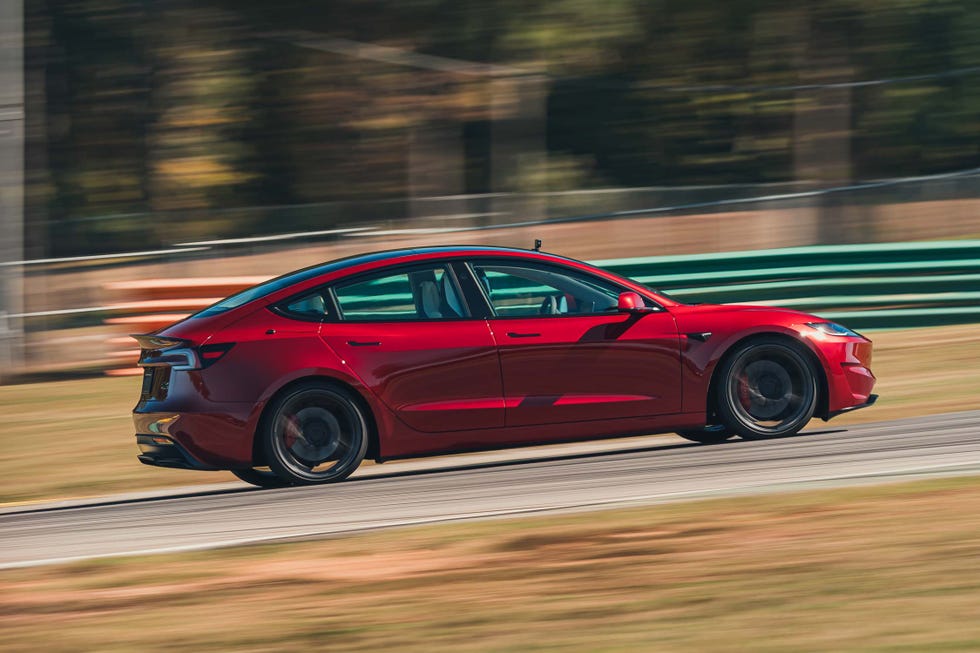
One lap of fury, then a cooldown and a charge. That’s the deal. Still, a sub-three-minute lap at VIR in a $65,000 sedan is nothing to dismiss. The EV performance war just got a new talking point, and the Model 3 Performance planted its flag right at the top of the affordable pile.


Share this Story