
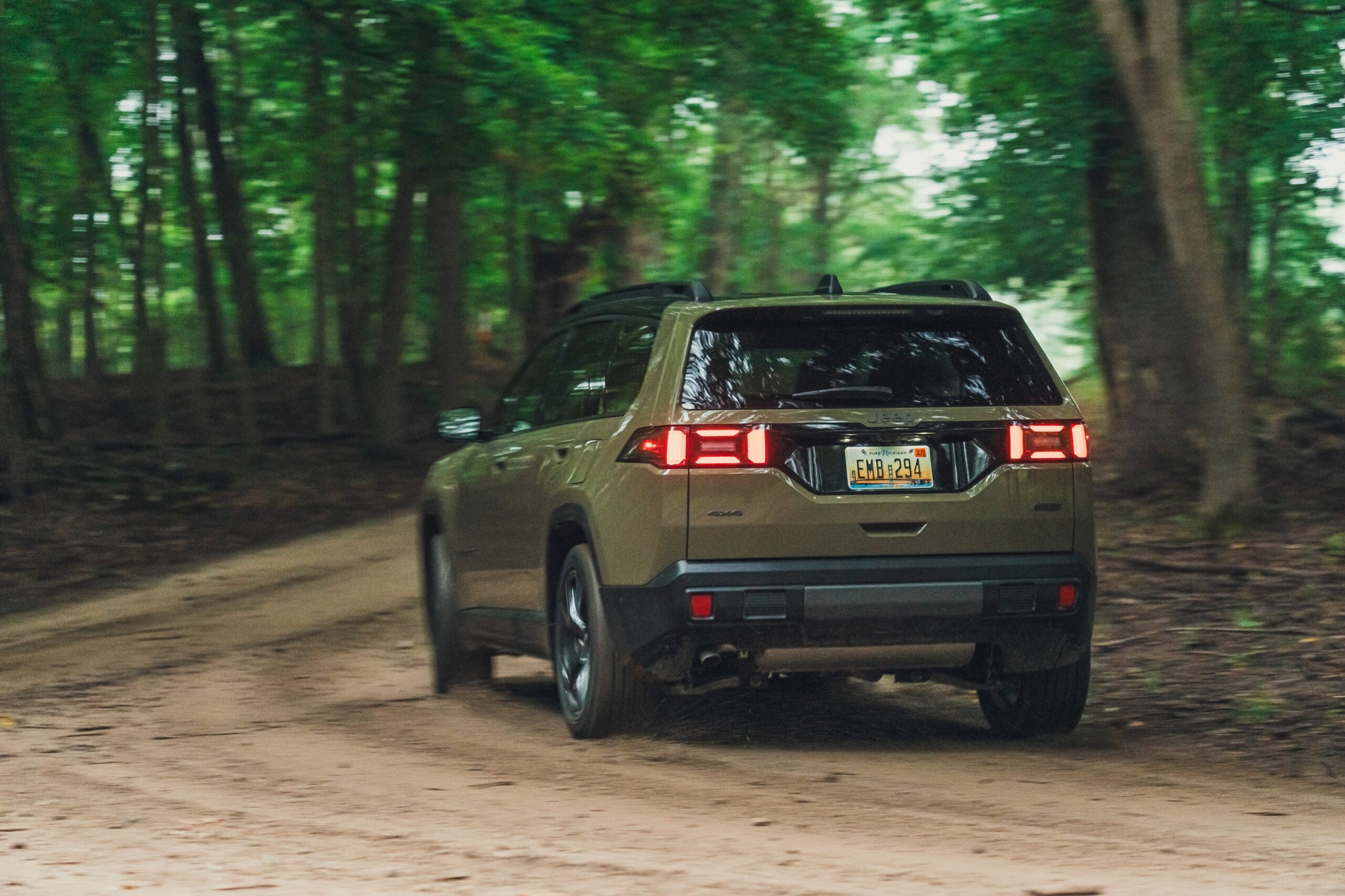


Jeep’s new Cherokee hits the scales at 4,403 pounds. That is more than 500 pounds heavier than the Honda CR-V Hybrid or Toyota RAV4 Hybrid it needs to beat. You feel every one of those pounds when you mash the throttle.
The Cherokee nameplate returns after a three-year absence with boxy styling that deliberately buries the memory of its controversial predecessor. The squared-off look works. It gives the compact SUV a serious presence and delivers real packaging benefits: 34 cubic feet behind the rear seats, 68 with them folded.
On paper, Jeep built exactly the vehicle its dealers have been begging for. Then you drive it.
Under the hood sits a turbocharged 1.6-liter four-cylinder paired with two electric motors, producing a combined 210 horsepower and 230 pound-feet of torque through a CVT. This is the first hybrid Cherokee, and it is also the first Stellantis hybrid powertrain sold in the U.S. that isn’t a plug-in. Car and Driver’s instrumented testing clocked 8.5 seconds to 60 mph, putting the Cherokee at the bottom of its class alongside the Subaru Forester Hybrid.
The CR-V Hybrid and RAV4 Hybrid both manage 7.1 seconds, a gap that feels wider in real traffic than the numbers suggest. Merging onto a highway requires faith and patience.
Fuel economy is the powertrain’s redeeming quality. EPA estimates land at 39 mpg city and 35 highway, making this the most efficient Jeep ever sold. But the RAV4 Hybrid still walks away with 46 city and 39 highway, and Car and Driver observed just 29 mpg in mixed driving, a meaningful gap from the combined EPA estimate of 37.
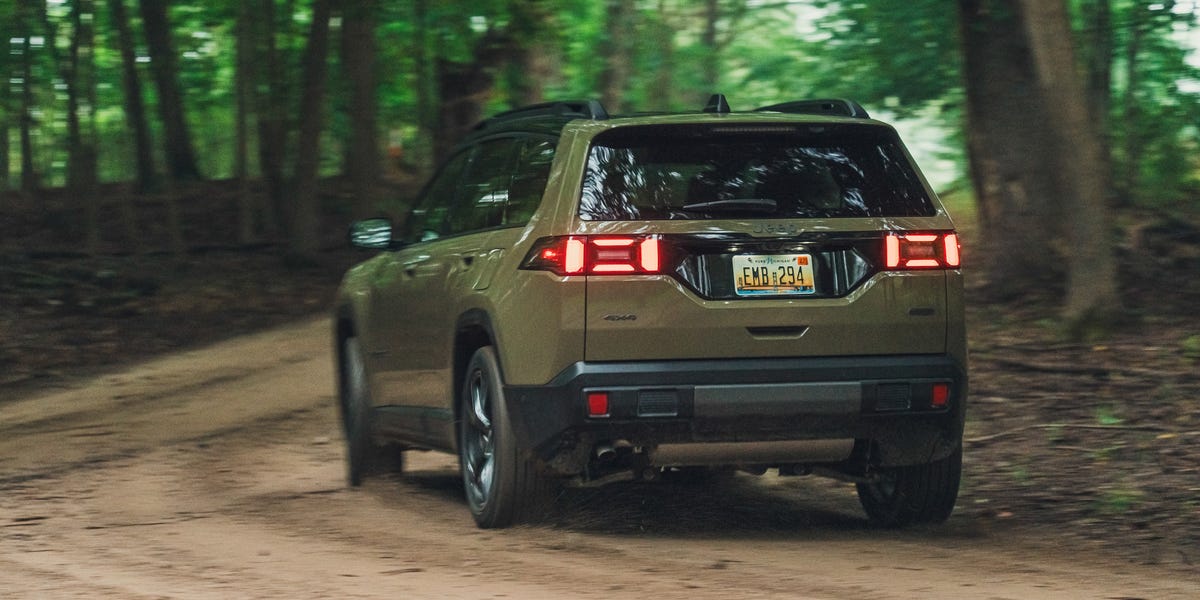
The hybrid system’s calibration needs work. Transitions between gas and electric power are smooth enough, but the 1.6-liter engine groans under acceleration. Extended stop-and-go driving reveals an annoying shudder as the powertrain cycles on and off the throttle, and it feels like what it is: a first effort.
Ride quality tells a similar story. Initial impressions on smooth coastal California roads were favorable. Real-world pavement in the New York metro area and Michigan exposed a chassis that is softly sprung yet poorly damped, bobbing over bumps without actually isolating occupants from them. That is a frustrating combination, the worst of both approaches.
Inside, the materials in the $46,585 Overland test vehicle were unremarkable for the price, though that is a disease afflicting most of the segment outside the Mazda CX-50 and top-trim Volkswagen Tiguan. What is harder to forgive is the steering wheel. Jeep went with an octagonal shape and a rim roughly 50 percent fatter than necessary.
It feels awkward in hand and blocks the driver’s view of critical controls on the left edge of the infotainment screen, including the volume knob and seat climate toggles. A round wheel has worked flawlessly for over a century, and nobody asked for this.
The Cherokee starts at $44,995 for the Overland trim, with a just-announced Trailhawk model adding a two-speed transfer case and electronically locking rear differential for those who want actual off-road hardware. That pricing puts it in direct conflict with well-sorted competitors that are lighter, quicker, and more refined.
Jeep finally has a compact hybrid SUV in a segment that represents enormous volume. The brand needed this vehicle badly. Whether the vehicle, as currently calibrated, is ready for the fight is a different question.
A Trailhawk with proper trail gear might carve out a niche that the CR-V and RAV4 cannot touch. But on pavement, where the vast majority of these will spend their lives, the Cherokee is playing catch-up from day one.


Share this Story