
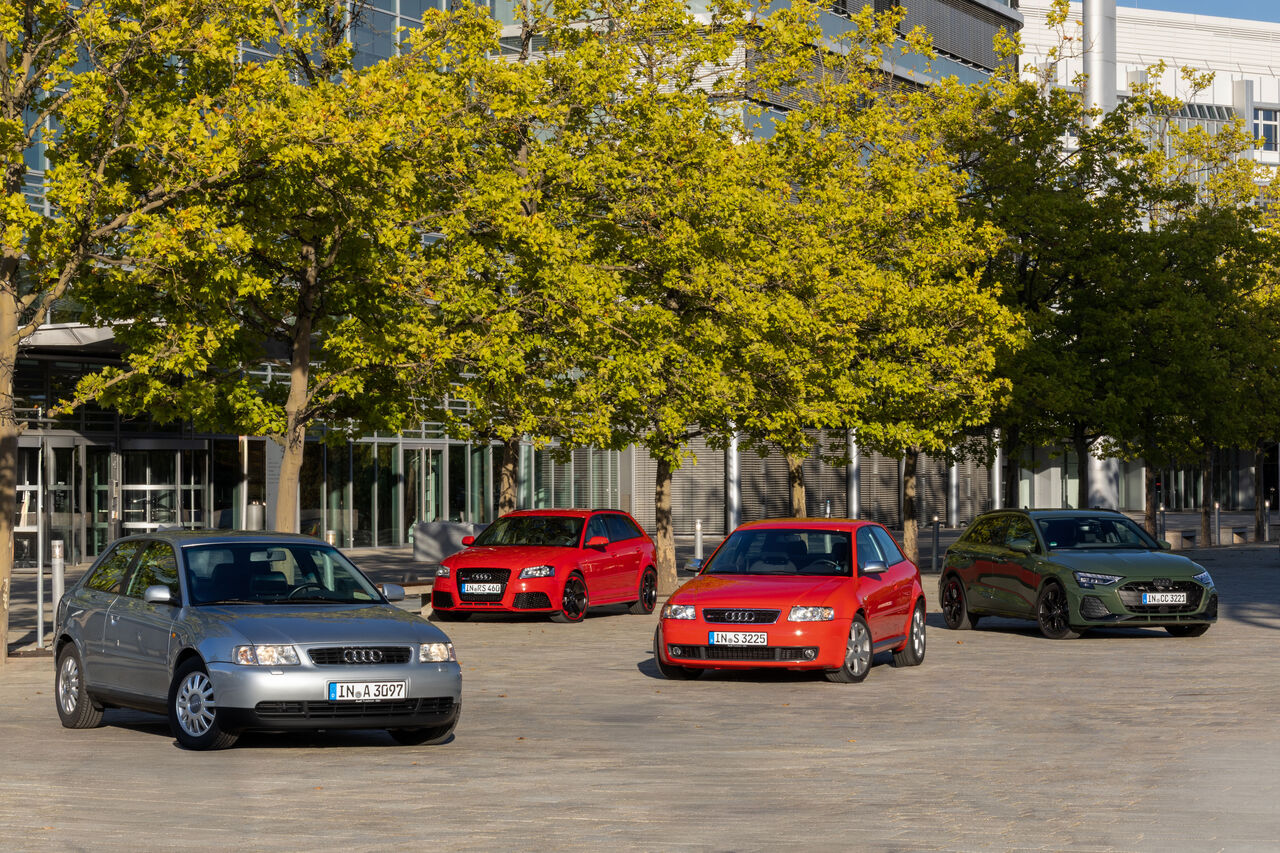


Six million units. That is the number Audi is hanging its hat on as it celebrates three decades of the A3, the car that invented the premium compact segment when it rolled into the 1996 Paris Motor Show as a sharp little three-door nobody asked for and everybody wanted.
Thirty years later, the A3 is still here, still selling, still being built in Ingolstadt, where it has been assembled since day one. That alone makes it an anomaly in an industry sprinting toward electric SUVs and software-defined vehicles.
The original 8L was a gamble. Audi took Golf mechanicals, wrapped them in finer materials, added coupé-like proportions with a strong C-pillar and low roofline, and charged more. Critics scoffed. Buyers didn’t.
By 1998, Audi had dropped quattro all-wheel drive into the compact platform, a first for the segment, using an electronically controlled multi-plate clutch designed specifically for transverse engines. The S3 followed in 1999 with 210 PS, Recaro seats, and the kind of swagger that made hot-hatch owners look twice.
Each generation since has added layers. The second-gen 8P in 2003 brought a seven-speed dual-clutch gearbox, a proper four-link rear suspension, and the Sportback body style that remains the best-selling A3 variant to this day. The A3 Cabriolet arrived in 2008.
The RS 3 Sportback landed in 2011 with a 340 PS five-cylinder engine and widened carbon-fiber fenders, writing the playbook for the modern hyper-hatch.
Generation three, the 8V, was where things got digital. Built on the MQB platform, it shed weight with aluminum panels, introduced cylinder-on-demand technology, and packed adaptive cruise control and lane-keeping assist previously reserved for the A8. The A3 Sedan appeared in 2013, targeting buyers in China and North America who wanted trunk space without the crossover compromise.
A year later, the A3 Sportback e-tron became Audi’s first compact plug-in hybrid.
The current fourth-generation 8Y, launched in 2020, piles on 48-volt mild hybrid tech, a panoramic digital display, and the torque splitter rear axle on RS 3 models. That torque splitter, which variably distributes power between the rear wheels, replaced the old Haldex system and gave the RS 3 a 3.8-second sprint to 100 km/h. The 2024 addition of the A3 allstreet, a raised Sportback with an off-road look and three centimeters of extra ground clearance, reads like Audi’s concession that crossover buyers still need to be courted from within the hatchback family.
Today the A3 lineup offers 17 model and powertrain variants. Gasoline, diesel, plug-in hybrid, performance. It ships to more than 100 countries, with production running in Ingolstadt and having previously been supplemented by plants in Brazil and Győr, Hungary.
The tension underneath all this anniversary fanfare is real. Audi’s parent company Volkswagen Group is pushing hard into electric vehicles. The A3’s future beyond this generation is uncertain.
There is no confirmed fifth-generation model and no announced battery-electric successor wearing the A3 name. For now, the compact that built a category keeps selling in a world that has moved on to talking about range and charging speeds.
Six million cars and thirty years in, the A3 remains Audi’s volume anchor. Whether Ingolstadt sees it as heritage or as a profit engine with plenty of life left is a question the next product cycle will have to answer. The assembly line is still running.
Share this Story