
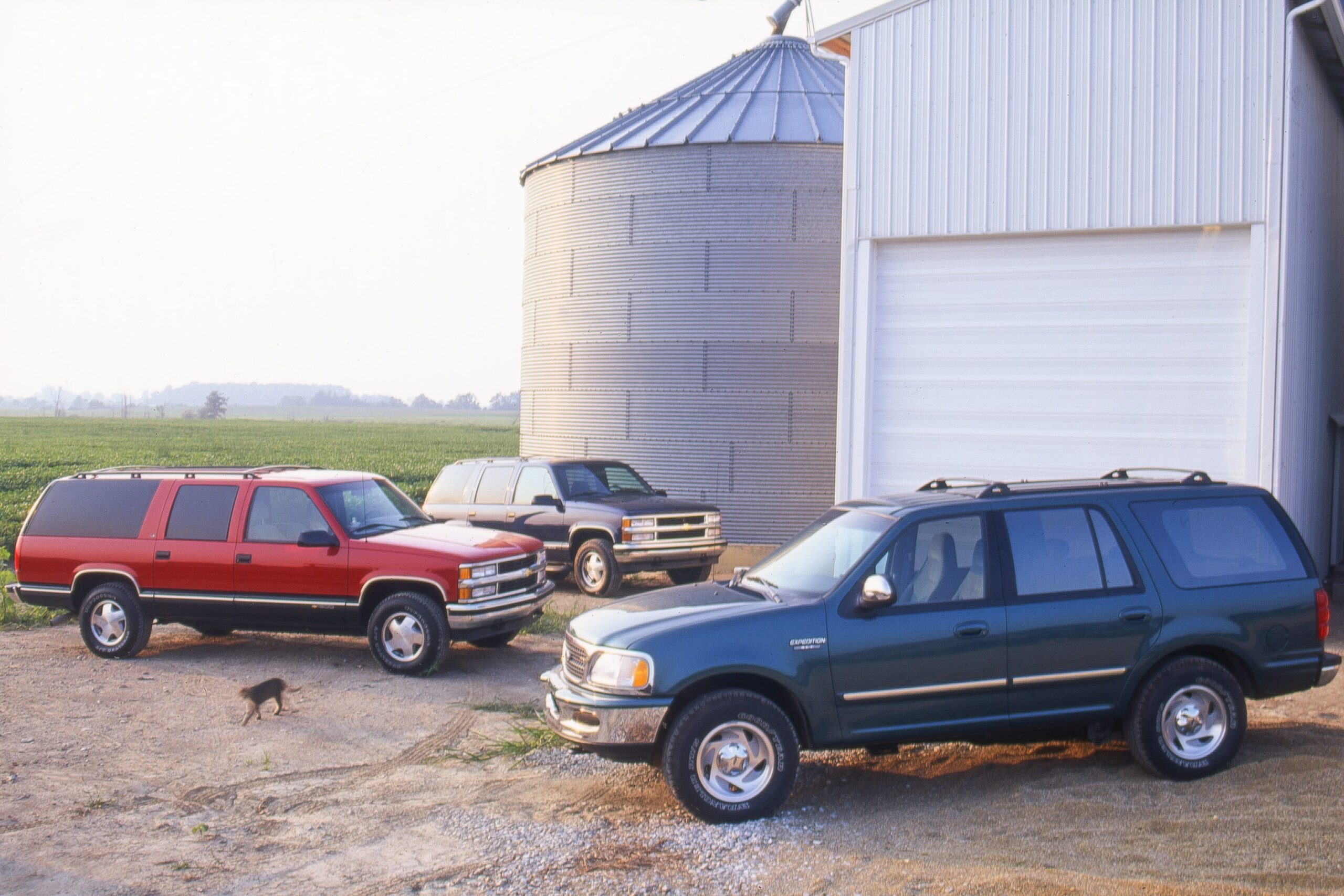


In December 1996, Car and Driver lined up three full-size SUVs in the flatlands of Indiana and the sand dunes of Michigan, and the results rattled a decades-long monopoly. The Ford Expedition XLT, a first-year truck built on the new F-150 platform, beat both the Chevrolet Tahoe LS and the Chevrolet Suburban K1500LS. It was the opening shot in a war GM had been fighting against itself.
That last part is the real story. For decades, the Suburban owned the large five-door SUV segment unchallenged. Then GM itself fractured the market in 1995 by introducing the shorter, more manageable Tahoe, and Ford saw the gap and drove a 5,500-pound truck right through it.
The Expedition didn’t win on brute capability. Its 230-horsepower 5.4-liter V-8 barely kept pace with the Chevy’s 250-horse 5.7-liter in acceleration runs, and its four-wheel-drive system actually broke during dune testing at Silver Lake, Michigan. Ford hadn’t even figured out the problem by press time, while the Suburban climbed 200-foot dunes with the least drama of the three.
But the Expedition won where it counted for the buyers GM was trying to court: on the road.
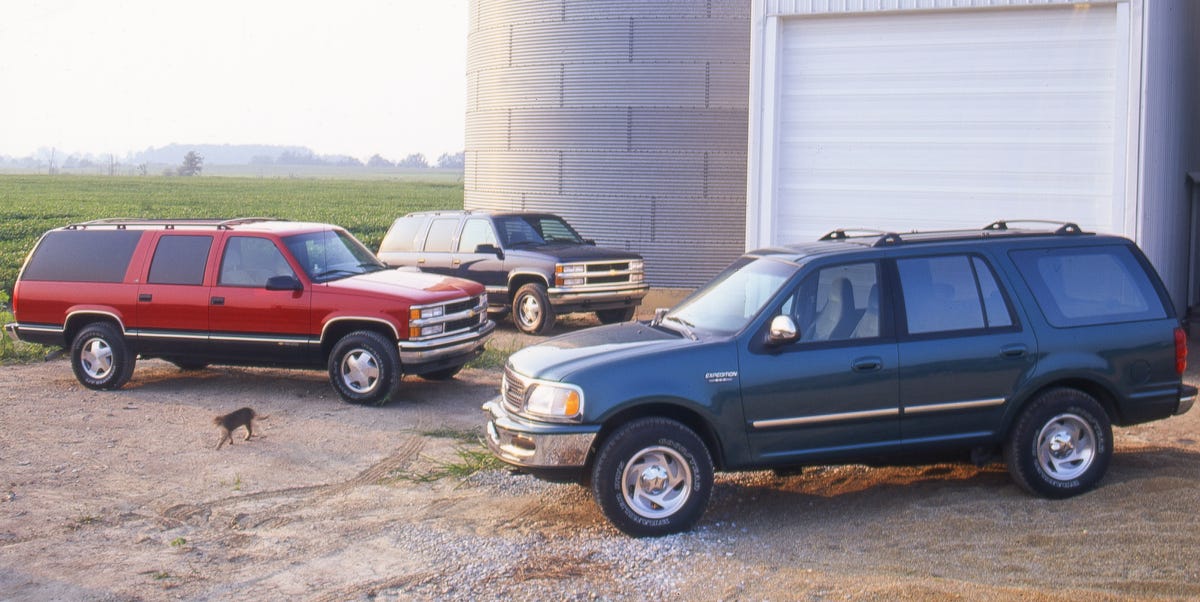
Car and Driver’s editors described it as “the most carlike of the three vehicles,” praising its steering precision, minimal body roll, and suspension control. Four-wheel disc brakes with ABS stopped the Ford from 70 mph in 216 feet, nine feet shorter than the Tahoe and a full 24 feet shorter than the lumbering Suburban. The Chevy trucks still used rear drums.
The Suburban finished dead last, weighed down by its own enormity. Its 47.8-foot turning circle was nearly eight feet wider than the Expedition’s. Editors described its steering as “vaguely connected” and its brake pedal as requiring an inch of mush before anything happened.
One driver’s entire log entry amounted to: “Damn, this is huge.” At 5,844 pounds, the thing rode well enough until a roller-coaster back road turned stomachs.
The Tahoe split the difference. It was the quickest of the three, hitting 60 mph in 9.8 seconds and posting a 6.0-second 50-to-70-mph passing time that beat the others by at least seven-tenths. It returned the best fuel economy at 16 mpg over 900 miles, which tells you everything about what “best” meant in this class.
But its steering was still lifeless, its seats so unsupportive that one editor genuinely wondered if he might slide out, and its styling prompted comparisons to a shipping crate.
Ford understood something GM didn’t yet, or wouldn’t admit. Buyers migrating from sedans and minivans into these big trucks wanted refinement, not just capability. The Expedition’s flowing interior surfaces, standard power driver’s seat, rear air conditioning with roof vents, and CD changer at $34,418 made the Chevys feel like they were still selling to ranchers.
Load-leveling rear air springs came included. In the Chevy camp, you got a bench seat and honest utility.
None of these trucks were paragons of engineering. All three suffered brake fade during testing. The Suburban blew a rear brake cylinder at the Chrysler proving grounds.
The Expedition’s power steering froze momentarily during emergency lane changes, meaning it couldn’t weave through cones any faster than the vastly larger Suburban. These were still body-on-frame trucks pretending to be family vehicles, and the pretense had limits.
But the Expedition pretended better than anyone else. Ford took the new F-150’s bones and wrapped them in enough civility to poach customers GM had assumed were locked in. Within a few years, the Expedition would become one of the most profitable vehicles in Ford’s lineup.
GM had created the segment, then created its own competition within it, then watched Ford walk in and take the crown. The Suburban’s 150 cubic feet of cargo space and 10,000-pound tow rating still made it the only choice for serious haulers. For everyone else, Ford had built a better answer to a question GM asked first.

Share this Story