


Reeves Callaway’s prototype Corvette hit 193 mph on a German autobahn in the fall of 1988. Street-legal. No roll cage. No parachute. Just a pair of turbochargers, a set of experimental Goodyear ZR40s on magnesium wheels, and the kind of audacity that defined the aftermarket performance world before electronic nannies and lawyers killed it.
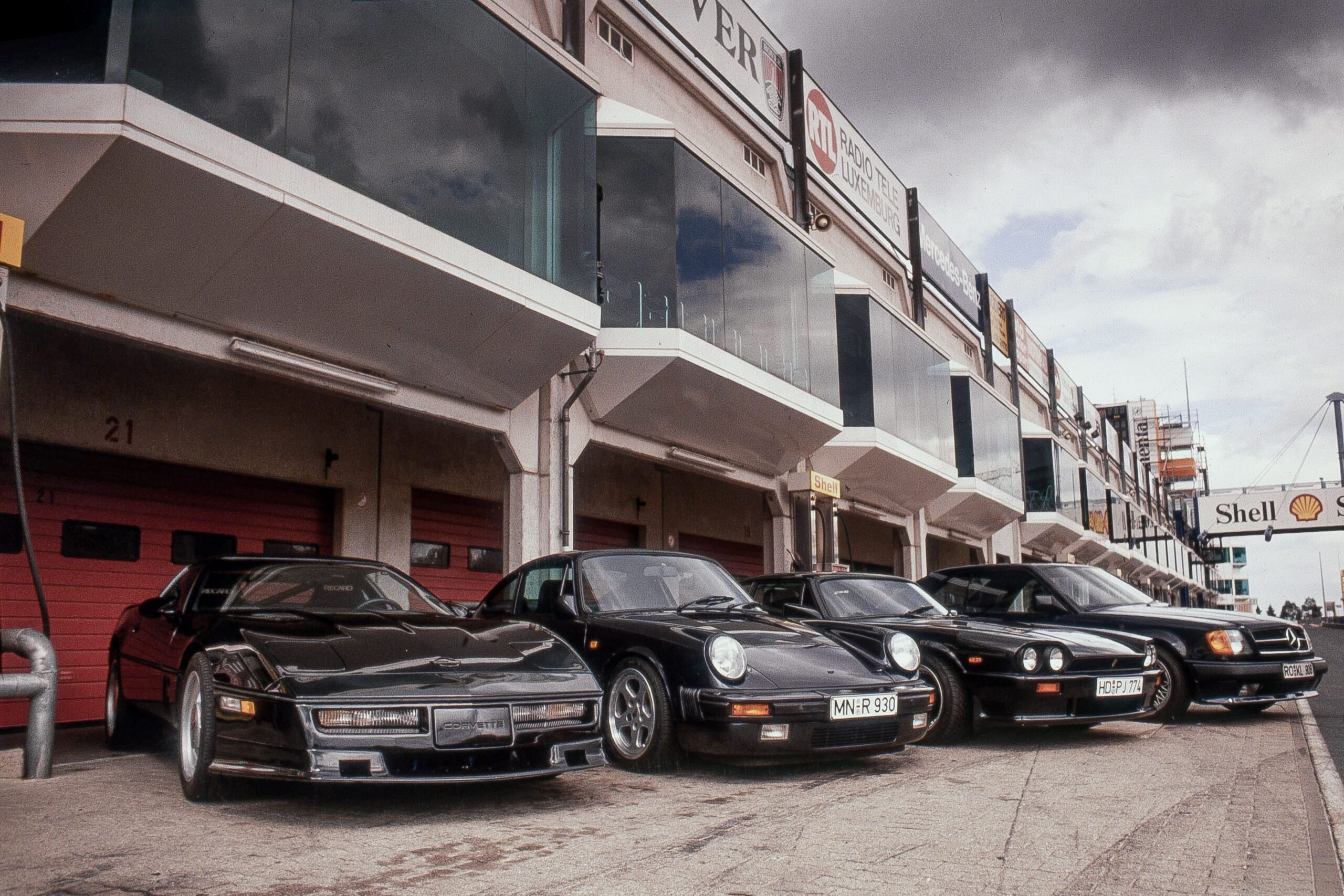
That number anchored a four-car comparison test organized by Germany’s Sport Auto magazine and attended by Car and Driver, a gathering of modified exotics that reads like a fever dream from the last golden age of tuner cars. A Ruf Porsche 911 Turbo. A Brandenburger Lister Jaguar XJ-S. A Lotec Mercedes 300CE Turbo. And the Callaway Corvette, a one-off European-spec prototype that nobody in America could buy.
None of these cars existed in any manufacturer’s catalog. They were built by obsessives — small-shop engineers who took factory hardware and bent it toward a single purpose.
Kurt Lotterschmid of Lotec bolted a Rayjay turbocharger onto Mercedes’ 3.0-liter inline-six without cracking the block open. The result was 340 horsepower and a 170-mph top speed — impressive by any normal standard, and dead last in this field.
Roland Brandenburger, Germany’s only exclusive Jaguar dealer, grafted Lister bodywork and a stroked 6.0-liter V-12 producing 475 horsepower onto a stripped XJ-S. It hit 175 mph and looked like it wanted to fight you in the parking lot afterward. He’d built exactly four of them.
Alois Ruf, the quiet zealot from Pfaffenhausen, squeezed 369 horsepower from a 3.4-liter flat-six with 15 psi of boost. His narrow-body 911 Turbo clocked 187 mph. He deliberately avoided the wider Turbo fenders because the reduced frontal area was worth more than ten miles per hour at the top end. That’s the kind of thinking that separates a tuner from a decorator.
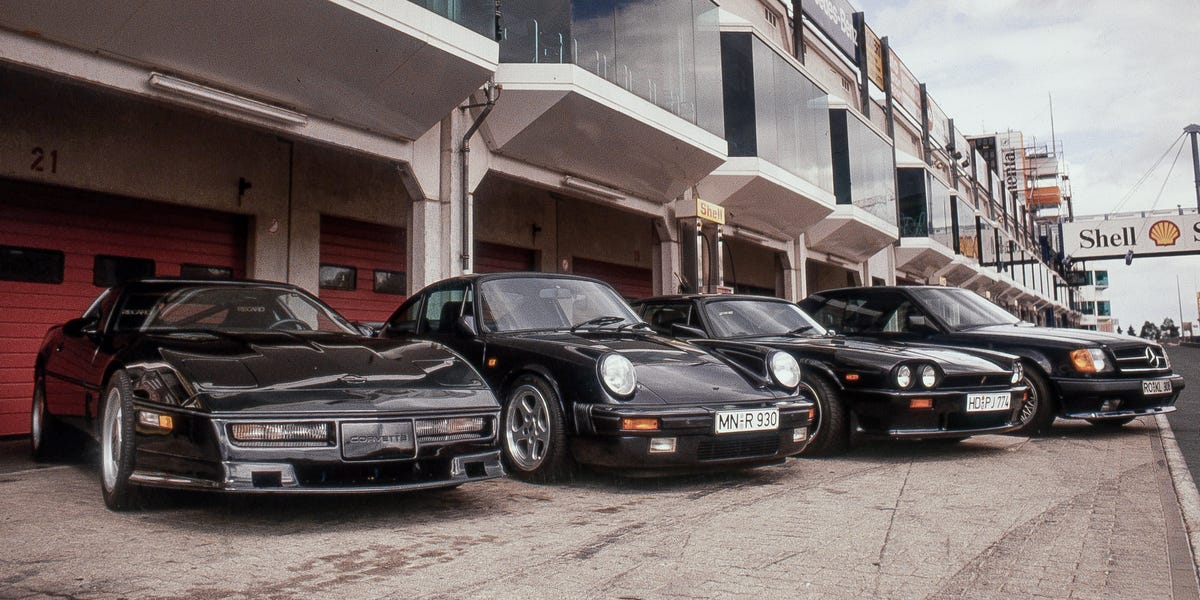
But the Corvette owned the autobahn. Callaway’s roughly 400-horsepower twin-turbo V-8 didn’t dominate off the line — the Ruf’s rear-engine traction advantage gave it a 4.3-second zero-to-sixty run versus the Corvette’s slightly slower launch. Through the quarter-mile, the Ruf posted 12.5 seconds at 112 mph.
Then physics shifted. The Callaway trapped 118 mph in the quarter, and by 150 mph it was pulling away. Its 22.8-second run to 150 beat the Ruf. And that 193-mph top speed wasn’t just six ticks faster than the Porsche on a spreadsheet — at those velocities, the Callaway was accelerating four times harder than the Lotec Mercedes at 150 mph.
The differences went deeper than straight-line speed. The Jaguar’s naturally aspirated V-12 delivered instant throttle response at any rpm, even lugging at 1000 rpm in fifth. The Callaway and Lotec showed moderate turbo lag but remained usable. The Ruf was a lit fuse — nothing below 4000 rpm, then everything all at once. On the Nürburgring’s 14.2 miles of elevation changes and blind corners, that behavior turned exhilarating into exhausting.
AMG was supposed to bring a Hammer coupe. It pulled out at the last minute, racing commitments taking priority. You can’t help wondering what that 6.0-liter V-8 sedan would have done to the hierarchy.
What makes this test resonate nearly four decades later isn’t the numbers, though they still impress. It’s the ecosystem that produced these machines. Four independent shops on two continents, each with a different philosophy, each accountable to nothing but speed and their own reputations.
Callaway built over 200 twin-turbo Corvettes by 1988. Brandenburger had finished four Listers. Ruf’s operation was tiny. These were cars made by hand, tested at full throttle on public roads, and sold to people who understood the risks.
The 193-mph Callaway Corvette was a prototype that never went into production in that form. It existed for one test, on one stretch of unrestricted highway, in a country that still let you find out what a car could really do. That world is gone.




Share this Story