
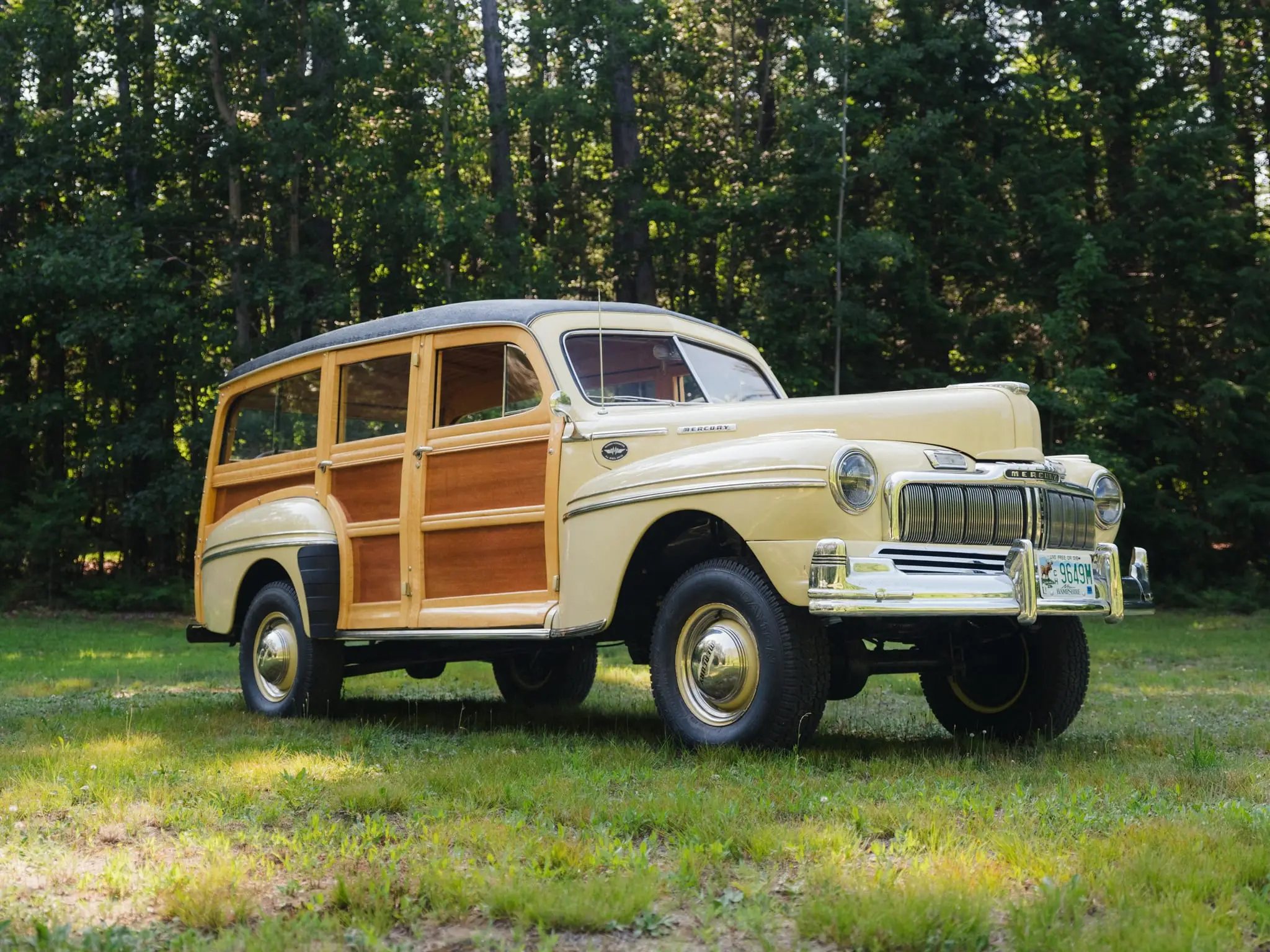


A 1948 Mercury Eight Wagon with a factory-approved Marmon-Herrington four-wheel-drive conversion just rolled onto Bring a Trailer, and it might be the most beautiful argument ever made for a brand that’s been dead since 2011.
Three rows of bench seats. A 255-cubic-inch flathead V-8. A three-speed manual with synchromesh. And enough wood paneling to make a yacht jealous. This thing was hauling families through the backcountry before the word “SUV” existed.
Ford killed Mercury because it couldn’t figure out where the brand fit. Looking at this wagon, you have to wonder if the answer was staring them in the face the whole time.
The Marmon-Herrington conversion is the detail that elevates this from beautiful antique to genuine artifact. In the late 1940s, four-wheel-drive civilian vehicles barely existed outside of surplus Willys Jeeps. Ford contracted Indianapolis-based Marmon-Herrington to build transfer cases and axles for select vehicles, which were then sold new at dealerships.
The arrangement produced some of the earliest factory-backed 4×4 passenger vehicles in America.
Marmon-Herrington, remarkably, still exists. Still makes axles and transfer cases. The Marmon half of that name traces directly to the Marmon Car Company, whose yellow Wasp won the inaugural Indianapolis 500 in 1911. That’s not trivia — it’s lineage, the kind Detroit used to care about.
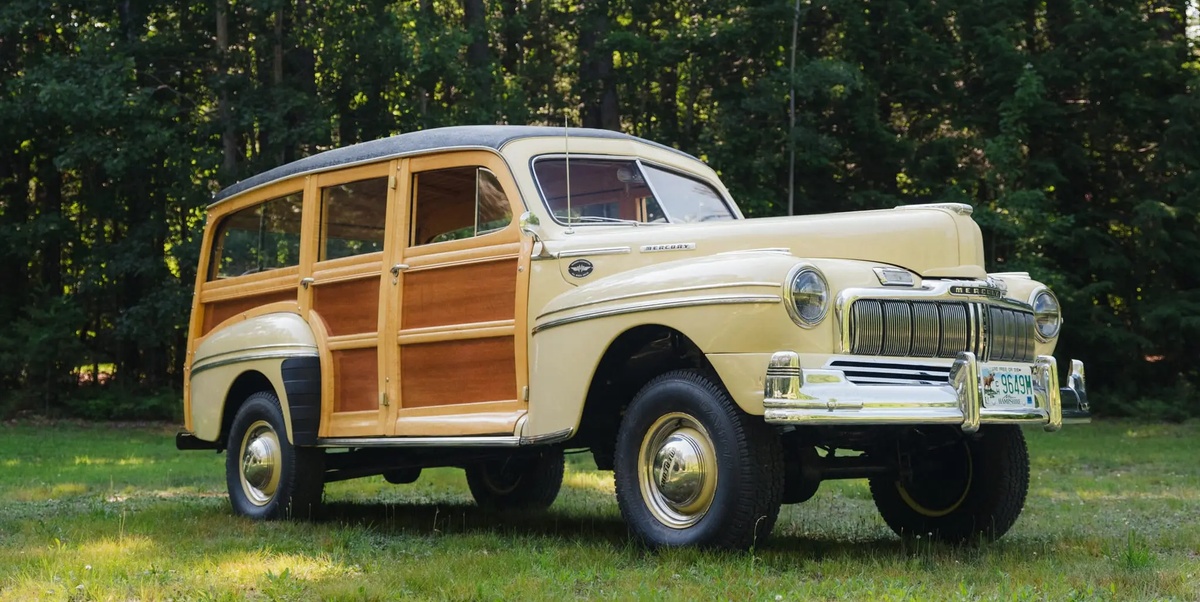
A Mercury woody wagon from this era is already scarce. One with the Marmon-Herrington drivetrain is scarcer still. This particular example has passed through a couple of collections and been recently refurbished, with a full engine and transmission pull for inspection, brake work, and axle repairs completed this year.
It runs. It drives. The seller wisely suggests keeping it under 40 mph, which is probably all the flathead V-8’s roughly 100 horsepower wants to give you anyway. This is a machine built for dirt roads and picnic stops, not highway merges.
The interior is where the car earns its keep as a showpiece. The woodwork is extraordinary — tight, precise joinery that evokes craftsmanship from an era when body panels were still built by people who understood timber the way a shipwright would. Somebody tucked Bluetooth capability behind the original AM radio face. The dash clock runs on a quartz movement now.
Small concessions to modernity that let you actually use the thing without pretending it’s 1948.
Body-on-frame construction. Three rows of seating. Rear cargo space. Four-wheel drive. A big V-8 up front. Read that spec sheet to anyone in 2026 and they’d assume you were describing a Suburban or an Expedition. Mercury had the formula 78 years ago — it just didn’t have the marketing department to name it correctly.
Ford’s calculus when it shuttered Mercury was straightforward: the brand was cannibalizing Lincoln sales from below and Ford sales from above. The margins didn’t justify the complexity. That math was probably right. But math doesn’t explain why a car like this still stops people cold at a gas station.
The auction closes July 22. Whoever wins gets a legitimate piece of American automotive history — a vehicle that sits at the exact crossroads where station wagons became something tougher, something more capable, something that would eventually evolve into the most profitable segment in the industry.
Ford spent the last two decades trying to build the perfect full-size SUV. Turns out Mercury had a pretty good rough draft in 1948. Nobody at Dearborn was paying attention.
Share this Story