
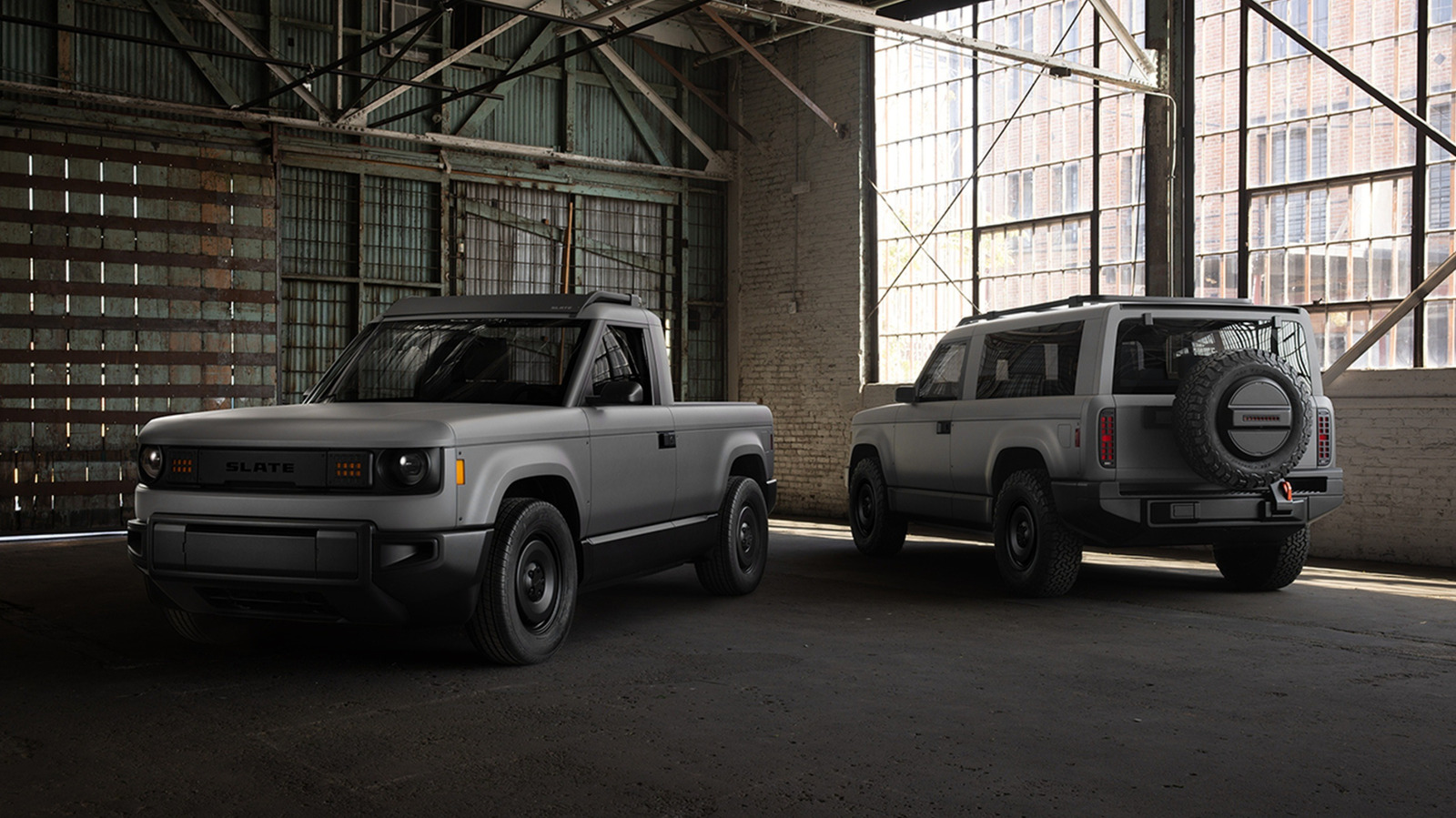


Slate opened pre-orders Wednesday for its modular electric pickup at $24,950 before destination fees, making it the cheapest EV on the American market. But that price buys you a truck stripped to its bones — no stereo, no screen, no center console, no carpet in the frunk. Even door armrests are extra.
This is either the most cynical nickel-and-dime play since airline baggage fees or the most refreshing idea in the truck business in two decades. Based on the spec sheet, it looks a lot more like the latter.
The Amazon-backed startup spent over a year teasing prototypes without revealing much substance. That changed this week. Standard equipment includes a backup camera, keyless entry, heat and AC, six airbags, electronic stability control, automated emergency braking, and a NACS charging port.
Everything a federal regulator demands, plus the bare minimum to keep you comfortable. Nothing more.
Want speakers? A pair for the dash runs $149.99. A center channel is another $249.99. Prefer your own Bluetooth speaker? Slate will sell you a mount. Need a screen? Bring your own tablet.
Door armrests come in 12 colors for $50 a set. Dashboard color swaps are $60. A locking glovebox, center console, fog lights, rock lights, molle panels, roof racks, a solar tonneau cover, lift kits, lowering kits, 20-inch wheels — the options list reads like a parts catalog for a vehicle that hasn’t decided what it wants to be yet. That’s the entire pitch: you decide what the truck is.
The powertrain story shifted since the initial announcement. Slate originally planned two NMC battery options — a 52.7-kWh base pack with 150 miles of range and an 84.3-kWh upgrade offering 250. Demand skewed so heavily toward the bigger battery that Slate scrapped both and landed on a single 63-kWh LFP pack claiming 205 miles of range.
DC fast charging jumped from 120 kW to 150 kW, enough for a 20-to-80-percent fill in 30 minutes.
Horsepower from the single rear-mounted motor dropped from 201 to 181, with torque holding at 195 pound-feet. Zero to 60 takes about eight seconds. Nobody’s drag racing this thing, and that’s fine.
Payload climbed to 1,550 pounds and towing capacity doubled to 2,000 pounds — modest numbers, but honest ones for a truck this size.
An SUV-style rear body with four-passenger seating starts at $29,950. A fastback SUV variant with less cargo utility opens at $31,950. Deliveries are targeted for January through March 2027.
The strategy borrows from a playbook Detroit abandoned sometime around 2005, when even base-model pickups started arriving with touchscreens and leather-wrapped steering wheels and $45,000 window stickers. Slate is betting there’s a market full of people who want a truck that works, not a truck that impresses the neighbors. Think the stripped-down fleet-spec Ranger or the rubber-floor S-10 that got a contractor through a decade of job sites without complaint.
Whether Slate can actually execute is the open question. Startups promising affordable EVs have a grim track record. Delivery timelines slip, costs balloon, and suppliers balk.
The company still hasn’t announced destination charges, and plenty of accessory prices remain TBD with assembly just months away.
But the product concept itself is sharp enough to make established truckmakers uncomfortable. A $25,000 electric pickup that lets buyers add exactly what they need and skip what they don’t attacks the segment’s most glaring weakness — the relentless creep of standard equipment that has pushed the average new truck transaction price past $58,000.
Slate doesn’t need to outsell the F-150 to matter. It just needs to prove the market still exists for a truck that respects your wallet as much as your workload.
Share this Story