
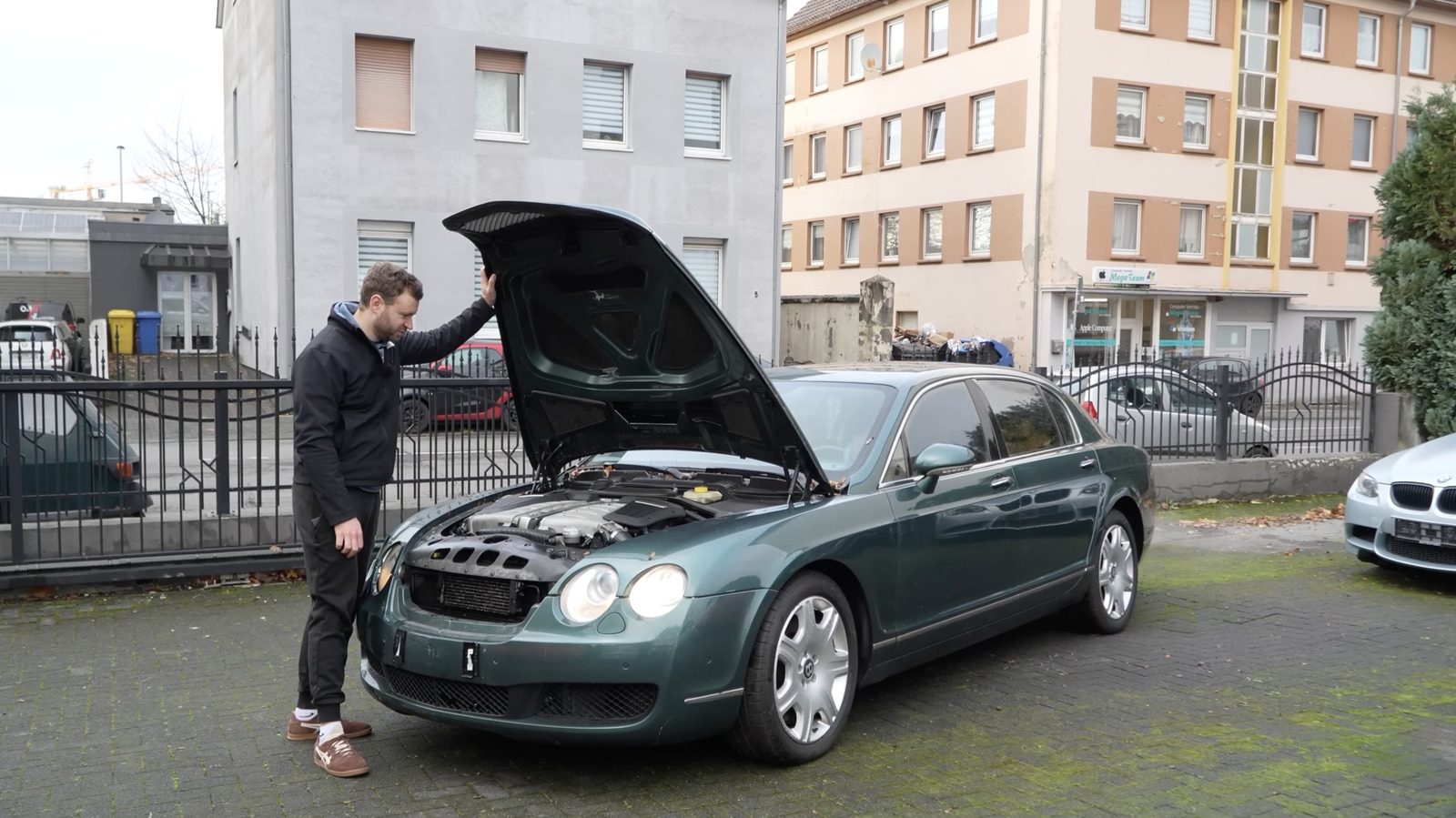


YouTuber Sreten of M539 Restorations bought the cheapest Bentley Flying Spur in Europe for $12,500. It originally stickered at $275,000. It had 160,000 miles, mold-filled footwells, electrical gremlins, rust, and a paint job that could generously be described as criminal. The W12 under the hood, though, was running.
That last detail is the remarkable part of this story, and it only gets more remarkable.
Once Sreten got the car back to his shop, the initial work was standard-issue cheap luxury car triage. Sunroof drains were leaking, turning the floor mats into wading pools. The rear parking brake was shot.
He spent days just drying the interior out. None of this was surprising. A $12,500 Bentley is a $12,500 Bentley.
The real drama started when he took the Flying Spur out on the road. It overheated almost immediately. After extensive diagnosis, it became clear this wasn’t a new problem. The plastic coolant overflow tank had physically swollen from repeated heat cycles.
This engine had been cooking itself for what appeared to be years.
A block test showed combustion gases in the coolant, the classic signature of a blown head gasket or cracked head. But Sreten wasn’t buying it. The W12 showed none of the other usual symptoms.
A borescope inspection confirmed his suspicion. The head gasket was intact. Instead, the chronic overheating had stretched a cylinder head bolt, allowing gases to sneak past under load.
He replaced the bolt, knowing full well that pulling a single bolt without removing the engine is the wrong way to do it. It worked. Then it didn’t.
More digging revealed missing parts, literally. A previous owner had yanked the thermostat entirely, apparently hoping that running coolant full-time would solve the overheating. The engine was still running hot even with the cooling system permanently wide open, which tells you everything about how desperate previous repair attempts had been.
The actual culprit turned out to be a partially blocked radiator. A new radiator, combined with new head bolts, a proper thermostat, and a fresh coolant tank, finally brought the temperatures under control. Twenty years and untold abuse later, the W12 purrs.
There’s still a bad turbo boost solenoid keeping the engine in limp mode, and fixing it requires pulling the entire powertrain. But with the overheating solved, that’s a job worth tackling. Sreten’s total investment stands at $16,431 with more bills ahead.
The Volkswagen Group’s W12 has always had a reputation as a complex, intimidating engine. Twelve cylinders arranged in a compact W configuration, twin turbos, enough plumbing to confuse a submarine engineer. Shops charge accordingly, and owners fear accordingly.
That fear is half the reason a $275,000 sedan ends up on the market for the price of a used Civic.
But this particular engine survived what amounts to prolonged mechanical torture. Chronic overheating severe enough to deform plastic components and stretch head bolts. Missing thermostat. Blocked radiator. Previous owners who clearly threw their hands up and walked away.
Through all of it, the W12 kept firing, kept running, kept delivering the kind of creamy twelve-cylinder smoothness that justified its original price tag.
Volkswagen built this engine to power flagships — the Continental, the Flying Spur, the Phaeton. They over-engineered it to a degree that now seems almost absurd. No engine should survive this level of neglect, and this one did.
Sreten’s project is far from finished. But the W12 at its heart already proved its point.




Share this Story