
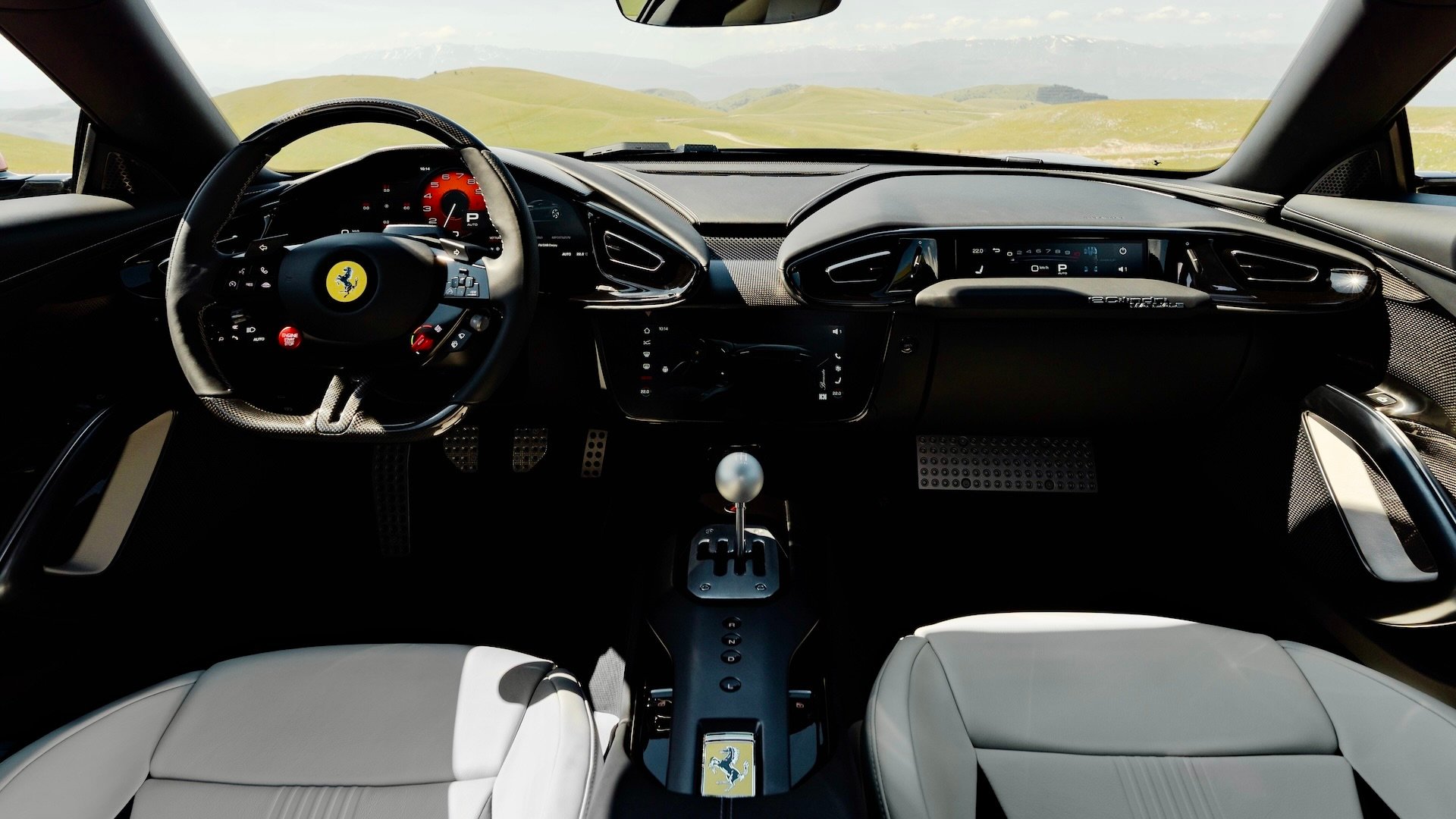


Only 1,499 people will pay at least €590,000 for a Ferrari that lets them row their own gears—sort of. The 2027 Ferrari 12Cilindri Manuale, unveiled this week in Maranello, brings back the gated shifter, the clutch pedal, and the satisfying mechanical theater of a three-pedal car. But beneath that gorgeous shift gate lies the eight-speed dual-clutch automatic from the SF90 Stradale, rewired and stripped of two gears.
Ferrari calls it Manuale by Wire. There is no mechanical linkage between the clutch pedal, the shift lever, and the transmission. The clutch pedal pushes against nothing but a simulator, and the gated shifter clicks through choreographed resistance patterns modeled after the 599 GTB.
This is a car that can stall. It can do burnouts. It rewards heel-and-toe downshifts. And it can also be switched into full automatic mode at the touch of a button for crawling through Roman traffic in August.
Ferrari’s engineers went deep on the tactile details. Pedal pressure, engagement point, the metallic scrape of the shift rod against the gate—all calibrated to replicate a true manual experience. You can over-rev the 6.5-liter naturally aspirated V12 if you insist on holding a gear too long, though the computer will block any shifts that could grenade the drivetrain.
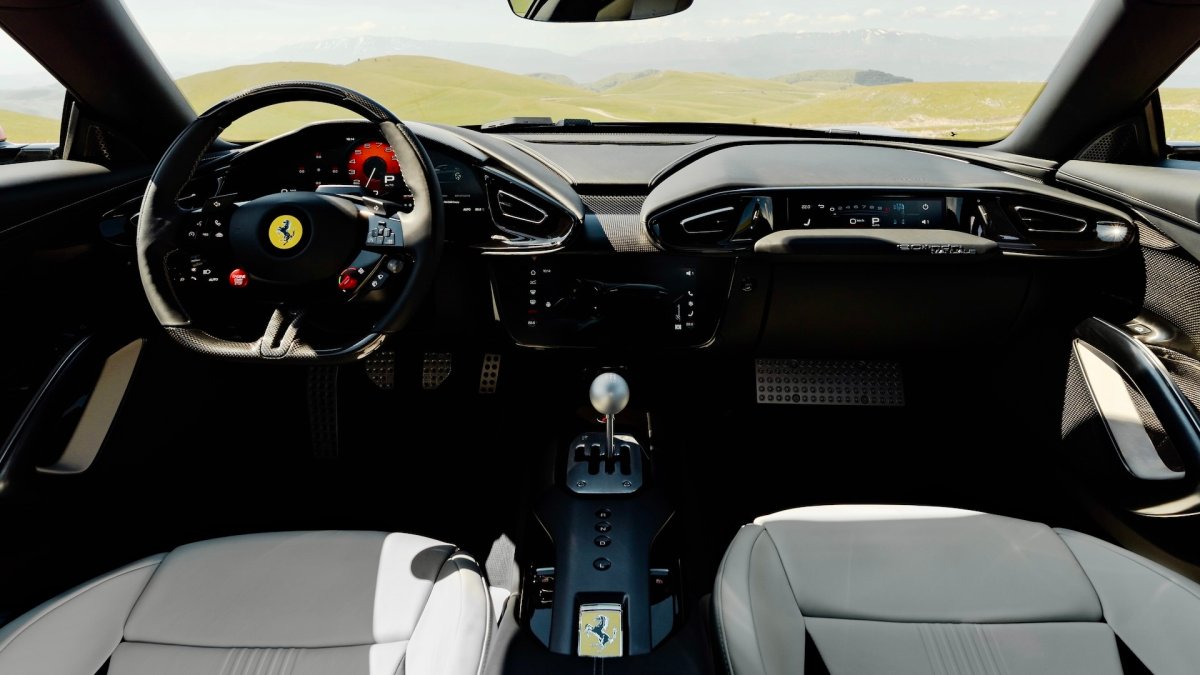
The philosophical tension here is unmistakable. Ferrari declared the manual transmission dead more than a decade ago. The last Ferrari sold new with a true stick was the California in 2008. Now it’s back—but only as a simulation, a digital puppet show performed by an automatic gearbox wearing period costume.
Six gears were enough, engineers said, to deliver the desired character. The other two from the SF90’s eight-speed were simply amputated.
There is something genuinely clever about the approach. The 819-horsepower V12 makes this among the most powerful Ferraris ever sold to customers, and asking a traditional manual gearbox to handle that output reliably in the hands of owners who drive maybe 2,000 miles a year would be a headache Ferrari didn’t want. A dual-clutch automatic already proven in the SF90 is robust, validated, and ready to go. Dressing it up in a gated costume is cheaper than developing a clean-sheet manual transmission for a limited run.
All 1,499 units will be coupes, no Spiders. Every car goes through Ferrari’s Tailor Made bespoke program. Build slots, if any remain, are allocated by Maranello’s client relationship apparatus—the same gatekeeping system that decides who gets access to Ferrari’s most desirable products.
The market clearly wants this. Porsche has proven that manual transmissions drive loyalty and residual values in low-volume sports cars. Gordon Murray’s T.50 made the three-pedal layout central to its identity. Aston Martin’s Valour sold out immediately with its six-speed stick. Ferrari watched all of this happen and built its answer: the sensation of a manual with none of the mechanical commitment.
Whether that compromise satisfies purists or infuriates them depends entirely on how good the simulation feels at eight-tenths on a mountain road. Early hands-on impressions from journalists who worked the shifter and clutch at the reveal suggest Ferrari nailed the tactile fidelity. The clutch bites. The gates resist. The engine dies if you botch a launch.
But a simulated stall is still a simulated stall. Ferrari has built a $650,000 tribute act to the very thing it killed, and the waiting list is probably already full. That tells you everything about where the supercar market stands in 2025—nostalgia is the ultimate performance upgrade.
Share this Story