
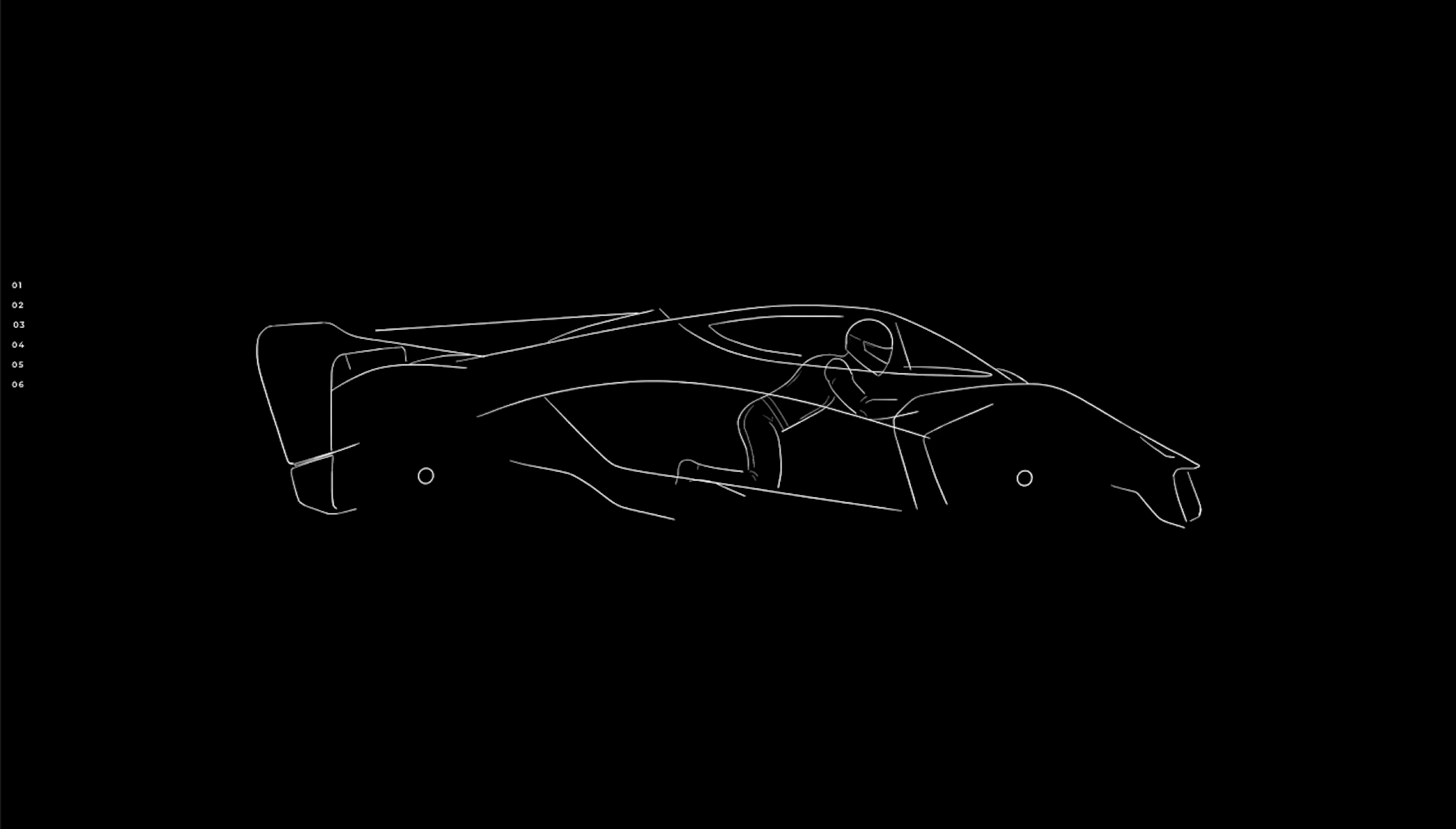


A Netherlands-based company called Sanrivatti has no engine specs, no powertrain details, and no confirmed engineering partnerships. What it does have is a seating position borrowed from MotoGP racing and enough audacity to build an entire brand identity around it.
The concept is called Apex Position. Forget bucket seats and six-point harnesses. Sanrivatti wants drivers stretched forward, feet back, body low, chest nearly over the steering inputs, straddling the car the way Pecco Bagnaia straddles a Ducati Desmosedici at 220 mph. It is, on paper, the most radical rethinking of how a human occupies a car’s cockpit since Colin Chapman bolted a reclining seat into a Lotus 25 in 1962.
Santiago Sánchez Rivero, the company’s founder and CEO, cut his teeth at Donkervoort, the small Dutch outfit known for stripped-down, track-obsessed sports cars that weigh about as much as a large refrigerator. He has since recruited executives with résumés from Bentley, McLaren, and Lotus. The pedigree is real. The product is not, at least not yet.
And that’s the tension at the heart of this announcement. Sanrivatti is making noise in a market already drowning in noise. The hypercar startup space has become a revolving door of renders, press releases, and venture capital pitches.
Rimac actually delivered. Koenigsegg keeps delivering. Most of the rest evaporate somewhere between the concept sketch and the first crash test.
So why pay attention? Because the motorcycle-derived driving position is genuinely different. Every hypercar maker on earth fights the same ergonomic battle: how low can you seat a driver, how far back can you recline them, how much visibility can you sacrifice for aerodynamics.
Sanrivatti sidesteps the question entirely. By pitching the driver forward, the company claims it can unlock a sensation closer to earthbound flight, a feeling superbike riders have known for decades but four-wheeled machines have never attempted to replicate.
There is logic buried in the novelty. Humans rode horses in a forward-leaning posture for thousands of years before the automobile forced us into chairs. The standard driving position is inherited from carriages and wagons, not from any biomechanical ideal. Whether a prone-style cockpit actually improves driver engagement or just creates a spectacular way to herniate a disc remains to be seen.
The practical questions pile up fast. How do you manage crash safety with a rider leaning forward into a steering column? What does ingress and egress look like, and does it require the flexibility of a yoga instructor? How do you package a mid-mounted engine behind a human body that is now oriented horizontally rather than vertically?
None of these have public answers yet. Sanrivatti is still in concept mode. No prototype has been shown running. No price has been quoted. No timeline has been given beyond the vague promise of a future production car.
The hypercar world loves a good origin story, and “we reinvented how you sit” is a better pitch than most. Donkervoort proved that a tiny Dutch company could build credible, thrilling machines with global followings. Whether Sanrivatti can do the same with a position that asks buyers to abandon a century of seated driving convention is another matter entirely.
The idea is bold. The execution is invisible. In this market, that gap is where most startups go to die.
Share this Story