
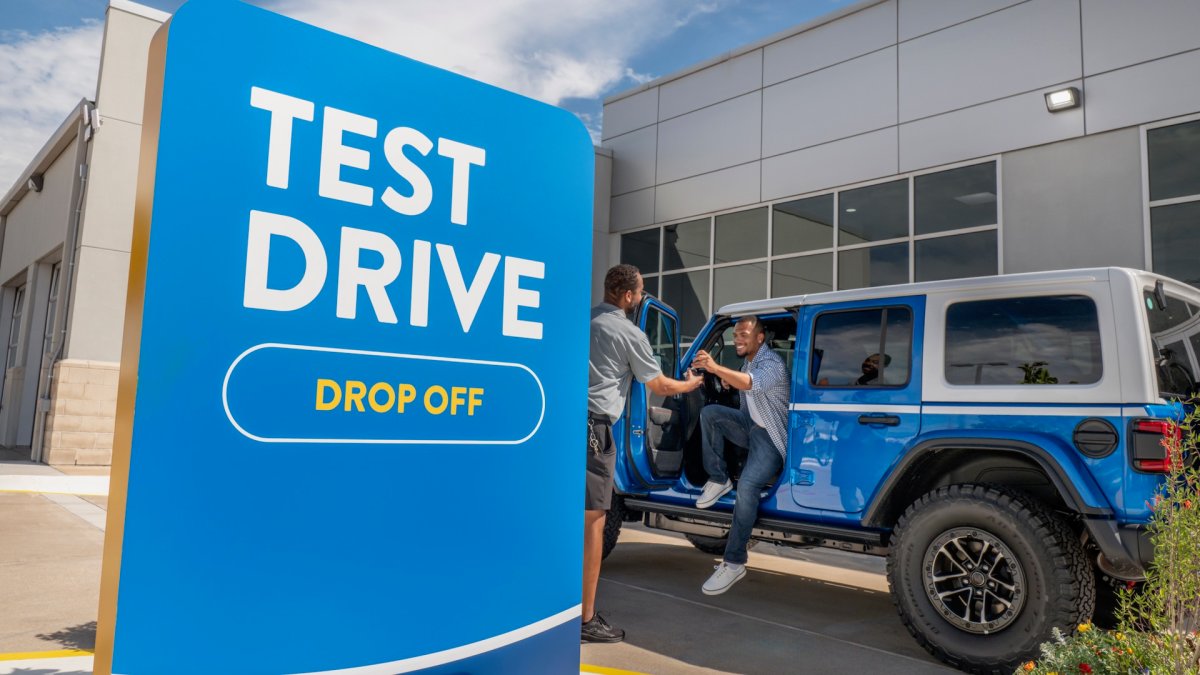


Carvana, the company that built its brand on never making you talk to a car salesperson, just opened a place where you can talk to car salespeople. Sort of.
The online used-car giant launched a Test Drive Center at its newly acquired Chrysler-Dodge-Jeep-Ram franchise in Texas, letting customers drive new Stellantis vehicles before buying. Staff are present, but Carvana insists they’re there only to answer questions and move cars around. No pitches. No four-square worksheets. No manager visits.
It’s a fascinating pivot from a company that once marketed itself as the antidote to the traditional dealership experience.
Shoppers walk in and browse vehicles on a four-sided screen, compare trims, and configure a build. Display models sit on the floor with QR codes linking to virtual tours with specs and options. Once a customer picks something, the system finds the closest match from a fleet of test vehicles, and staff bring it to a valet lane.
The actual purchase still happens on Carvana’s website, either on-site or from the couch at home. No-haggle pricing remains the rule.
The Texas store is one of two Stellantis franchises Carvana bought in 2025, the other being in Arizona. That’s a telling move for a company that rose to prominence specifically by avoiding brick-and-mortar retail.
Carvana’s trajectory over the past five years reads like a cautionary tale about riding a wave you didn’t create. The pandemic inflated used-car prices to absurd levels, and Carvana gorged on the growth. Then the market cooled, and the company nearly collapsed under its own weight.
Paperwork backlogs caused customer registrations to lapse across multiple states. Michigan yanked its dealer license. Connecticut forced a lawsuit settlement over delayed registrations and unpaid sellers. The car vending machines made for great Instagram content but couldn’t paper over operational chaos.
Then came a rebound that one investment group memorably labeled “a grift for the ages.” The stock recovered. The company stabilized. But the underlying vulnerability remained: Carvana’s entire business model was tethered to the volatility of used-car pricing, a market no one truly controls.
Buying franchised new-car dealerships is an acknowledgment of that problem. New-car sales carry their own risks, but the pricing structure is more predictable, the supply chain more transparent, and the margins better understood. Franchise agreements also give Carvana something it has struggled to earn on its own — legitimacy in states where dealer lobby groups have fought hard against online-only sales models.
The test drive concept itself is shrewd. The number one complaint about dealership visits remains the pressure. Customers consistently say they want to touch the car, sit in it, drive it — and then be left alone to decide.
Carvana is betting it can deliver that experience better than traditional dealers, who have spent decades promising to fix the process and never quite getting there.
Whether this scales beyond two Stellantis stores is the real question. Running a franchise requires parts departments, service bays, warranty infrastructure, and manufacturer relationships that Carvana has zero history managing. Selling used cars online and running a full-service franchise operation are fundamentally different businesses.
But the direction is unmistakable. The company that made its name by rejecting the dealership model is now building one — just with fewer handshakes and no closing room.

Share this Story