
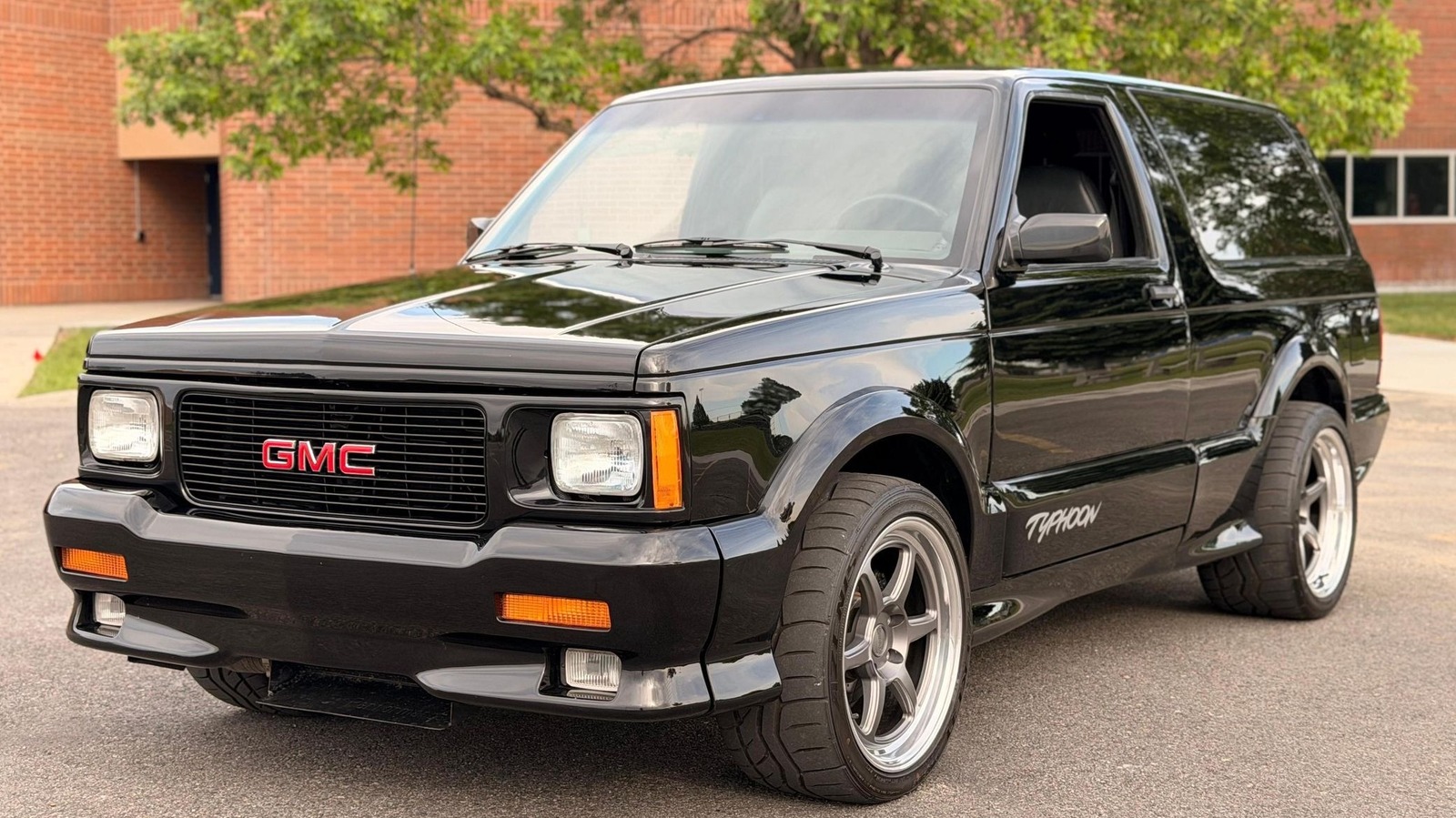


A 1993 GMC Typhoon packing 682 horsepower at the wheels is currently up for sale on Cars & Bids, and its owner has a message for Dodge Durango SRT Hellcat shoppers: why spend $82,000 on a new truck when a 30-year-old two-door from Montana can embarrass it at the strip?
It’s a fair question, at least on paper. The Durango Hellcat’s supercharged 6.2-liter V8 makes 710 horsepower at the crank. This Typhoon’s turbocharged 4.3-liter V6, with a shot of nitrous, reportedly puts 682 to the wheels. Nobody knows the crank number, but even conservative drivetrain loss estimates put it well north of 800. That’s a lot of fury running through a platform GM never intended to handle it.
The seller claims it consistently runs mid-10-second quarter miles at Montana’s elevation, which is no small feat given thinner air. No 0-60 time was ever recorded, apparently. That’s either charming honesty or a red flag, depending on your disposition.
GMC built roughly 4,700 Typhoons during the model’s brief production run, and they’ve developed a cult following that keeps prices surprisingly modest. Stock examples trade hands in the $20,000 range. This one is far from stock, obviously, but it’s also unlikely to crest the Durango Hellcat’s $81,990 sticker price.
That price gap is the whole pitch. You’re getting comparable or better straight-line performance for potentially a fraction of the cost, wrapped in a package with considerably more personality than anything rolling off a modern assembly line.
But here’s the thing about buying someone else’s heavily modified, nitrous-fed, three-decade-old project truck: you’re not buying a car. You’re buying a relationship. The kind that calls you at 2 a.m. needing bail money.
The Typhoon has no rear doors, no third row, no factory warranty, no tow rating, and a powertrain that has been pushed so far beyond its original engineering brief that every drive is a trust exercise. The Durango Hellcat, for all its absurdity, comes with Dodge’s backing, modern safety systems, seats for seven, and the ability to tow 8,700 pounds. It also sounds like the apocalypse, while a turbocharged V6 on nitrous sounds like an angry dishwasher.
None of that matters to the buyer this truck is meant for. That buyer already knows. They’ve probably already bid.
The modified Typhoon represents something the new-car market has largely abandoned: unfiltered, consequence-be-damned mechanical excess built in a garage, not a boardroom. No electronic nannies. No over-the-air updates. No subscription fees. Just boost, nitrous, and whatever prayers you brought with you.
Stock Typhoons have always been undervalued relative to their rarity and significance. They were among the first factory-performance SUVs, predating the entire segment that now includes everything from the Durango Hellcat to the BMW XM. A modified one making this kind of power sits in strange territory — too wild for collectors, too old for warranty shoppers, perfect for a very specific kind of enthusiast who treats reliability as a suggestion.
The auction will sort out what the market thinks it’s worth. Expect something well above a stock Typhoon’s going rate but well below Hellcat money. The real cost, of course, comes later. It always does with cars like this.
If you’re the type who sees a turbocharged, nitrous-fed, mid-10-second GMC from 1993 and thinks “bargain,” you probably already know what you’re getting into. And if you’re the type who thinks “money pit,” you’re probably right too. Both things can be true at the same time. That’s the entire point.

Share this Story