
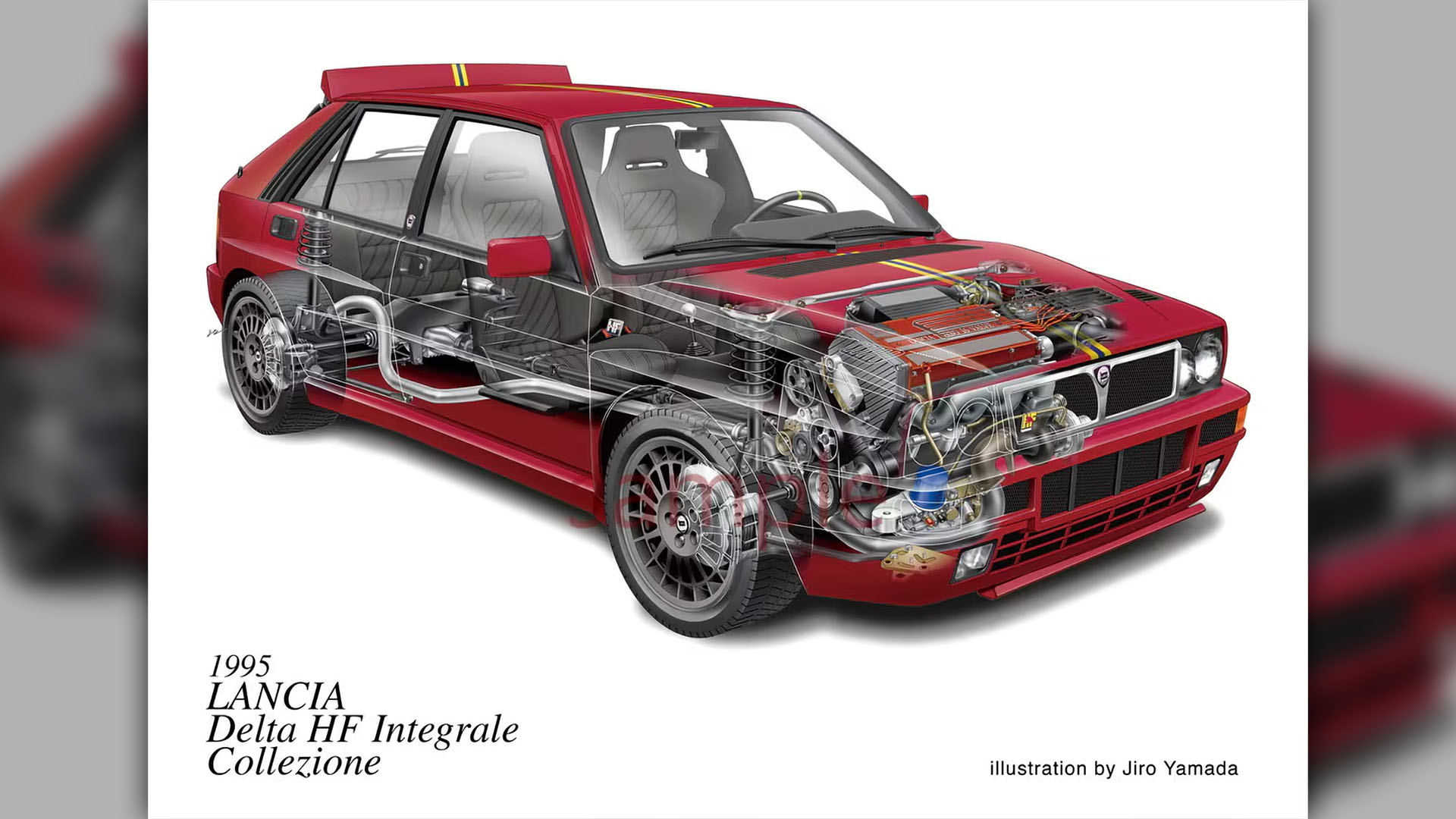


Jiro Yamada died last August at 65. The world didn’t find out until this week.
That gap says something about the kind of man Yamada was, and about the kind of work he did — painstaking, obsessive, largely invisible to anyone who wasn’t paying close attention. Yamada was a Japanese illustrator who spent more than four decades peeling back the skins of machines and rendering their inner lives with surgical precision. Pancreatic cancer took him, but his body of work remains staggeringly intact.
Yamada started illustrating professionally in 1979, when cutaway art was still done entirely by hand — ink on board, airbrush over ink, hours dissolving into days. His subjects ranged from Formula 1 cars to helicopters to rocket engines. Automakers hired him for technical and promotional materials.
Enthusiast publications leaned on him. Private collectors sought him out. If you cracked open the official guidebook for the original Gran Turismo in 1998, his name was in the credits.
His website still hosts a meticulously organized archive of automotive works sorted by make and model. It is not a portfolio. It is a cathedral.
One section walks through his process using a Porsche 906 prototype as the example, and it reveals just how much invisible labor goes into a single illustration. The research alone — sourcing technical drawings, cross-referencing photography, understanding the mechanical relationships between components — could consume weeks before a single line was drawn.
Then came the drawing itself, where artistic judgment determined what to expose, what to leave covered, and how to guide the viewer’s eye through a machine’s anatomy without losing either clarity or beauty.
Yamada made the transition to digital production in 2000, following a path others in his field had taken. Jim Hatch, another practitioner interviewed by Road & Track in 2020, described the pre-digital era bluntly: “Everything was done by hand. There were no computers.” Digital tools brought consistency and speed, but they did not bring vision. That remained the illustrator’s burden and gift.
Days before his death on August 7, Yamada posted on Twitter that he had entrusted the Cinquecento Museum in Nagoya — a Japanese museum dedicated to the Fiat 500 — to maintain and sell reproductions of his work. It was a final act of curation, ensuring the archive would outlast him. The fact that he chose a tiny museum devoted to a tiny car feels right.
Cutaway illustration occupies an unusual space. It is technical documentation dressed as art, or art disciplined by engineering — depending on which direction you approach it from. Yamada saw no contradiction.
He described his work as “expressing both the rationality and beauty of machines at the same time.” That’s not a slogan. It’s a philosophy that takes decades to execute at the level he achieved.
The field has always been small. The number of illustrators who could produce work at Yamada’s standard was never large, and it is shrinking. Digital rendering tools have democratized certain aspects of technical illustration, but they haven’t replicated the interpretive eye that decides exactly where to slice a car open and what story its guts should tell.
Yamada’s archive remains online. The Cinquecento Museum holds his reproductions. But the hand — the specific, practiced, irreplaceable hand — is gone. And nobody announced it for nearly a year.
That quiet exit was perhaps the most fitting tribute a man like Yamada could have received. His work always spoke louder than he did.




Share this Story