
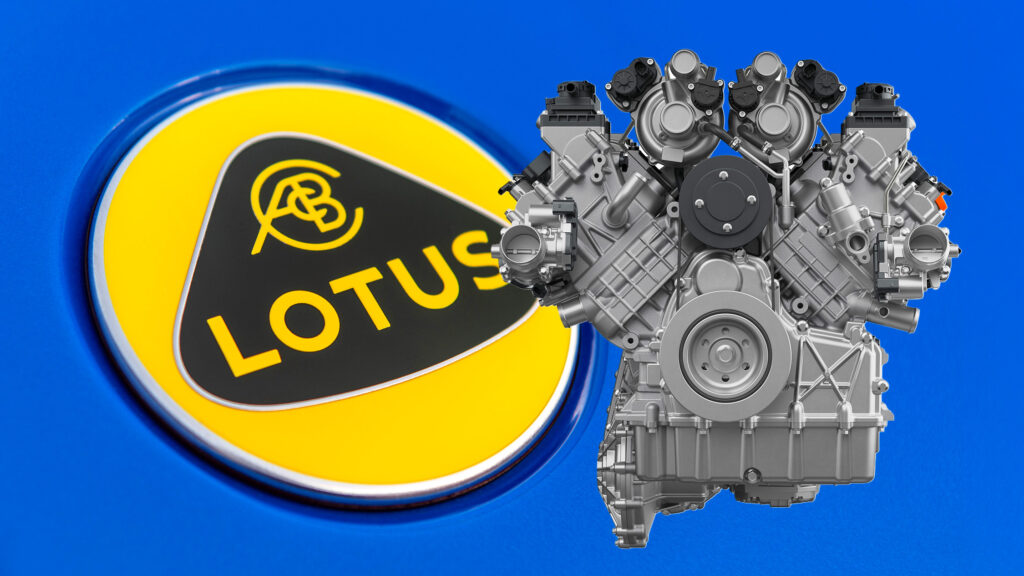


The next Lotus Emira won’t have a Toyota V6 under its skin. It won’t have a Mercedes-AMG four-cylinder, either. Instead, the Cayman-rival will reportedly run a 3.0-liter twin-turbo V6 built by Horse Powertrain, the Geely-Renault joint venture most people associate with economy-car hybrids, not mid-engine sports cars.
That’s quite a sentence to digest for enthusiasts who’ve spent decades associating Lotus with borrowed engines from proven performance brands.
According to Autocar, the revised Emira arrives in 2028 carrying Horse’s W30 engine, which debuted at the Beijing Auto Show last month. On paper, the numbers are hard to argue with: 536 horsepower and 516 lb-ft of torque before any hybrid assist, all packed into a block weighing just 353 pounds. Horse claims it’s the lightest V6 currently in production, undercutting rivals by roughly 22 pounds. For a company that has always obsessed over mass, that detail matters more than the badge on the cam cover.
Lotus CEO Feng Qingfeng pointed to American buyers as the driving force. “They told us that they love the V6 engine, and actually the V6 version is our best-seller in the US market,” Feng told Autocar. So the Toyota 3.5-liter supercharged V6 that gave the Emira its character gets retired in favor of something newer, lighter, and firmly inside the Geely family tree.
Horse CEO Matias Giannini says the engine’s compact footprint comes from modular engineering rooted in four-cylinder architecture. “There’s no hybrid V6 engine that fits in the package that ours fits,” Giannini said. The W30 is designed to pair with a four-speed hybrid transmission and integrated electric motors, supporting everything from mild hybrid to full hybrid to range-extender configurations.
A four-speed hybrid gearbox in a Lotus would be a strange fit, though. It’s reasonable to expect Hethel has its own transmission plans for the Emira application.
The deeper play here is vertical integration. For years, Lotus relied on outside suppliers for its powertrains — first Rover, then Toyota, then AMG. That dependency always created a ticking clock.
When a supplier discontinues an engine or changes its strategy, Lotus scrambles. By pulling the powertrain into Geely’s corporate ecosystem through Horse, the company controls its own destiny. It also keeps the money in-house, a calculation that rarely goes unnoticed in boardrooms.
The ambition doesn’t stop at six cylinders. Lotus is preparing a V8 hybrid supercar expected to revive the Esprit name, also due in 2028. The V8 reportedly shares architecture with the W30 V6 and could deliver north of 986 horsepower with electric assistance. An official teaser image surfaced this week, confirming the project is real and progressing.
Both the updated Emira and the new Esprit are expected to be built at Hethel in Norfolk, the factory Lotus has called home since 1966. That commitment to the UK site is a lifeline for the workforce and a signal that Geely sees value in the heritage, not just the logo.
Still, asking Lotus loyalists to trade Toyota and AMG engines for something from a company called Horse Powertrain requires a leap of faith. The specs suggest the hardware can deliver. Whether the name can earn the same trust is another question entirely.
Lotus has always been a company that punches above its weight by being smarter about engineering than anyone else on the grid. If the W30 truly is the lightest, smallest hybrid V6 available, it fits the Lotus philosophy perfectly. Colin Chapman never cared whose name was on the engine. He cared what it weighed.
Share this Story