
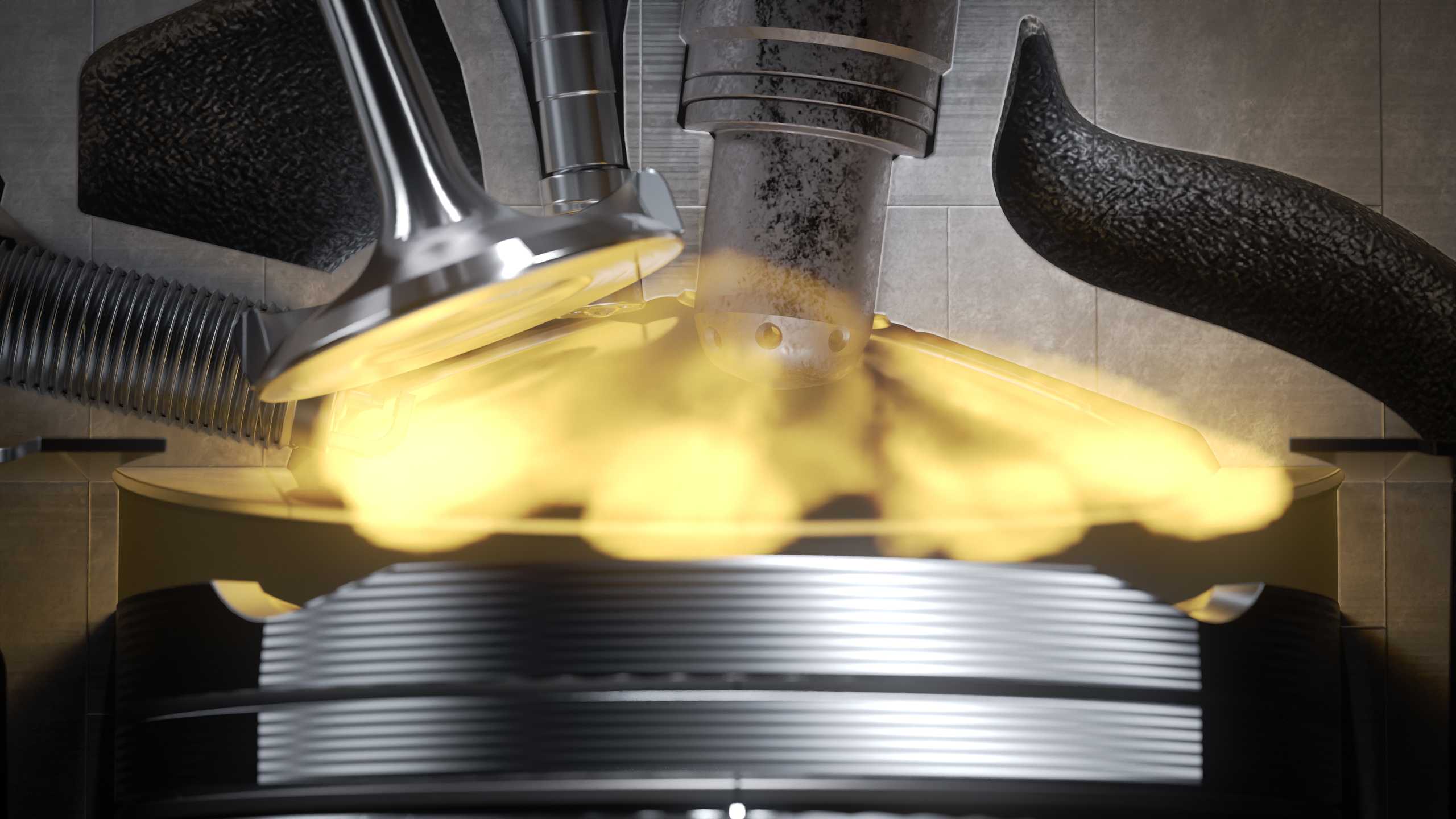


The inline-six that powers BMW’s M2, M3, and M4 just got a stay of execution. Starting July 2026, every S58 engine rolling out of the Steyr plant will carry a pre-chamber ignition system called M Ignite — a technology borrowed directly from endurance racing that fires micro jets of flame at nearly the speed of sound inside each cylinder.
The reason is Euro 7, Europe’s incoming emissions standard taking effect in November 2026. Without M Ignite, the S58 would have been regulatory roadkill. BMW M’s answer was not to hybridize the engine or bolt on an electric motor, but to rethink how combustion happens inside it.
Each cylinder now carries two spark plugs. A small pre-chamber sits in the redesigned cylinder head, connected to the main combustion chamber through tiny overflow openings. At low revs, the conventional spark plug leads.
Push past the midrange and the pre-chamber takes over, igniting a portion of the fuel-air mixture that then blasts into the main chamber through those openings as multiple flame jets. Instead of relying on a single flame front creeping across the piston, it lights the charge at several points simultaneously.
The result is faster, more stable combustion. Knock tendency drops, exhaust gas temperatures fall, and compression ratios go up. New variable turbine geometry turbochargers replace the old units, and camshafts, pistons, and exhaust ports have all been reworked.
The power figures? Identical. Every variant keeps its existing displacement and output. BMW M’s head of development, Alexander Karajlovic, was blunt about the priority: “We are offering our customers a purist combustion engine without hybridisation that meets our high standards for an M powertrain whilst also complying with future regulatory requirements.
That word — purist — is doing enormous work in that sentence. In an industry racing to electrify everything, BMW M chose the most mechanically complex possible path to keep a pure internal combustion powertrain alive. Two ignition systems per cylinder, twelve spark plugs total, new turbo technology — all to avoid strapping a battery pack and motor to a car that didn’t want one.
The efficiency gains are real but targeted. Fuel consumption drops most under high load, exactly where track-day drivers live. BMW frames this as more laps per tank.
The everyday commuter won’t notice much difference. The driver who red-lines the thing at the Nürburgring will.
Production of M3 and M4 models with M Ignite begins July 2026. The M2 follows in August. The system also meets China’s incoming C7 emissions standard, ensuring these cars can still be sold in the world’s largest auto market.
Karajlovic hinted the technology is “in principle, scalable” to other BMW M engines, then immediately walked it back to the present tense. Promising a pre-chamber future for every M car would invite questions about cost and complexity that BMW probably doesn’t want to answer yet.
The S58 has been in production since 2019. It is, by any measure, a mature engine. Cramming a second ignition system, new turbochargers, and revised internals into that existing architecture while keeping the Steyr assembly line running at full capacity is not a small engineering feat.
It is an expensive, painstaking way to keep a gasoline engine legal. BMW M could have gone hybrid. They chose flame jets instead. That tells you everything about who they think their customer is — and how far they’ll go to keep that customer from shopping elsewhere.
Share this Story