
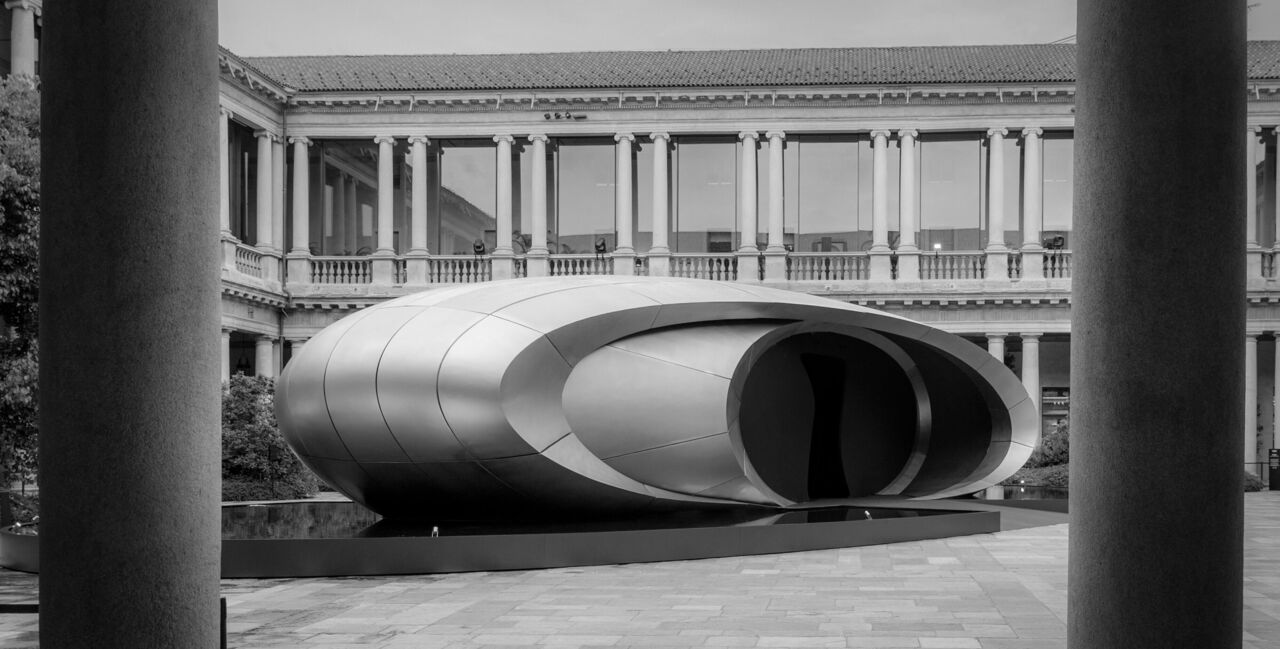


For 13 straight years, Audi has shown up at Milan Design Week. And for 13 straight years, the company has insisted it’s not there to show cars. This year’s installation, “Origin,” created with Zaha Hadid Architects, is a sculptural object parked in the courtyard of a former seminary on Corso Venezia. Its purpose, according to the brand, is to help people “filter the noise.”
The noise Audi would prefer you filter apparently includes the fact that it brought two very significant vehicles to Milan anyway.
Sitting alongside the meditative titanium-skinned sculpture is the new RS 5, Audi Sport’s first high-performance plug-in hybrid. Also present: the Audi R26, the car that marks the brand’s entry into Formula 1. These are not footnotes. They are the two most consequential product stories Audi has right now, and they’re being unveiled at a design fair rather than a motor show.
That tells you everything about how the German automaker sees its competitive landscape in 2026.
The RS 5 is a pivot point for the performance division. Audi Sport, long synonymous with turbocharged excess, has gone hybrid. The sedan posts weighted combined CO2 emissions of 98 to 86 grams per kilometer and sips 18.4 to 17.7 kWh per 100 km in electric mode.
Run the battery flat, though, and you’re looking at 10 liters per 100 km. That’s a reminder that plug-in hybrids are only as clean as their owners’ charging habits.
The F1 car is the louder statement. Audi debuted the R26’s design last November, and bringing it to Milan rather than reserving it for motorsport venues signals the brand wants its racing ambitions to function as cultural currency, not just engineering credibility. Formula 1 has become a lifestyle product, and Audi is treating it as one.
“Our recurring presence in Milan is not about showing cars — it is about contributing to a broader cultural debate,” says Massimo Frascella, Audi’s Chief Creative Officer. The quote is almost too perfect in its contradiction. You don’t ship an F1 car to a courtyard in central Milan to avoid talking about cars.
The “Origin” installation itself leans hard into the brand’s refreshed design language: clarity, technicality, intelligence, emotion. These are the same words Audi attached to its Concept C study last September, and they now serve as the philosophical underpinning for everything from door handles to architecture.
The structure’s matte metallic surfaces shift with daylight, its reflections changing as visitors walk around it. Zaha Hadid Architects, no strangers to making buildings feel like they’re moving while standing still, delivered exactly what the brief demanded. Something photogenic, contemplative, and easy to explain in a press release.
The real tension here is strategic. Traditional auto shows are shrinking or dying. Geneva is a memory.
Detroit reinvented itself as a public festival. Frankfurt became Munich and then became uncertain. Milan Design Week, meanwhile, draws hundreds of thousands of visitors who are affluent, design-literate, and allergic to conventional advertising.
For a premium brand trying to redefine itself around electrification and motorsport at the same time, it’s a smarter room to work. Audi is not the only automaker that has figured this out, but 13 years of consistency gives it a territorial claim. The installation may invite quiet reflection, but the business strategy behind it is anything but quiet.
Two cars, one sculpture, zero traditional auto show booths. That is Audi’s 2026 marketing playbook, wrapped in a matte titanium skin and placed gently in a Milanese courtyard. It dares you to call it a product launch.



Share this Story