
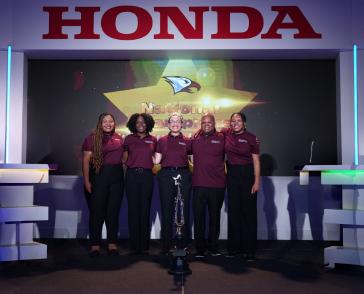


Thirty-four trips to the National Championship Tournament. Thirty-three times going home without the title. North Carolina Central University finally broke through at the 37th Honda Campus All-Star Challenge, dethroning defending champion Hampton University in a final that came down to the last round.
The $100,000 grand prize heads to Durham, North Carolina, and the four women who earned it did something no NCCU team has done before. They didn’t just win. They competed in the championship game as an all-female squad.
Team captain Ronni Butts, a junior political science major, didn’t sugarcoat the grind. “Our team practices four days a week for several hours,” she said. The roster — Butts, Chantel Chestnutt, Alena Dockery, and freshman Jadzia “Z” Kowalczyk — fielded questions spanning history, science, geography, and culinary arts under coach Clayton C. Mack Jr.
Three political science majors and an art major. Not a single STEM concentration among them. They beat everybody anyway.
Honda hosted 200-plus students and coaches from 32 qualifying HBCUs at its Southern California headquarters, drawn from a field of 65 schools that competed in regional tournaments throughout the year. The automaker is distributing more than $500,000 in institutional grants across participating schools. Hampton picked up $40,000 as runner-up, while Fisk University and Spelman College each collected $26,000 for third and fourth place.
Those dollar figures matter more than they might appear. Honda has now funneled over $16 million into HBCU programs and facilities since launching the Campus All-Star Challenge in 1989. In an industry where corporate sponsorship often amounts to slapping a logo on a stadium, Honda has built something with actual roots — 37 years of continuous investment touching more than 350,000 students.
The program feeds directly into Honda’s recruitment pipeline. Through its “Drive the Legacy” initiative, the company partners with the Thurgood Marshall College Fund, the National Urban League, and local UNCF chapters to funnel HBCU talent into its workforce. One of this year’s Alumni Hall of Fame inductees, Mark Stepney from Harris-Stowe State University, built a career as an automotive industry veteran. The competition isn’t just a feel-good exercise. It’s a farm system.
Dr. John Miglietta of Tennessee State University took Coach of the Year honors, a recognition of more than two decades invested in the program. He coached TSU’s 2007 championship team and is a Fulbright scholar who spent a year in Tajikistan. The kind of résumé that reminds you these academic competitions attract serious people doing serious work.
Brynn Patterson of Fisk earned the Ernest C. Jones Sportsperson Award, voted on by fellow competitors — always a more telling honor than anything handed down by a committee.
Norfolk State, North Carolina A&T, Prairie View A&M, and Southern University–Baton Rouge rounded out the Elite Eight. The geographic spread alone tells the story of HBCU culture: Virginia, North Carolina, Texas, Louisiana, Tennessee, Georgia, all represented at the highest level.
NCCU’s breakthrough lands at a moment when HBCUs are experiencing a surge in visibility, enrollment interest, and corporate attention. Whether that attention translates into sustained institutional support or fades when the news cycle moves on is the question that always lingers.
Honda, at least, has 37 years of receipts. And NCCU has a championship trophy that was 34 years in the making — carried home by four women from North Carolina who practiced four days a week and never flinched when it counted.

Share this Story