
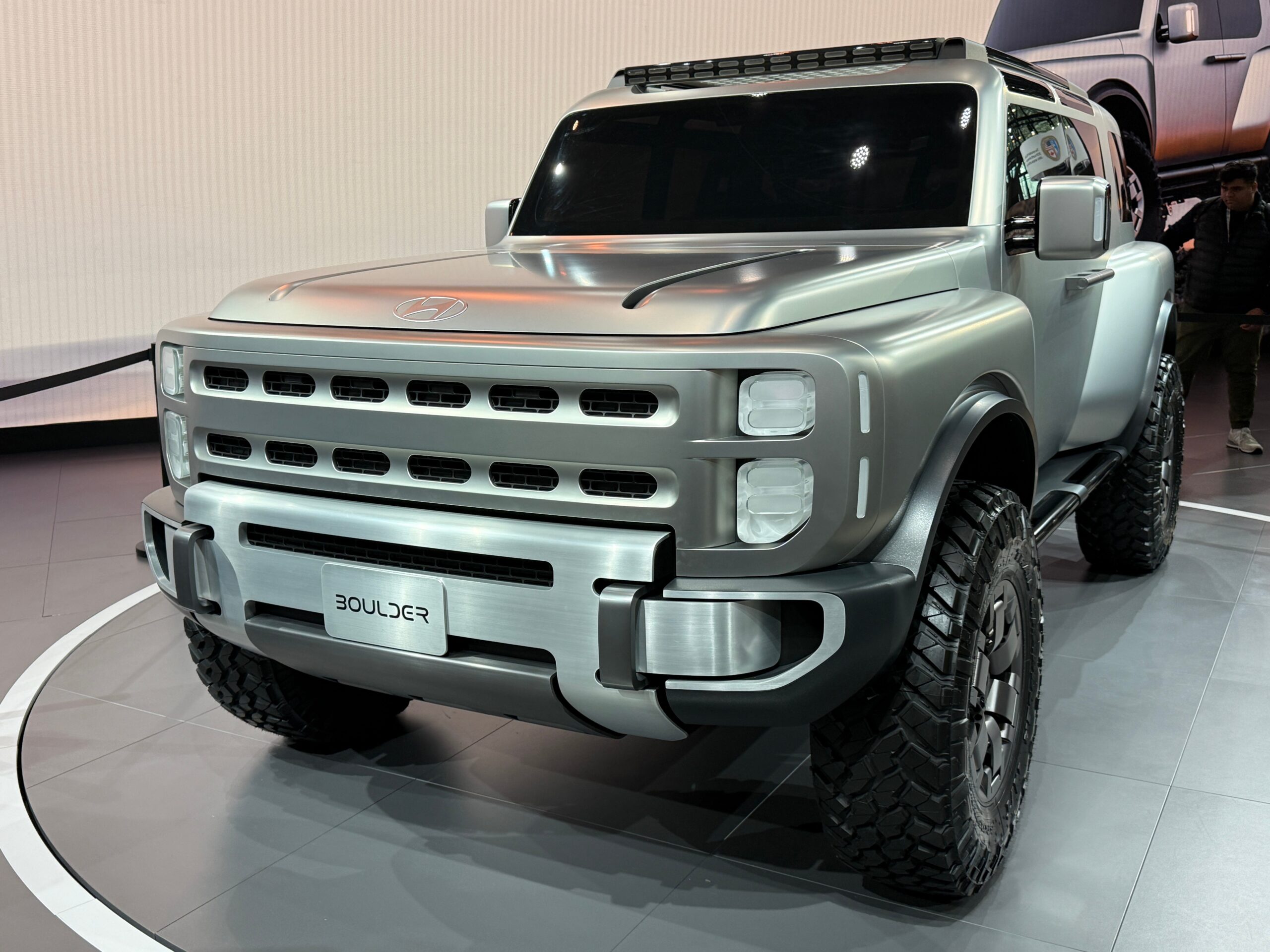


Hyundai didn’t tease a pickup truck at the 2026 New York Auto Show. It teased a whole empire.
The Boulder concept, revealed Wednesday in a traditional curtain-drop that felt almost defiant in the age of social media leaks, is a body-on-frame SUV riding on 37-inch tires with the kind of squared-off aggression that says Hyundai has been studying its enemies closely. Very closely.
“This is the beginning of Hyundai’s body-on-frame journey,” said SangYup Lee, Hyundai’s executive vice president and head of global design, choosing his words with the precision of someone who knows exactly how loaded they are.
The Boulder isn’t the midsize pickup Hyundai confirmed last year for a 2030 launch, the one aimed squarely at the Toyota Tacoma and Ford Ranger. It’s something more provocative: a signal that the pickup will be the foundation for a full lineup of body-on-frame vehicles, not a standalone experiment. Lee described the strategy in terms that leave little room for ambiguity: “We see body-on-frame as more of a lineup, rather than a specific vehicle.”
Then he practically winked. “Obviously, it’s a concept car, but if you look at the car, it’s a very serious concept car,” Lee said, drawing out those last four words like a man who already knows the production timeline.
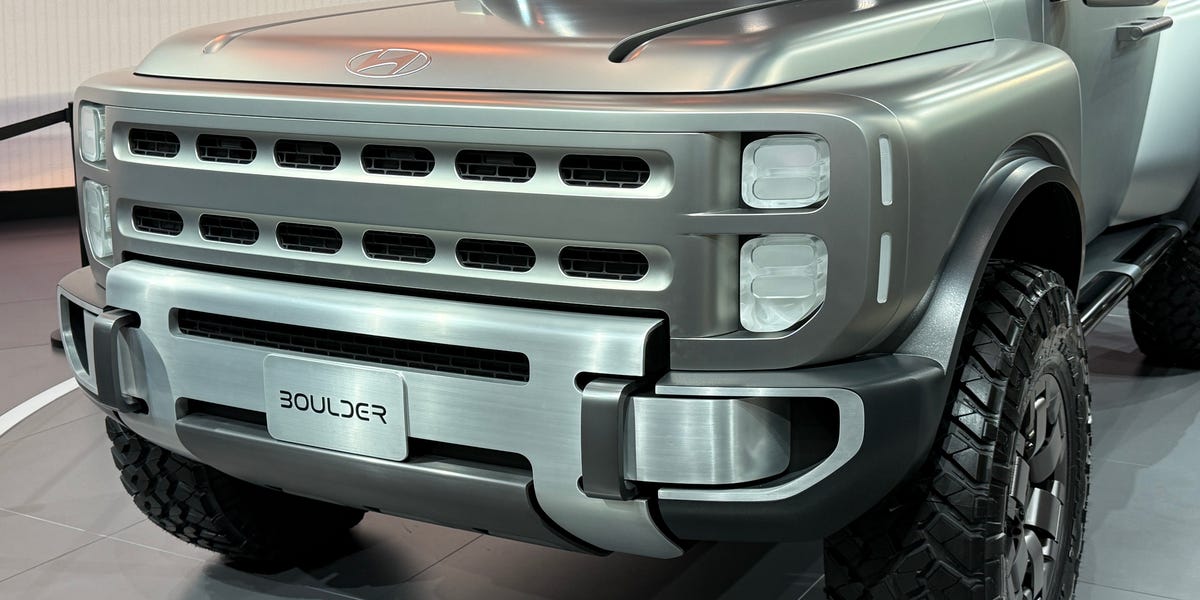
The design language Hyundai is calling “Art of Steel” leans hard into restraint. Lee talks about not forcing sheetmetal, about letting natural forms do the work. He pointed to the open space around the Boulder’s pixel-styled taillamps, gaps left intentionally as a design feature, eliminating the panel-fit headaches that plague production trucks.
The rear hatch opens from either side. The face is broad and unapologetic. Nothing about the Boulder feels tentative.
That’s the contradiction at the heart of this story. Hyundai, a brand that built its American reputation on value sedans and crossovers, is walking into the most tribal, most loyalty-driven segment in the U.S. market and declaring it belongs. Jeep Wrangler owners have tattoos of their trucks.
Bronco buyers waited years through delays and markups. These aren’t customers who switch brands because someone showed up with clever panel gaps.
Lee knows this. “As a latecomer, we have to take it seriously,” he said, citing his respect for Jeep and Bronco by name. His answer is to match their capability and then add what he called “plus alpha,” Korean slang for giving a little more than expected.
The manufacturing story is just as calculated. Hyundai’s body-on-frame vehicles will be built with American steel in American factories, a detail that matters when your competitors are already whispering about foreign badges in a segment where “Built in the USA” might as well be a trim level. “The whole message is: in U.S., for U.S., to global,” Lee said.

The timing is ruthless. Ford is expanding the Bronco lineup. Jeep just got the Wrangler’s safety sorted after years of embarrassing crash-test results. Toyota’s Tacoma and 4Runner are freshly redesigned.
Hyundai is choosing to pick this fight at the exact moment every incumbent is at full strength. That’s either supreme confidence or supreme foolishness.
Hyundai’s track record over the past decade, the Ioniq 5, the Genesis GV80, the Santa Cruz, suggests the company knows the difference. They entered the luxury market when nobody asked them to and made it work. They built a lifestyle pickup when the segment barely existed.
Body-on-frame is a bigger bet. The tooling costs are staggering. The customer loyalty barriers are real.
But Hyundai isn’t floating a trial balloon here. The Boulder is a declaration dressed up as a concept, from a company that has learned the American market rewards aggression far more than it rewards caution.
Share this Story