
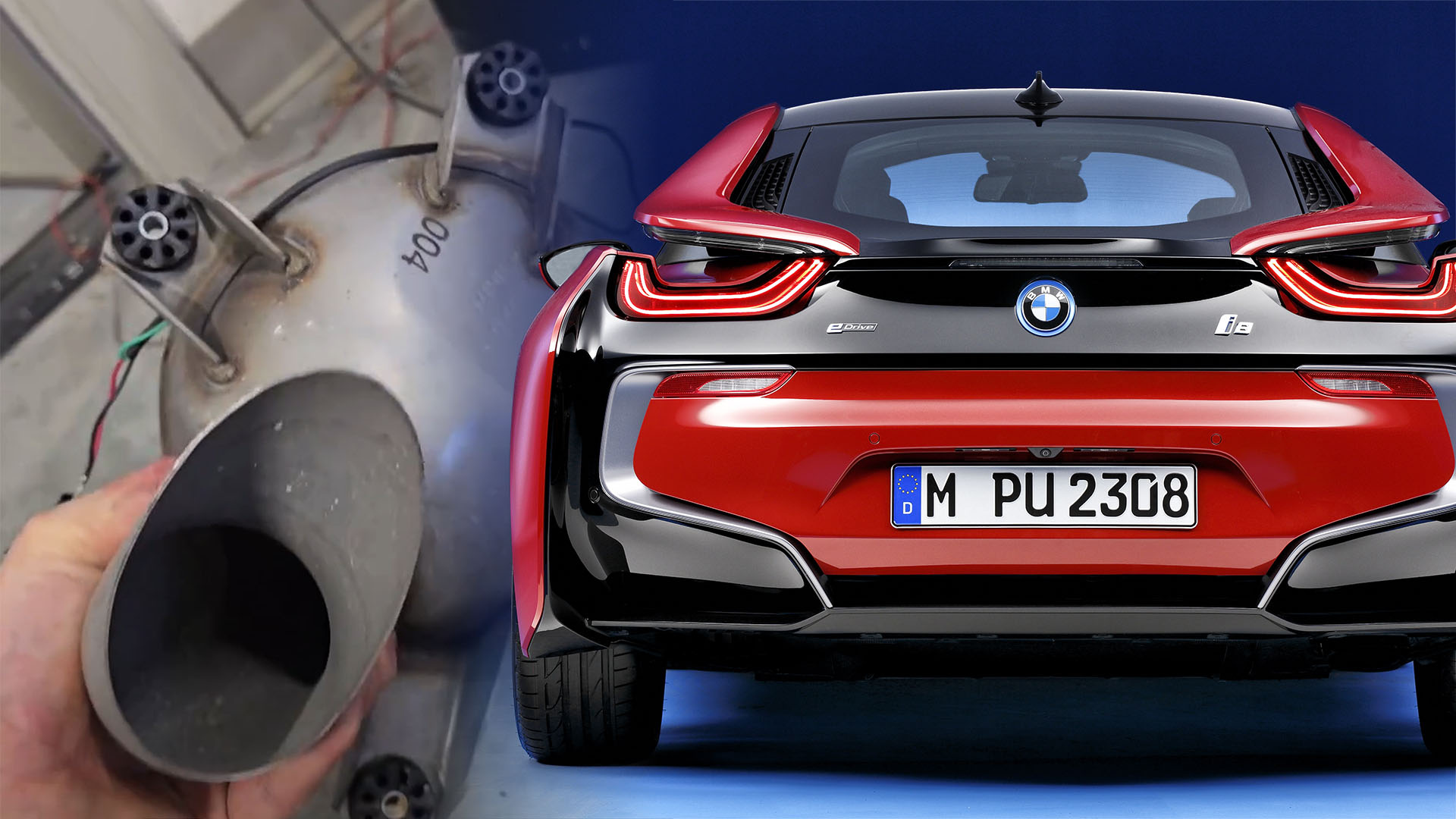


The BMW i8 had two tailpipes poking out behind its rear bumper. Only one of them was connected to the engine. The other was a loudspeaker wired up to broadcast synthetic exhaust noise, and it could rattle windows at 110 decibels — roughly the volume of a rock concert.
Trevor Elam, who runs the BMW parts site Bimmernetwork, discovered the speaker during a teardown of his i8 when the factory service manual casually instructed him to remove the “acoustic generator.” BMW’s own documentation alternates between calling the device an “acoustic sensor” and a “sound generator,” which is refreshingly honest branding from a company that also invented the term “Sports Activity Vehicle” to avoid calling its X5 an SUV.
In a video posted to YouTube, Elam connected the sound generator to a standard stereo and proved it functions as an ordinary — if absurdly powerful — speaker. He told The Drive his shop used it to blast music for a day. It’s tuned heavily toward bass, which makes perfect sense for a component engineered to simulate the low-frequency rumble of a bigger engine than the i8 actually had.
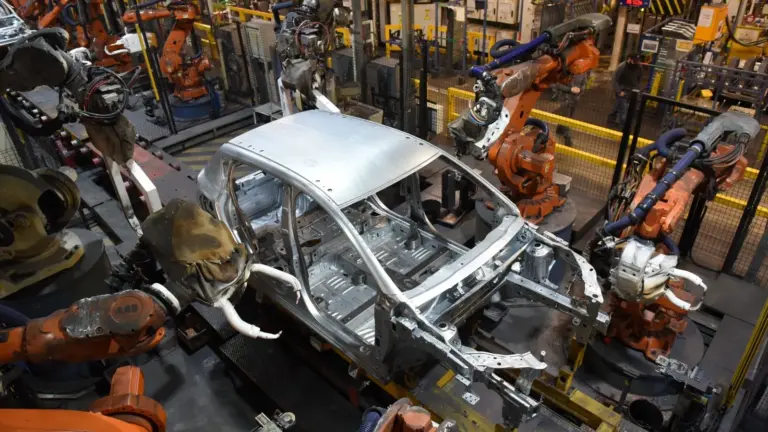
The i8 was always a paradox machine. Butterfly doors suggested supercar intent. A 1.5-liter three-cylinder hybrid powertrain said otherwise. A full carbon-fiber monocoque put it in the structural company of cars costing twice as much, yet the whole package landed in no-man’s-land — too exotic for commuters, too mild for the track-day crowd.
The fake exhaust speaker was the perfect metaphor for the entire car: stunning ambition undercut by a refusal to commit.
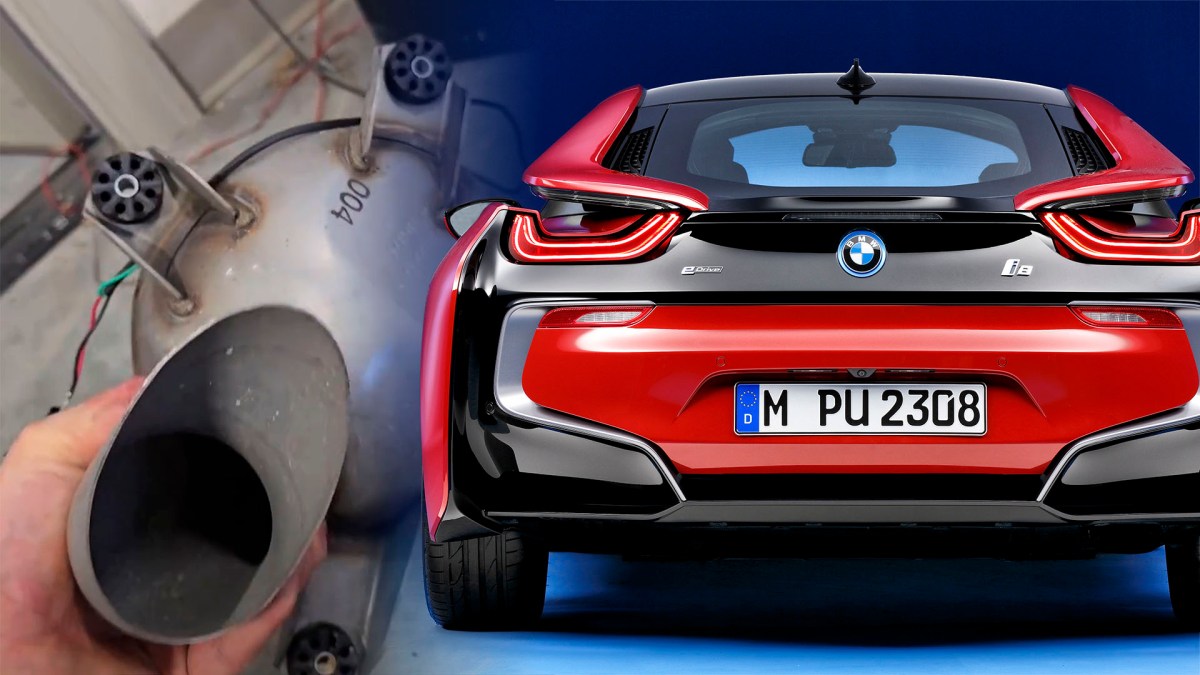
Synthetic sound enhancement has become common in modern performance cars and EVs. But most automakers pipe their augmented noise through the cabin speakers or use resonators in the intake tract. BMW went a step further with the i8 by building an entire external speaker disguised as a tailpipe, broadcasting fabricated engine sounds to pedestrians and anyone standing behind the car.
A Hagerty test measured it at 110 dB — louder than many actual sports cars at wide-open throttle.
Elam’s i8 won’t need the acoustic trickery much longer. He’s in the process of swapping a BMW B58 inline-six into the car’s front end, fitted with a Dynamic Autowerx turbo and targeting around 700 horsepower at the wheels. He says the number is conservative, given that his B58-powered drag-prepped 340xi already makes 1,000 hp.
The most telling detail in this story isn’t the speaker. It’s a message Elam received from a BMW engineer who helped develop the i8 in Germany. The engineer endorsed the B58 swap project and admitted his team had always hoped someone would eventually “install a proper engine” into the hybrid sports car.
That’s a quiet confession from the people who built the thing. The i8’s designers knew the powertrain was the weak link. They dressed up a genuinely innovative chassis in dramatic bodywork, gave it a carbon tub worthy of a McLaren, and then strapped in a motor that needed a fake exhaust pipe to sound like it belonged there.
Twelve years after its launch, the i8 remains one of the strangest production cars BMW ever made — a rolling contradiction that looked like the future but sounded like a Bluetooth speaker. Now Elam is giving it the engine its creators always wished they could have. The loudspeaker is going in the trash. The real noise is coming.


Share this Story