
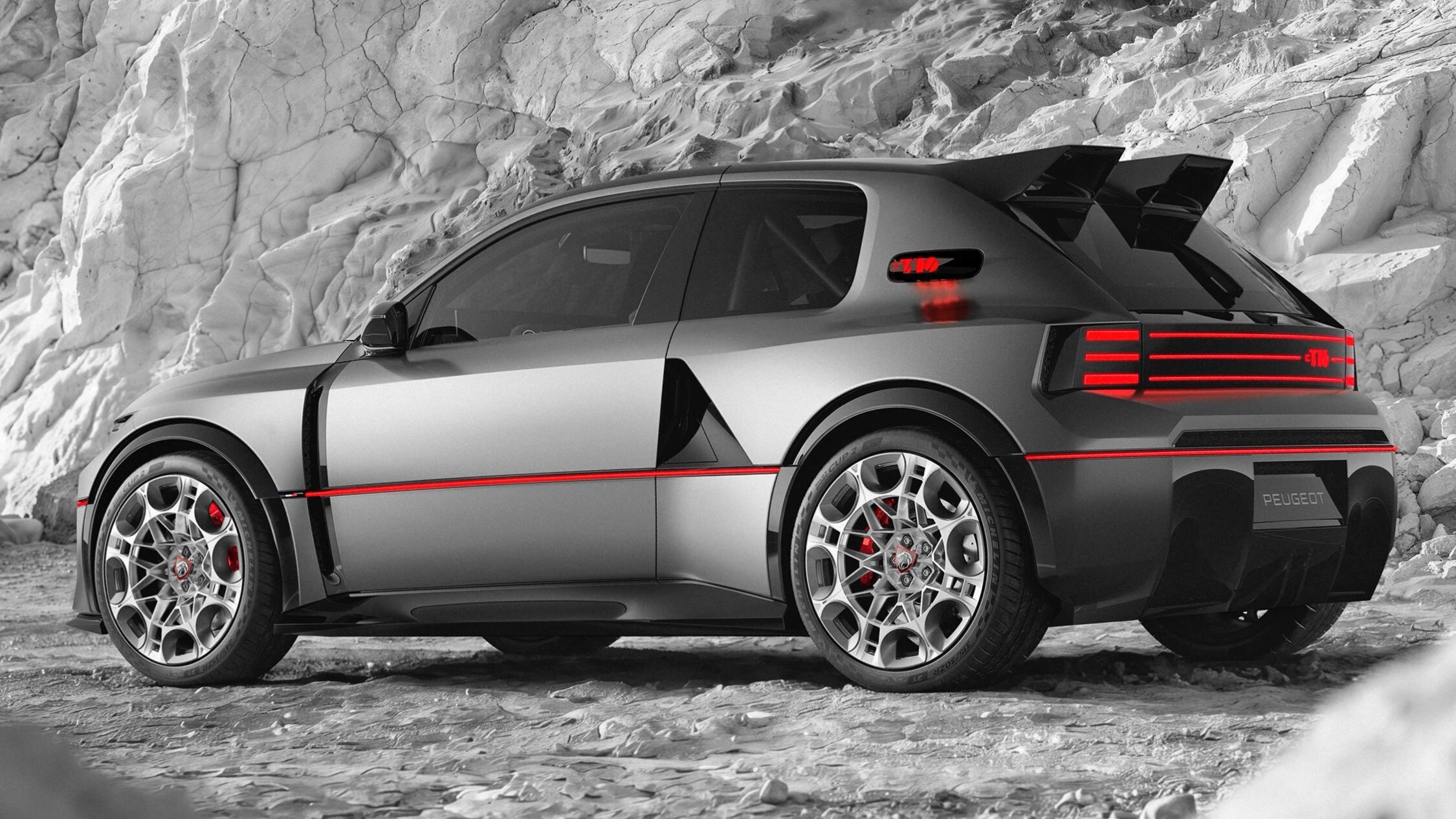


Peugeot just built the most powerful car in its 215-year history, and it looks like a rally weapon from 1985 that got zapped into the future. The E-T16 Concept packs 816 hp from three electric motors, hits 62 mph in 2.5 seconds, and reaches 186 mph in 16 seconds flat. The brand calls it a “Hyperhatch,” and when you see this thing, the word fits.
The concept marks the 40th anniversary of Peugeot’s back-to-back World Rally Championship victories with the 205 T16 in 1985 and 1986. That car remains the poster child for Group B, the era when rally regulations basically dared engineers to build the most terrifying machines possible. The E-T16 channels that same reckless energy, except the mid-mounted engine bay now houses batteries and electric motors instead of a screaming turbocharged four-cylinder.
One motor drives the front axle. Two drive the rear. Torque vectoring works across both axles, and there’s a vertically mounted hydraulic handbrake for hairpin theatrics.
Michelin rubber stretches 275 mm wide up front and 315 mm at the rear, wrapped around wheels stopped by 15-inch brake discs at every corner. Peugeot Sport clearly didn’t treat this as a styling exercise alone.
But the limits of electric performance still peek through the cracks. Peugeot boasts that a new battery cooling system, which extracts heat from the sides of the cells rather than the base, lets the E-T16 complete three consecutive laps of the Nürburgring Nordschleife without losing power. Three laps.
The original 205 T16 could run a full rally stage all day on fuel stops measured in seconds. That gap between combustion endurance and electric thermal management remains stubbornly wide, even on a concept with no cost constraints. The 85-kWh battery delivers up to 248 miles of WLTP range, which is respectable for a street car but would barely get you through a single competitive rally day.
Visually, the thing is unhinged in the best possible way. Widened fenders bulge over those massive tires. A rear wing that would make a DTM car blush sits above a rising rear clamshell that echoes the original T16’s engine cover.
Winchester Matte Grey paint and a red illuminated stripe running the car’s perimeter tie it back to the rally livery. A floating C-pillar channels air toward the rear diffuser, which features adjustable aerodynamic blades.
The cabin previews where Peugeot’s production interiors are heading, and that’s where things get tangible. A curved 21-inch panoramic display spans the dashboard, and the Hypersquare steering wheel connects to the front wheels through steer-by-wire. Both the display and the steer-by-wire system are confirmed for the next-generation E-208, expected in 2027.
That’s the real story buried inside this rally homage. Peugeot is using the E-T16 to telegraph its production intentions. The horizontal three-claw lighting signature, the steering tech, the interior architecture, all of it trickles down to the next E-208.
The hot hatch won’t get 816 hp or carbon bucket seats, but the DNA transfer is deliberate. Whether Peugeot has the nerve to build something closer to this concept as a limited-run halo car remains an open question. The brand has a habit of teasing wild ideas and then retreating to sensible superminis.
The 205 GTI became a legend because Peugeot actually had the guts to sell it. The E-T16 only matters if some version of it reaches a showroom floor. Peugeot Sport is calling this the birth of a new category, but categories don’t survive on concepts alone.

Share this Story