
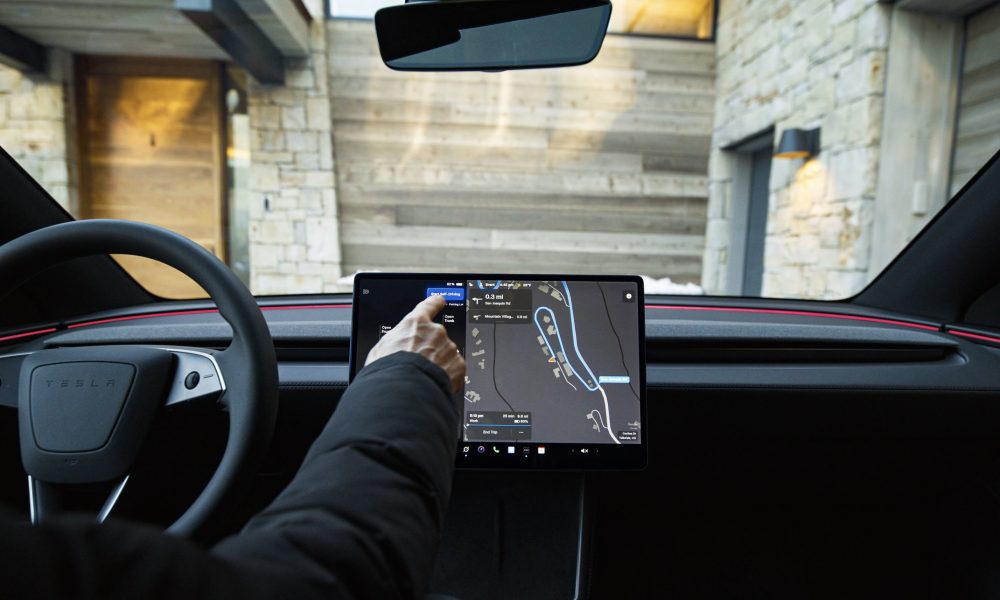


Elon Musk posted on X today that Teslas will begin remembering individual driver interventions and adapting to personal preferences. The statement, made in reply to Tesla influencer Whole Mars Catalog, who complained his car sometimes ignores his own settings, was characteristically brief: “The car will start to remember your specific interventions and match each person’s individual preferences.”
It sounds like a small thing. It isn’t.
The vast majority of Full Self-Driving interventions have nothing to do with safety-critical failures. Drivers take over because the car parks where they don’t want it to park, lingers in the left lane like a tourist, or picks routes they’d never choose themselves. These are annoyances, not emergencies, but they still count as interventions — the single metric standing between Tesla and the regulatory argument for unsupervised autonomy.
Musk laid the groundwork for this earlier in July when he said parking was “by far” the top reason drivers intervene with FSD. If Tesla can train its system to remember that a specific driver always pulls into the far corner of a parking lot, or never wants to take the highway through downtown, the intervention count drops without a single line of safety-critical code changing.
There’s anecdotal evidence the cars may already be doing some version of this. Teslarati’s own testing of FSD at “Except Right Turn” stop signs in Pennsylvania showed the system handling one frequently traveled intersection with confidence while stumbling at less familiar ones. That’s not preference learning per se, but it suggests the neural network is already weighting repeated exposure.
The distinction between a car that drives safely and a car that drives the way you want it to is enormous. Every human driver on the road operates on personal preference — lane position, following distance, route choice, parking habits — and does so without incident millions of times a day. An autonomous system that ignores those preferences will always feel like a rental car driven by a stranger, no matter how technically competent it becomes.
Tesla’s approach here would use its existing neural network infrastructure, which already aggregates fleet-wide driving data, and layer individual behavioral profiles on top. The company has the hardware advantage: cameras and onboard compute in every vehicle, plus driver profiles already tied to phone keys and seat positions. Connecting intervention patterns to those profiles is architecturally straightforward, even if the execution is anything but.
The timing matters. Tesla has been pushing hard on the narrative that FSD is closing in on true unsupervised capability, with analysts calling it the company’s potential “iPhone moment.” Reducing interventions by learning preferences is a faster path to impressive numbers than solving every remaining edge case in the driving stack. It’s clever engineering, and it’s also clever PR.
There’s a tension here that Tesla hasn’t addressed. Preference learning requires storing granular data about individual driving behavior — where you go, how you react, what you override. Tesla has faced scrutiny over cabin camera data and vehicle telemetry before. A system that builds a behavioral profile of every driver raises privacy questions that a blanket fleet-learning model does not.
Musk offered no timeline, no software version number, no technical detail. That’s par for the course. But the concept itself represents a genuine strategic shift: instead of only making the car drive better in absolute terms, make it drive better for you specifically. It’s the difference between a competent chauffeur and one who knows you never take the freeway on Sundays.
Whether Tesla can deliver on this before the competition catches up to its current FSD capabilities is the real question. Waymo doesn’t need to learn your preferences because it doesn’t have a driver to intervene. Tesla’s entire supervised-to-unsupervised pipeline depends on driving that intervention count to zero. Personalization might be the fastest lever they have left to pull.
Share this Story