
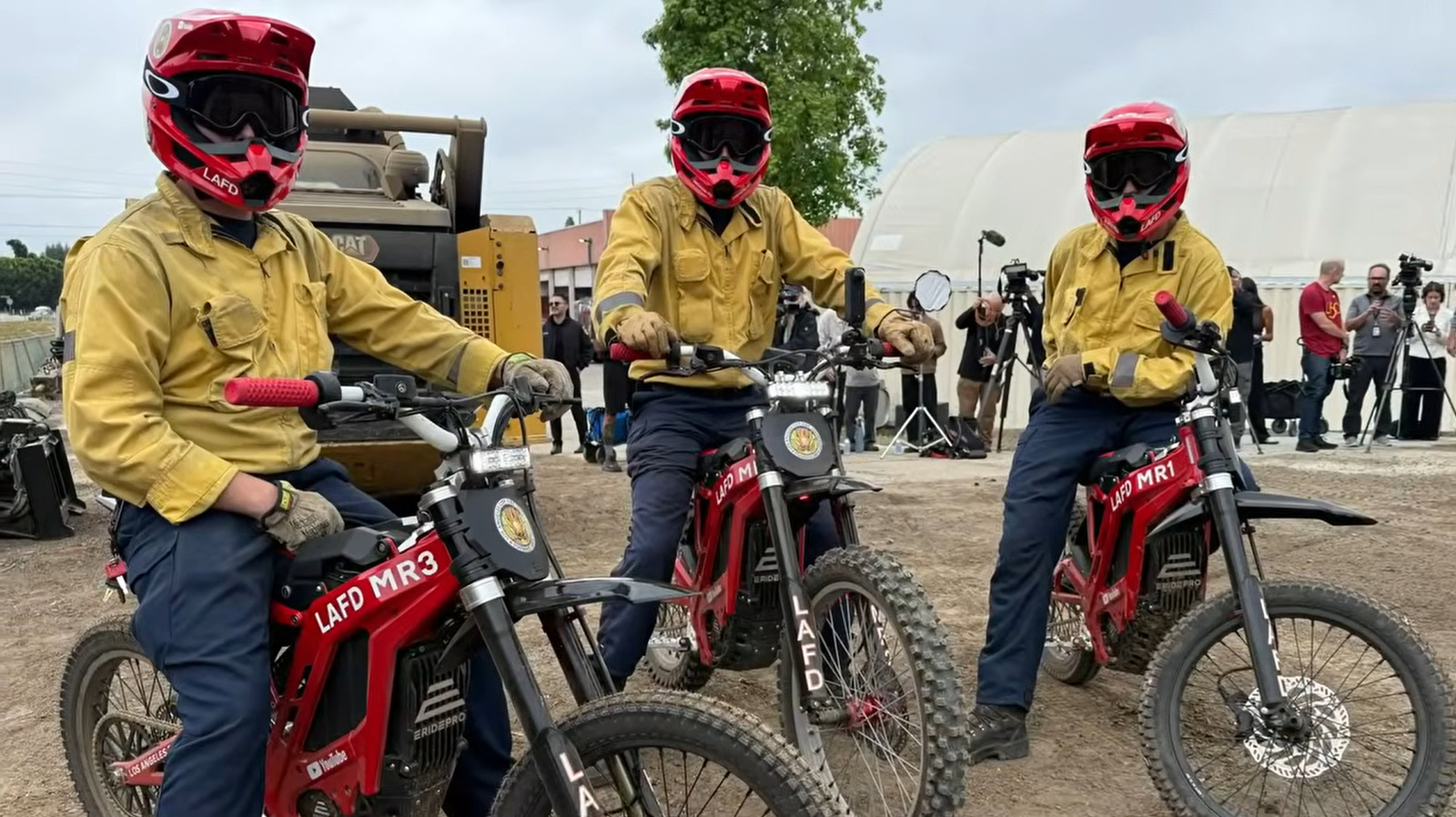


Thirty electric motorcycles just joined the Los Angeles Fire Department fleet, donated by Google and YouTube, and they tell you everything you need to know about the state of emergency response in America’s second-largest city.
The bikes are ERidePro units. No hoses, no ladders, no water tanks. Just a firefighter, a partner, and basic medical equipment.
LAFD Chief Jamie Moore was blunt about it: “These aren’t patrol bikes, they are mobile medical units assigned to our disaster response section and fully integrated into our dispatch and command system.”
In other words, the city’s fire department has acknowledged that its traditional apparatus — the big rigs, the ladder trucks, the ambulances — simply cannot get where they need to go fast enough. Not through LA’s grinding, soul-crushing traffic. So now firefighters will lane-split on electric dirt bikes to reach you first.
California law allows motorcycles to split lanes, which means these two-person teams can thread through gridlocked boulevards that would swallow a conventional engine company whole. Each unit functions as a compact medical response crew. Arrive first, assess the patient, stabilize, coordinate, and call in the cavalry.
But traffic isn’t the only reason Google and YouTube wrote the check. These ERidePro machines handle unpaved roads and rough terrain, which makes them tailor-made for wildfire response and search-and-rescue operations in the hills and canyons ringing the LA basin. After the devastating wildfires that have repeatedly tested the region’s emergency infrastructure, having lightweight, quiet, zero-emission bikes that can penetrate areas inaccessible to heavy apparatus is more than a nice-to-have.
The donation itself raises an eyebrow. Google and YouTube are effectively subsidizing municipal emergency services. That a tech giant is buying fire department equipment says something about both corporate PR strategy and the gap between what cities need and what their budgets provide.
LAFD isn’t the first department to experiment with motorcycles for rapid response. Fire departments in Europe and parts of Asia have deployed them for years. But the scale here — 30 units at once — is notable for a U.S. department, and the electric drivetrain is a deliberate choice.
No exhaust in wildfire zones where air quality is already lethal. No engine noise drowning out communication in chaotic disaster scenes. Lower maintenance costs over the long haul.
The deeper story is the one nobody in an official capacity wants to say out loud. Los Angeles built itself around the car, paved over its streetcar network, and engineered a metropolis where a fire truck can sit trapped on the 405 while someone is having a cardiac arrest three miles away. The motorcycles are a workaround, not a fix.
They are an admission that the infrastructure itself is the obstacle.
Still, pragmatism beats ideology every time. If a firefighter on an electric bike reaches a stroke victim four minutes faster than an ambulance stuck behind a FedEx truck double-parked on Wilshire, that’s a life potentially saved. The LAFD will deploy these bikes across the city, and the real test will come during the next major wildfire season or the next 7.0 earthquake, when every minute of response time is measured in casualties.
LA didn’t solve its traffic problem. It just found a way to ride around it.
Share this Story