
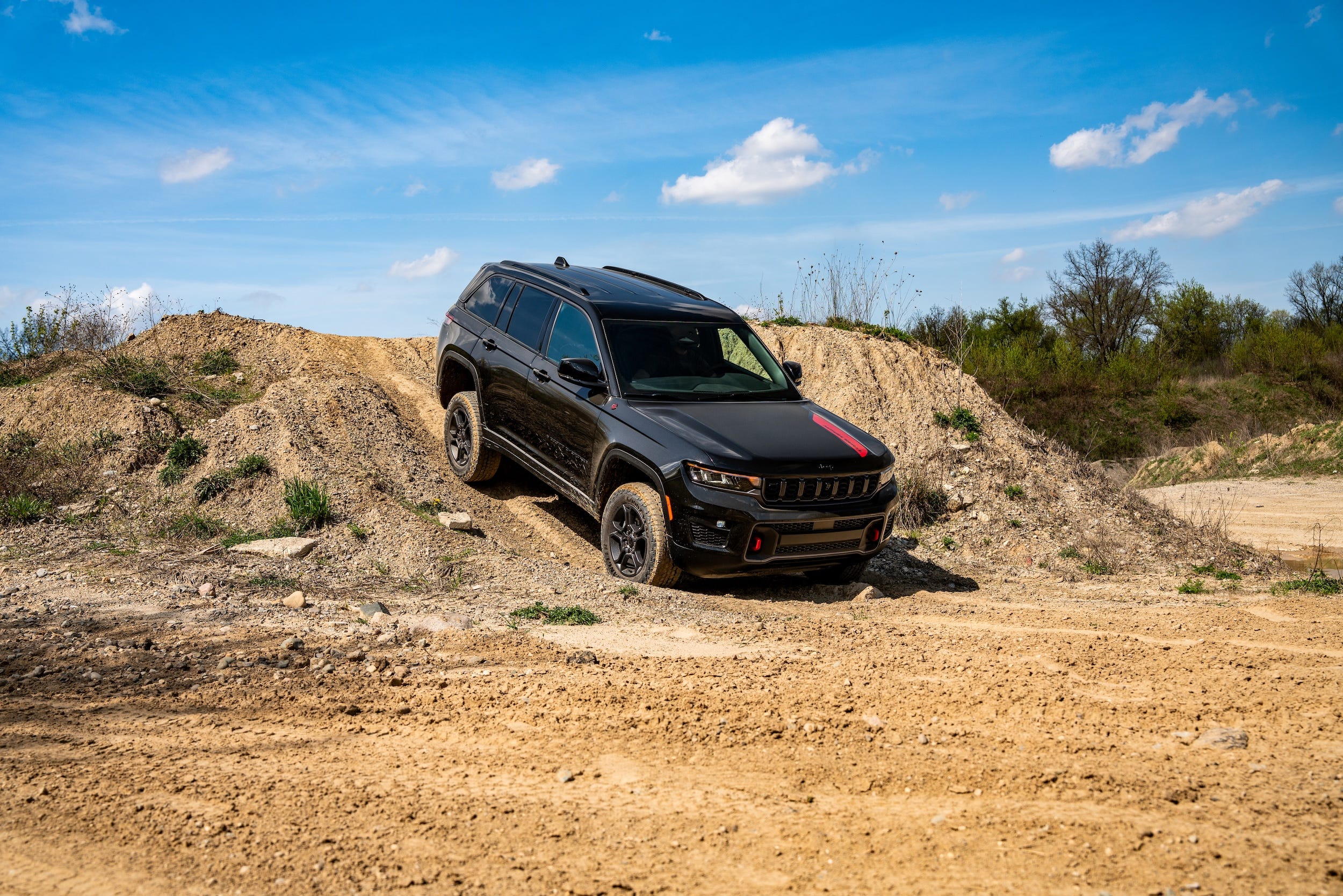


Stellantis killed every plug-in hybrid it sells in January. Five months later, the Jeep Grand Cherokee Trailhawk is back from the dead — reborn with a turbocharged four-cylinder and no electrical cord in sight.
The 2027 Grand Cherokee Trailhawk and Overland trims, both absent from the 2026 lineup, will return to dealerships later this year powered by the Hurricane 4, a turbocharged 2.0-liter four-cylinder making 324 horsepower and 332 pound-feet of torque. That is the same engine now spread across the entire Grand Cherokee range. It marks a sharp philosophical pivot for what was once the brand’s flagship PHEV off-roader.
When Jeep unveiled the refreshed Grand Cherokee last fall, the Trailhawk was supposed to remain exclusively paired with the 4xe plug-in-hybrid powertrain. That plan lasted roughly three months. Stellantis pulled the plug on all its PHEVs in early 2025, and the Trailhawk vanished along with them.
Now it returns stripped of any electrification pretense, running purely on premium unleaded and an eight-speed automatic.
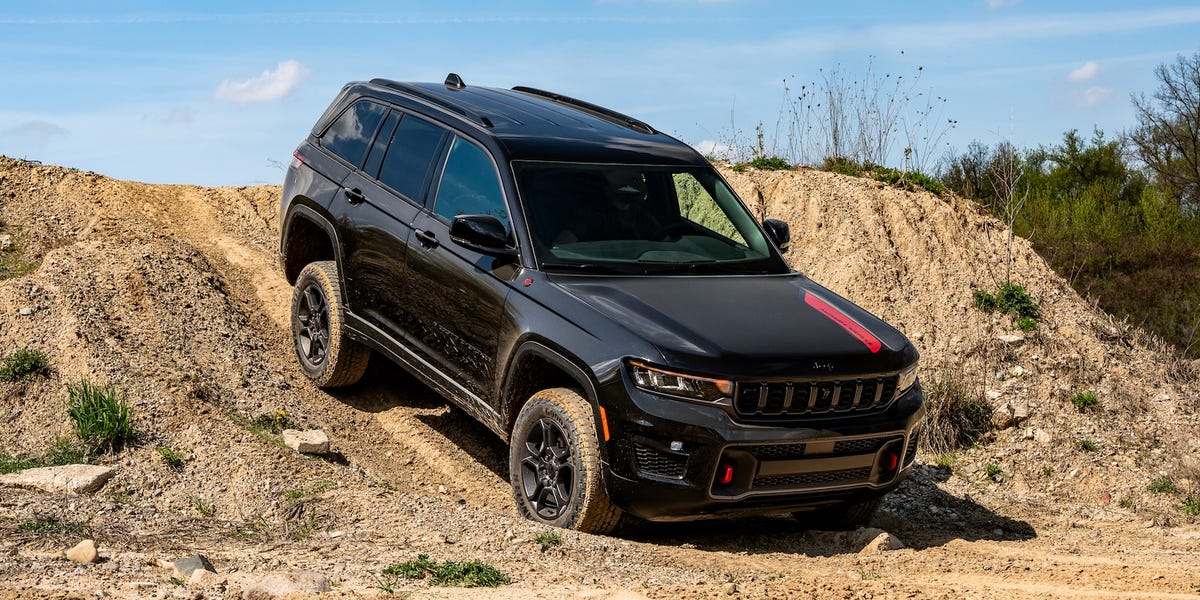
The Trailhawk still looks the part of a serious trail rig. It packs the Quadra-Trac II four-wheel-drive system with a two-speed transfer case, Quadra-Lift air suspension, an electronic limited-slip rear differential, and six steel skid plates protecting the engine, transmission, transfer case, fuel tank, and suspension. Ground clearance sits at 11.4 inches, with a 36-degree approach angle and 30-degree departure angle.
Goodyear Territory all-terrain tires in a 31-inch-tall size wrap 18-inch Granite Crystal wheels. Red tow hooks punctuate the revised front bumper, and a matte black hood graphic cuts glare. Inside, black nappa leather gets red stitching, and towing capacity hits 6,200 pounds with the standard Trailer Tow package.
The Overland returns as the Grand Cherokee’s luxury-meets-dirt option. It shares the Trailhawk’s air suspension and Quadra-Trac II hardware but trades the aggressive aesthetics for chrome tow hooks and polished 21-inch wheels. The cabin gets nappa leather with embossed “Overland” branding on the seatbacks, plus heated and ventilated seats. Hill-descent control is standard.
Both trims drink from the same Hurricane 4 well, and that is the real story here. The Trailhawk once justified its premium partly through its plug-in hybrid hardware — the electric torque, the silent low-speed crawling, the theoretical efficiency gains. All of that is gone.
Jeep expects the Trailhawk to land somewhere around $50,000, a meaningful drop from its PHEV predecessor, while the Overland should come in just north of $60,000. Pricing will be confirmed before the trucks hit lots later this year.
The Trailhawk nameplate first appeared in 2013, and for over a decade it has represented Jeep’s most trail-capable factory Grand Cherokee. That mission continues, but the means have changed dramatically. A 324-hp turbo four is a capable engine, but it is a long way from the torque-rich instant shove of an electric motor mated to a gas engine.
Stellantis clearly decided the PHEV math no longer worked — not for the Trailhawk, not for any of its vehicles. The company scrapped the entire 4xe program rather than carry the cost. So the Grand Cherokee Trailhawk soldiers on, doing what Jeeps have always done: adapting to survive, even if the adaptation means going backward to move forward.

Share this Story