
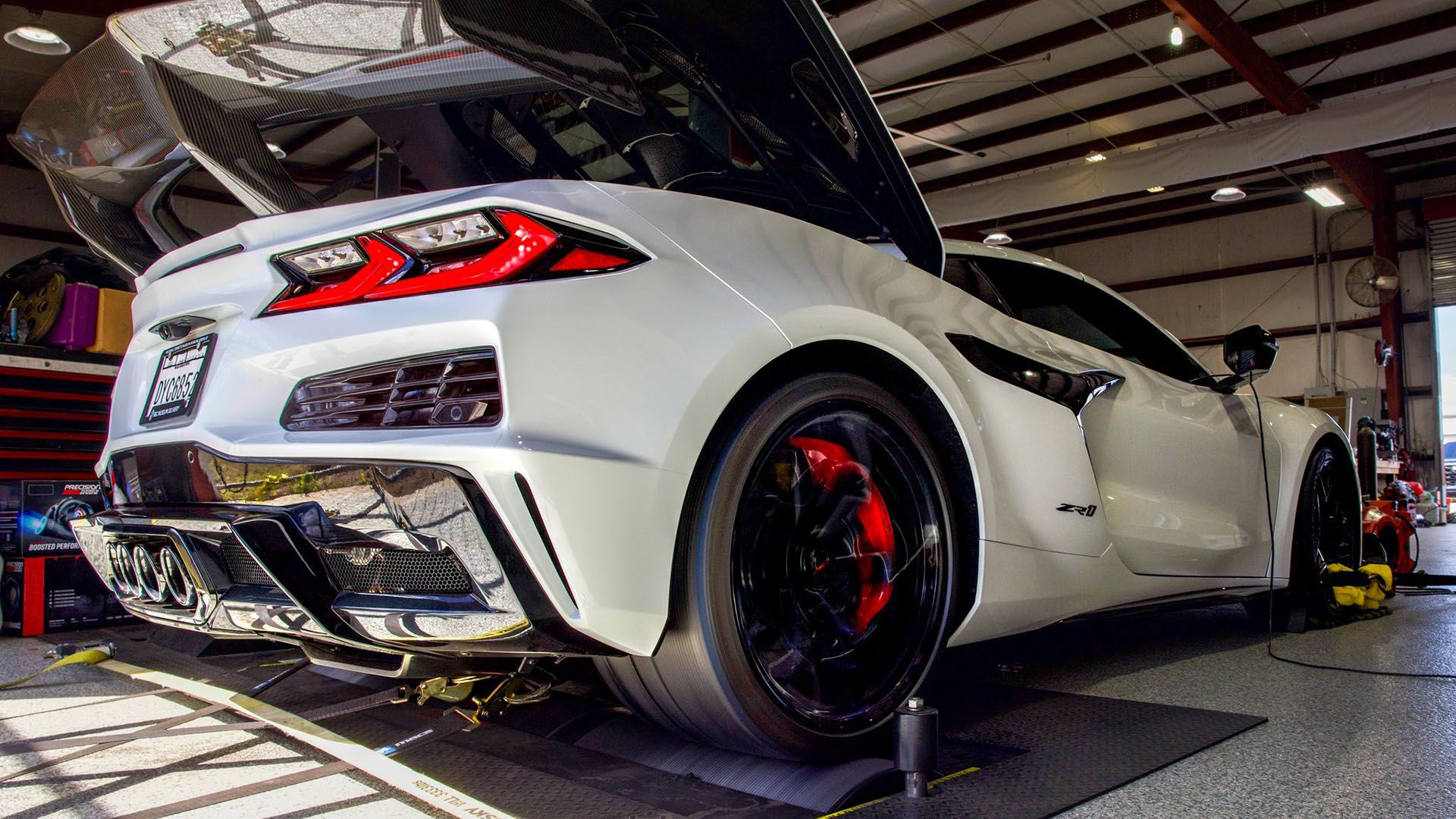


The Corvette ZR1 already makes 1,064 horsepower from its twin-turbocharged, flat-plane-crank 5.5-liter V8. For most sane humans, that should be enough. But the aftermarket doesn’t deal in sanity, and HP Tuners has now cracked the ECM on Chevrolet’s hyper-Vette, opening the floodgates for serious power gains.
Matt Sanford of HP Tuners dropped the news in a lengthy Facebook post, detailing the company’s weeks of testing on its own ZR1. The headline number is tantalizing: up to 25 percent more power with the right fuel. That puts the LT7 somewhere in the neighborhood of 1,330 horsepower, no hybrid assist required, no electric motors, no all-wheel drive.
Just a twin-turbo V8 doing ungodly things on race gas.
For owners who want to keep things more conservative, Sanford says a safe tune can unlock roughly 15 percent more power through the midrange and 10 percent at peak. That still translates to an extra 106 horses at the top end. On HP Tuners’ own dyno with their play-it-safe calibration, the ZR1 put down 1,180 horsepower and 1,094 pound-feet of torque at the wheels.
Stock ZR1s have been showing around 1,030 wheel horsepower and 840 pound-feet. That’s a massive jump for what amounts to minimal hardware changes and a software reflash.

But here’s where Sanford’s enthusiasm gives way to stern warning. He wants everyone to understand, in no uncertain terms, that the ZR1 is not your typical GM tuning project. The dual-clutch transmission, the combination of port and direct injection, and what he describes as complicated “airflow logic” all make this engine a different animal.
The factory limit for turbo shaft speed sits at 137,000 rpm, with the turbos typically spinning between 130,000 and 133,000 rpm at peak. Sanford says he wouldn’t push them past 142,000, and even then only in short bursts. Spin them harder and you’re gambling with catastrophic failure.
His warning to tuners who think they can approach the LT7 like any other boosted GM engine is blunt. Dialing up the limiters and scaling the torque model the way you normally would “WILL make enough bottom end power to destroy the engine, clutches, etc.” That emphasis on “will” is his, and he clearly means it.
HP Tuners can also work with the naturally aspirated LT6 in the Z06, though Sanford didn’t share specific power figures. Without turbochargers in the equation, the Z06 tune should be less fraught with catastrophic risk, though the gains will naturally be more modest.
For ZR1 owners chasing the biggest possible numbers, Sanford suggests swapping in port fuel injectors with more flow capacity to support additional fueling. Reading between the lines, the LT7 with larger turbochargers could become something truly terrifying. But anyone going down that road should budget for a new dual-clutch transmission and upgraded clutches, because the stock hardware has its own limits.
This is the inevitable trajectory of every performance car. Manufacturer builds something extraordinary, and the aftermarket immediately asks, “But what if we did more?” The ZR1 was already the most powerful Corvette ever produced, a car that needed no additional horsepower to embarrass exotic machinery costing three times as much.
Yet here we are, staring down the barrel of 1,300-plus-horsepower Corvettes running around on public roads with nothing more than a tune and some race fuel. The responsible thing to do would be to enjoy the stock car’s 1,064 horsepower, keep the warranty intact, and appreciate the engineering marvel GM built.
Nobody buying a ZR1 is going to do the responsible thing. And honestly, that’s the whole point.

Share this Story