
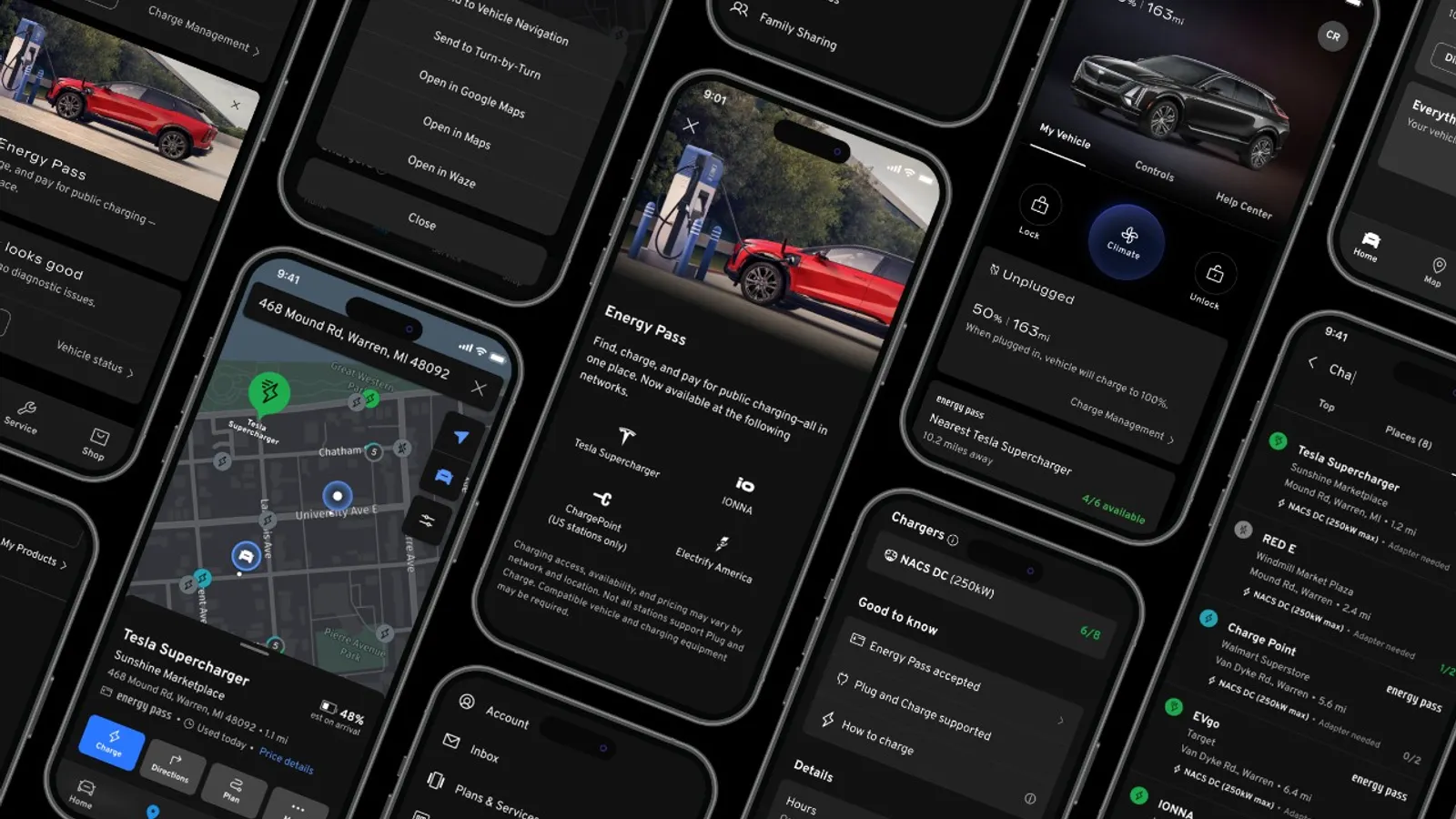


General Motors just launched Energy Pass, a single digital platform that lets its EV customers find, start, and pay for public charging sessions across multiple networks without juggling a half-dozen competing apps. It sounds simple. That’s because it should have been simple from the start.
Integrated into the MyChevrolet, MyCadillac, and MyGMC companion apps, Energy Pass replaces GM’s earlier Ultium Charge 360 platform, which debuted in 2021 and never quite delivered on its promise of frictionless public charging. The new system launches with access to Tesla Superchargers, Ionna stations, and Electrify America chargers, with ChargePoint and EVgo coming soon. GM says the combined footprint will cover nearly 70 percent of all DC fast chargers in the U.S., plus a healthy slice of Level 2 units.
The real play here is Plug & Charge. At compatible stations, drivers plug in and walk away. No credit card, no phone, no QR code fumbling in a parking lot at 11 p.m.
The system authenticates the vehicle automatically and bills the account. GM plans to extend Plug & Charge to ChargePoint this summer and to Tesla Superchargers later this year, once its 2027 models ship with native NACS charge ports.
That NACS timeline matters. GM expects every new 2027 model year EV to carry a North American Charging Standard port by December, completing the industry’s migration away from CCS. When those vehicles roll into Tesla Supercharger stalls and authenticate without an adapter or a separate Tesla app, the charging experience starts to resemble something gas-car drivers have taken for granted for a century: pull up, fill up, leave.
Public EV charging in America remains a patchwork. ChargePoint, EVgo, Electrify America, Tesla, Ionna, and a growing list of smaller operators each run their own networks, their own apps, their own payment systems. For early adopters willing to tolerate the friction, it was manageable. For the mass-market buyers GM needs to move metal, it’s a dealbreaker.
Ionna, the eight-automaker charging joint venture launched in July 2023, was supposed to address part of this problem by building high-quality stations purpose-built for the consortium’s customers. But building stations takes years. Energy Pass attacks the same problem from the software side, layering a unified experience over infrastructure that already exists.
GM wrapped the announcement in the kind of language automakers love, calling Energy Pass “one more step toward making public charging feel less like a workaround and more like a seamless part of your life.” Strip the polish and the message is an admission. Public charging has felt like a workaround. For years.
The platform also consolidates live charging status, session history, and payment receipts, and dangles exclusive discounts from select networks. GM promises ongoing updates with more networks, app improvements, and additional perks.
None of this is revolutionary technology. Aggregator apps and roaming agreements have existed in Europe for years. What’s notable is that GM, the largest domestic automaker, is finally treating software integration as a core ownership proposition rather than an afterthought bolted onto a vehicle sale.
Whether Energy Pass actually smooths the path for skeptical buyers depends on execution, from uptime reliability to payment accuracy to network expansion pace. The pitch is elegant. The charging network it sits atop is still messy, unevenly maintained, and growing slower than the cars that need it.
One clean app won’t fix broken chargers. But it removes one more excuse not to buy the car.
Share this Story