
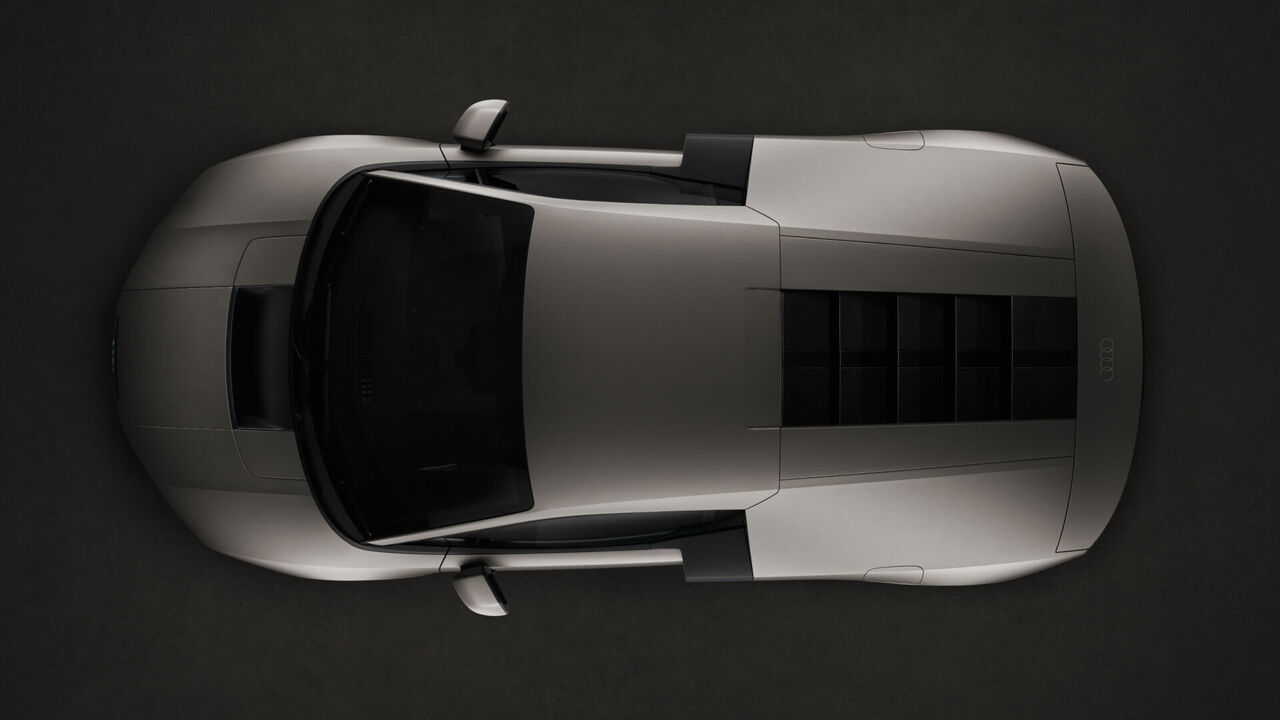


Audi just dropped a supercar nobody saw coming, and it has a V8, not a battery pack, at its heart. The Nuvolari, revealed Wednesday from Antibes, packs 1,001 PS from a hybrid powertrain built around a 4.0-liter twin-turbo V8 that screams to 10,000 rpm. It hits 100 km/h in 2.6 seconds, clears 200 in 6.8, and tops 350 km/h.
Limited to 499 units, deliveries start in the first half of 2027. This is Audi’s first supercar, and the timing says everything about where the brand’s head is at.
Two years ago, Audi killed the R8. The electric future was supposedly non-negotiable. Now the company is launching a mid-engine hybrid monster wrapped in carbon fiber and painted in the same Titanium hue as its Formula 1 car.
The pivot is loud, deliberate, and dripping with combustion-age ambition.
The powertrain architecture is genuinely unusual. That V8 sits amidships producing 800 hp on its own. Three axial flux electric motors — two at the front axle, one sandwiched between the engine and gearbox — add another 330 kW combined.
The front motors alone generate up to 2,150 Nm of torque, handling variable torque vectoring duties that Audi calls “quattro predictive ride.” The lithium-ion battery is a modest 7.3 kWh, enough for short electric-only stints but clearly not the point.
The point is lap times. Audi has borrowed heavily from its young F1 program to chase them.
The carbon exterior is a first for Audi production cars. Every panel is CFRP, built using prepreg autoclave technology and hand-laid — the same process used for F1 monocoques. Forged center-lock wheels debut in the production lineup.
The adaptive rear wing operates across three configurations and includes a manual DRS button on the steering wheel, lifted straight from grand prix racing. In high-downforce trim, the aero package generates over 400 kg of downforce.
CTO Rouven Mohr was blunt about the connection: “Formula 1 is a key impulse to bring innovations to the road quickly and with precision.” Audi’s F1 drivers apparently provided direct feedback during aerodynamic development.
The braking hardware underscores how seriously Audi is targeting track credibility. New “Audi Ceramic Pro” discs use long-fiber carbon derived from F1, paired with ten-piston front calipers biting 420 mm rotors. The system absorbs up to 2.8 megawatts of energy — a figure Audi claims matches a current F1 car.
A brake-by-wire system blends hydraulic and regenerative braking, with electric deceleration alone handling up to 0.3 g. The interior is stripped to essentials. Displays and physical controls cluster around the driver, with color accents referencing the Auto Union Type C from the 1930s — Audi reaching deep into the pre-war speed record era for emotional resonance.
What sits underneath all the engineering bravado is a strategic calculation. Audi enters F1 in 2026 with no racing pedigree to speak of in open-wheel competition. The Nuvolari gives that investment a consumer-facing halo before the team has turned a competitive lap.
It also repositions the brand against Ferrari, McLaren, and Mercedes-AMG at precisely the moment those competitors are wrestling with their own electrification timelines. The preliminary emissions numbers — 270 g/km combined, CO2 class G — confirm this is not a green-tech showcase.
It is a performance statement wrapped in a hybrid justification, built to sell 499 units to collectors who want the next era of Ingolstadt engineering on their walls and in their garages. Audi killed the R8 saying the future was electric. The Nuvolari says the future is complicated — and very, very fast.


Share this Story