
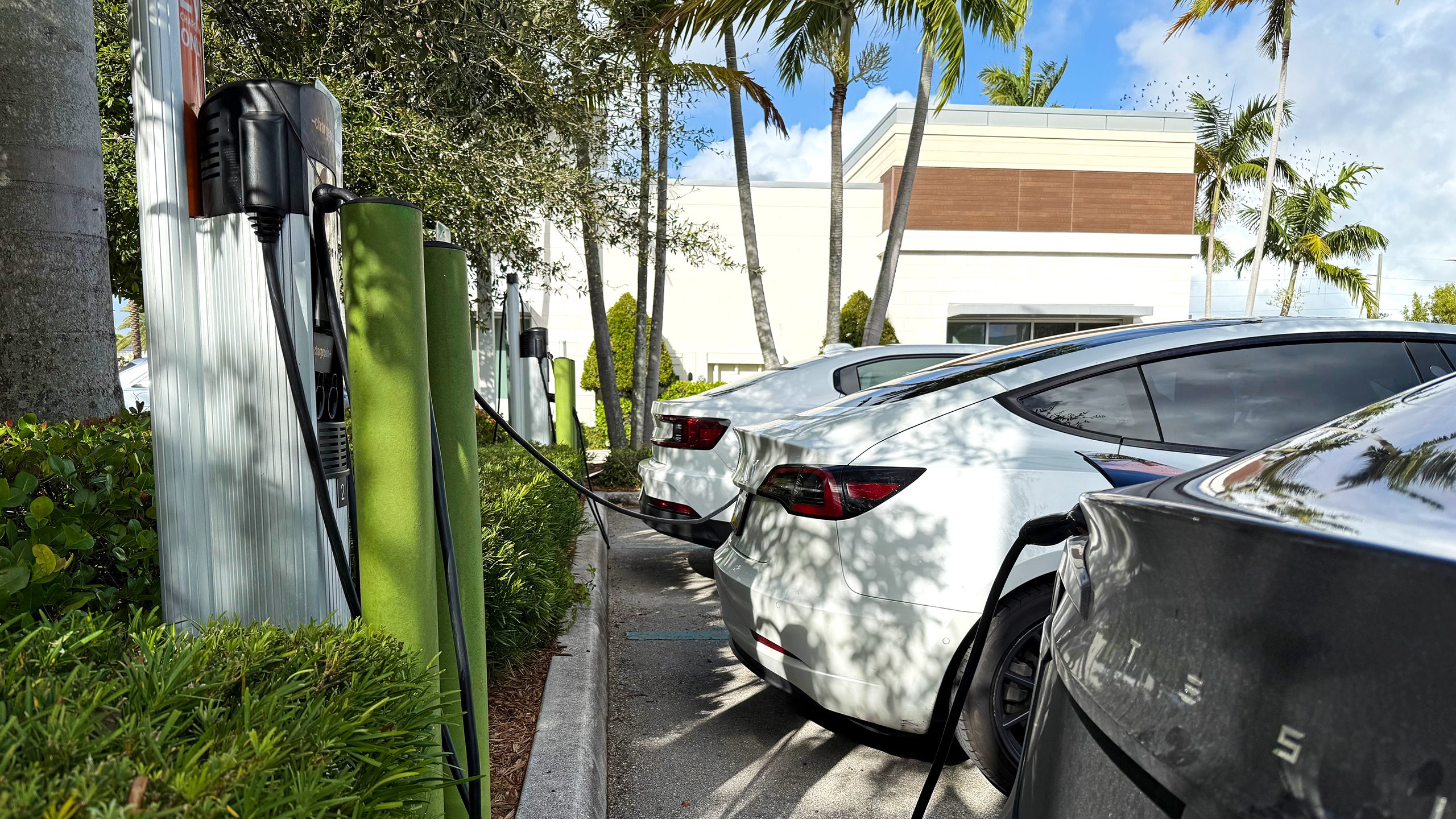


Florida has 200 million reasons to raise eyebrows. The state is redirecting its entire federal allocation for electric vehicle charging infrastructure toward building an “aerial highway network” of eVTOL flying taxis, according to documents obtained by the Miami Herald.
“The Florida Department of Transportation will not waste taxpayer dollars and spend it on everyday passenger vehicles,” the state’s planning document reads. Instead, it proposes what it calls “an innovative and strategic approach” supporting a “new emerging mode of transportation.”
The irony is thick enough to cut. Florida claims the second-highest number of registered EVs in the country, yet it still falls short of the nationwide average for chargers per vehicle. The state’s answer to that gap is not to close it, but to abandon the effort entirely and bet on aircraft that barely exist commercially.
Those federal dollars were part of the National Electric Vehicle Infrastructure program, designed specifically to ensure Americans can charge EVs along major travel corridors. Florida is now attempting to repurpose them for a technology that has yet to prove it can operate at scale, let alone serve as a practical transportation network.
Flying taxi companies have been making promises for years. Certification timelines slip, production targets shrink, and passenger volumes remain theoretical. Yet Florida sees this as a safer bet than chargers, which are proven technology with documented demand from hundreds of thousands of EV owners already driving on the state’s roads.
The move also arrives in a political climate where EV skepticism has become a reliable applause line. Framing charger funding as “waste” while championing futuristic air taxis threads a peculiar needle: it rejects the electrification of cars while embracing the electrification of aircraft. The eVTOLs Florida wants to fund are, after all, battery-electric machines themselves.
Whether the federal government will allow this reallocation is another question entirely. NEVI funds come with strings attached, and the program was authorized under the 2021 infrastructure law with explicit goals tied to EV charging. Redirecting the money toward a completely different transportation mode could face legal and regulatory challenges that Florida’s documents do not appear to address.
For the EV owners already navigating Florida’s charging deserts, particularly along less-traveled routes outside the I-95 and I-4 corridors, the practical effect is simple. Relief is not coming. The state has decided their needs rank below those of a transportation mode most Floridians have never seen, let alone used.
Ram truck owners, meanwhile, have their own problems. Stellantis is recalling 1.27 million Ram 1500 pickups in the U.S. and another 156,000 in Canada over second-row seat belt anchors that may never have been properly attached to the body structure. The recall covers every model year back to 2019.
Ford is also back with another backup camera recall, this time covering 2021-2023 F-150s and 2023-2026 F-250 Super Duty trucks, nearly 48,000 units total. Glitchy infotainment software is preventing the camera feed from displaying when drivers shift into reverse.
In a quieter but potentially consequential development, Alfa Romeo’s next-generation Stelvio SUV has reportedly been pushed to 2028 after the brand shifted its powertrain strategy from pure electric to a multi-propulsion approach. A brand that desperately needs fresh product just told its shrinking customer base to wait three more years.
Florida’s flying taxi gamble may or may not pan out. But every day those 200 million dollars sit unspent on chargers, the state’s actual EV owners are left circling parking lots, watching their battery gauges drop.




Share this Story