
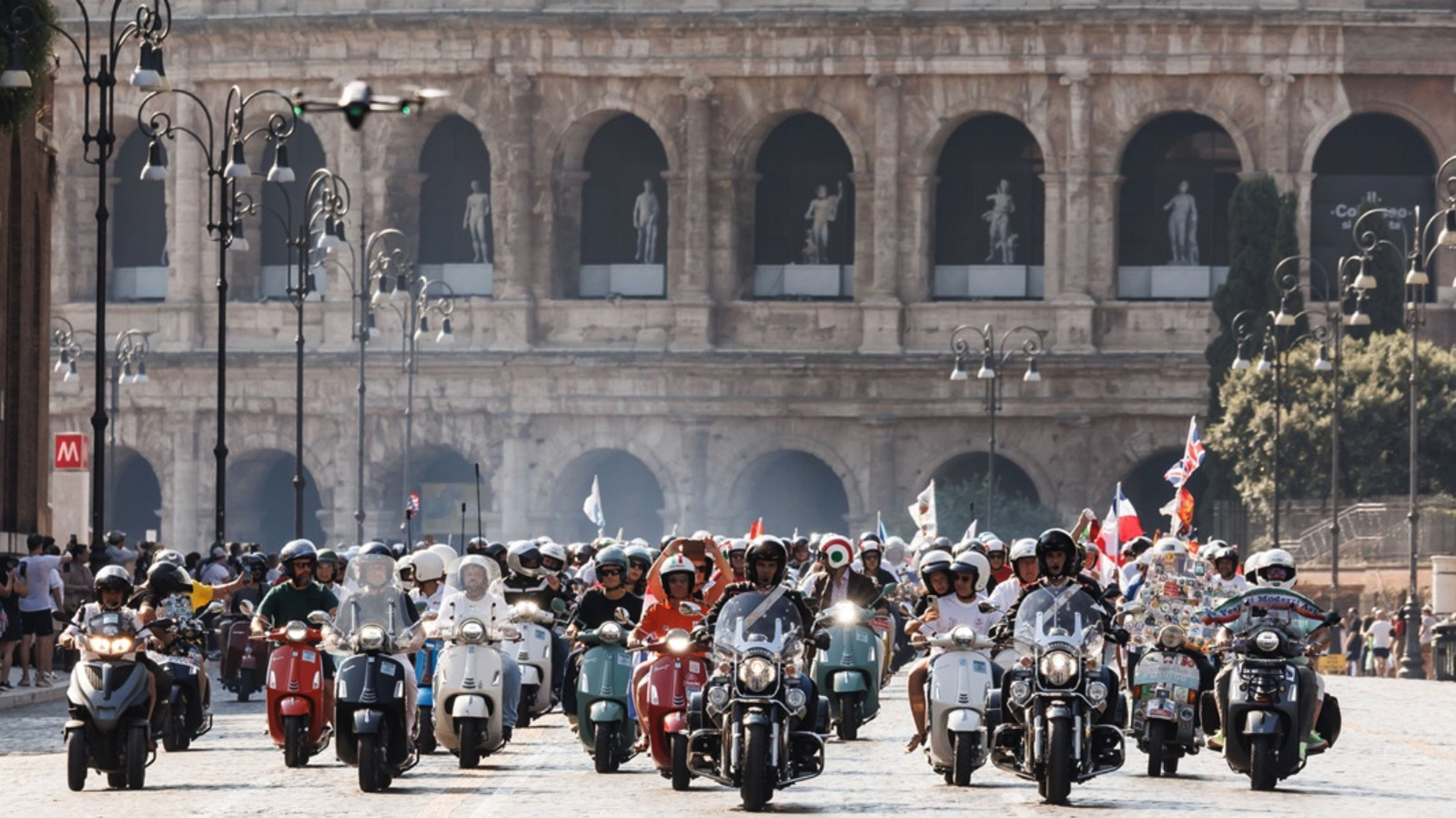


Twenty-five thousand Vespa owners from 67 countries descended on Rome this week, threading their scooters past the Colosseum, through Piazza Venezia, and along the Fori Imperiali in a rolling tribute to the machine that put postwar Italy on two wheels. Some riders brought along priceless Vespa 98s, the original 1946 production model with its tiny 98cc two-stroke single. They threaded irreplaceable hardware through Roman traffic with more guts than good sense.
The four-day celebration at “Vespa Village” in Foro Italico drew more than 50,000 visitors total, with music, street food, and an exhibition spanning 160 distinct models produced across eight decades. Piaggio Group, which still builds every Vespa, orchestrated the whole thing as a coronation for a brand that has moved 19 million units worldwide since a bombed-out aircraft factory forced the company to rethink everything it made.
That origin story still carries weight. Piaggio had been building planes when Allied bombs flattened its Pontedera plant during World War II. With no factory and no aviation market, the company pivoted to the cheapest possible form of personal transportation.
Engineer Corradino D’Ascanio, an aeronautics man who reportedly hated motorcycles, designed the MP6 prototype with its step-through frame and enclosed engine. Company founder Enrico Piaggio supposedly looked at it and said, “Sembra una vespa” — it looks like a wasp. The name stuck.
The Vespa 98 hit Italian streets in 1946 and sold modestly at first. Then it exploded. A 1950s press account described downtown Rome’s soundscape as rivaling the Indianapolis 500, thanks to the “staccato exhaust racket” of thousands of two-strokes bouncing off ancient stone.
The article warned visitors to “look four ways at once at street crossings.” Anyone who has tried to cross Via del Corso on foot knows that advice hasn’t aged a day.
What changed was the noise, not the chaos. Vespa eventually swapped its screaming two-strokes for cleaner, quieter four-stroke engines, and modern models now include electric variants. But the silhouette — that monocoque steel body, the single-sided front suspension, the spare tire mounted on the back like a fashion accessory — has barely shifted in 80 years.
It is one of the few vehicle designs recognizable to people who have never ridden one, thanks in no small part to Audrey Hepburn and Gregory Peck careening through Rome in 1953’s “Roman Holiday.”
The Rome rally deliberately echoed that cinematic route, a shrewd bit of brand mythology that Piaggio has polished to a shine. Few manufacturers can claim a product that doubles as a cultural symbol across continents. The Vespa is transportation in Naples, a lifestyle accessory in London, a vintage collector’s obsession in Tokyo, and a hipster signifier in Brooklyn.
It has outlasted the Lambretta, outcharmed the Honda Super Cub in Western markets, and survived every cycle of scooter trend and scooter indifference.
Eighty years is a long run for any vehicle nameplate. It is an extraordinary run for one that started as a desperate improvisation in a bombed-out factory. That 25,000 people flew in from 67 countries to ride through Roman traffic — voluntarily — says something about what Piaggio built.
Not just a scooter. A thing people actually love. The auto industry spends billions trying to manufacture that kind of loyalty. Piaggio stumbled into it with a wasp.
Share this Story