
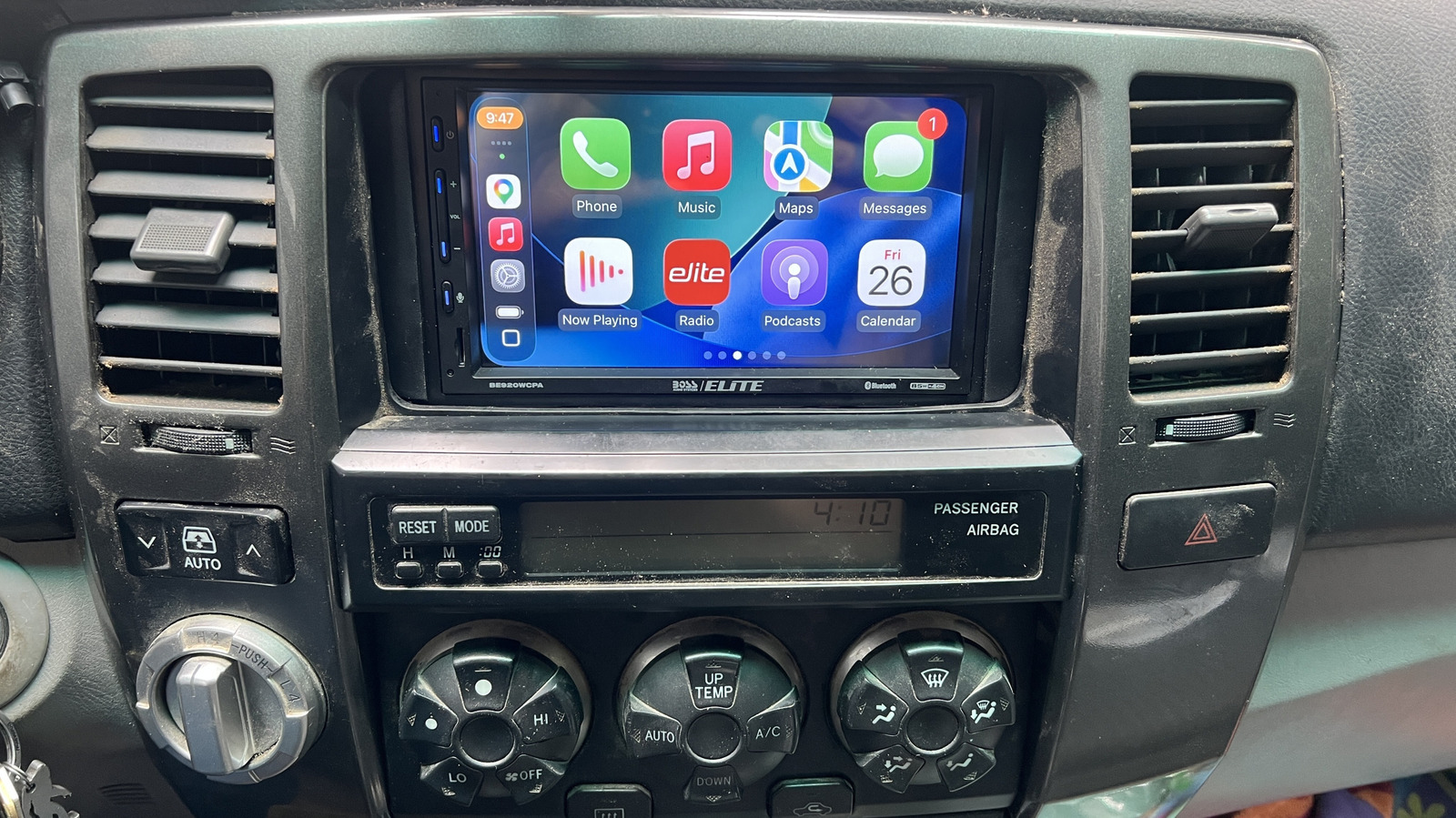


While automakers like GM strip Apple CarPlay out of brand-new vehicles, a 2006 Toyota 4Runner with nearly 300,000 miles just got it for $250 and a Saturday afternoon. The irony is almost too clean.
Justin Hughes, writing for Jalopnik, documented the full installation after his wife’s auxiliary jack died, killing her Spotify pipeline. Rather than tolerate the six-disc CD changer’s limited rotation, he ordered a CarPlay-compatible head unit from Crutchfield and did the swap himself. The total damage: roughly $250, basic hand tools, and some solder.
That price is worth sitting with. A single monthly payment on the average new car now runs north of $730. For a third of that, a two-decade-old SUV gets wireless CarPlay, Google Maps on the dash, and a microphone for hands-free calls.
Hughes’ 2021 Ford Transit camper van, five years newer, still doesn’t have it.
The job required a Phillips screwdriver, 10mm and 8mm sockets, and a Dremel to grind down a couple of metal nubs on the factory mounting brackets. Crutchfield supplied the mounting hardware, wiring harness, and step-by-step instructions specific to the 4Runner. No cutting into the vehicle’s factory wiring, no permanent modifications, and the whole thing is reversible if the truck ever changes hands.
Hughes soldered the harness connections rather than using crimp connectors, calling it overkill but noting it should outlast the truck. The 4Runner is pushing 300,000 miles and still running strong after a set of ignition coils and a coolant leak fix. These things simply refuse to die.
One compromise: the steering wheel audio controls no longer work. The adapter to reconnect them costs another $250, which would have doubled the project budget. His wife was fine with the volume knob on the new head unit, and sometimes the smartest engineering decision is knowing what to leave out.
The broader picture here is striking. Average used car prices remain elevated, and the average age of vehicles on American roads has climbed past 12.6 years. People are keeping their cars longer because they have to, and the aftermarket is quietly filling the gap that automakers either can’t or won’t.
A cottage industry of head unit manufacturers, harness adapters, and installation kits has made it dead simple to modernize an old interior without touching the mechanicals.
Hughes made a pointed observation about finding installation help online. Vehicle-specific forums from the mid-2000s remain goldmines of documented procedures for older trucks. Facebook groups that replaced them are, in his words, functionally unsearchable, and the institutional knowledge that keeps old vehicles alive exists largely because enthusiasts built it before social media buried it under algorithmic noise.
The plastic dashboard panels on the 4Runner came apart by hand without cracking, a detail Hughes contrasted with his Dodge farm truck’s disintegrating interior. Toyota built the fourth-gen 4Runner to last in ways that extend well beyond the drivetrain.
Every CarPlay-compatible head unit Hughes has encountered also supports Android Auto, so the upgrade isn’t platform-dependent. The real barrier isn’t cost or complexity. It’s the willingness to spend a few hours with a screwdriver and a wiring diagram.
New cars cost more, depreciate faster, and increasingly lock owners into proprietary software ecosystems that may or may not support the phone in their pocket. A 20-year-old 4Runner with a $250 head unit swap now offers a better infotainment experience than some vehicles rolling off the line today. That says less about the aftermarket and more about where the industry’s priorities have drifted.



Share this Story