
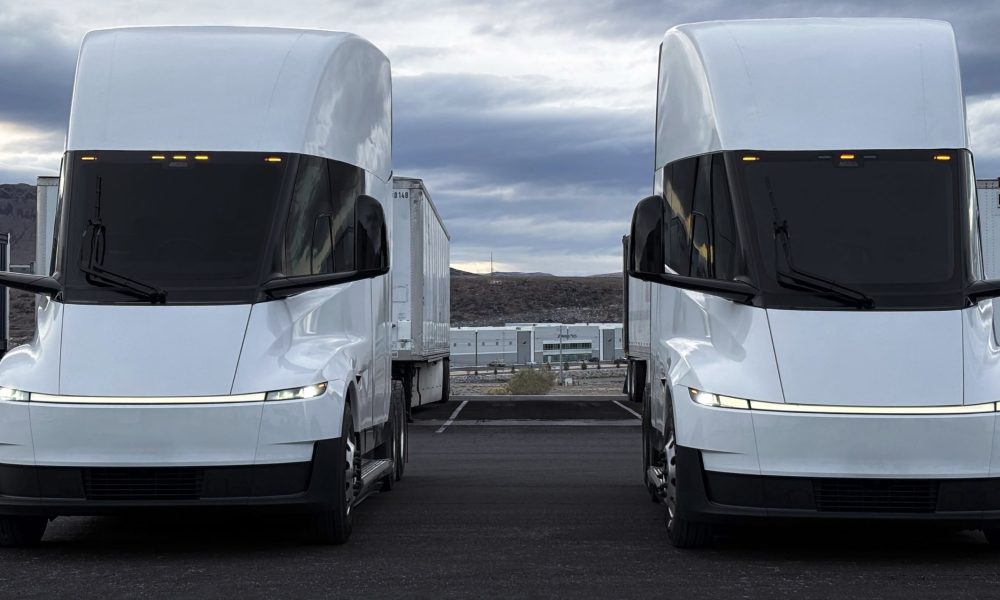


Tesla just carved the price of electrifying a trucking depot in half. The company this week launched a 125 kW Basecharger for the Semi, a compact overnight charging post priced from $40,000 for a minimum two-unit order. Compare that to $188,000 for a pair of its 1.2 MW Megacharger posts, and the math starts to look very different for fleet operators doing the napkin work on ditching diesel.
The Basecharger is not a fast charger. It’s not trying to be. It delivers roughly 60 percent of a Semi’s range in about four hours, which lines up neatly with federally mandated driver rest periods and the hours trucks sit idle at loading docks and distribution yards.
Tesla engineers pulled a power module straight from the V4 Supercharger Cabinet and stuffed it inside a single post, eliminating the need for a separate AC-to-DC conversion box. The result is a smaller footprint and a dramatically simpler installation.
The real cost savings come from the electrical infrastructure. Up to three Basechargers can daisy-chain off a single 125 kVA breaker, which means fleet operators don’t need to rip up their yards and install massive utility upgrades just to plug in a few trucks. That’s been the quiet killer of commercial EV adoption — not the vehicle price, but the site prep and electrical work that can dwarf the cost of the charger itself.
Deliveries won’t begin until early 2027, but Tesla is bundling the hardware with network-level software, remote monitoring, maintenance support, and a 97 percent uptime guarantee. For a fleet manager used to the reliability of a diesel pump, that number matters.
This launch doesn’t exist in a vacuum. Tesla is simultaneously ramping Semi production at its Nevada factory with a target of 50,000 units per year. Whether the factory actually hits that volume remains to be seen — Tesla’s production timelines have a well-documented history of optimism — but the signal is clear. This is no longer a pilot program with a handful of PepsiCo trucks.
The two-charger strategy is the piece worth watching. Megachargers handle the highway corridor, delivering a 30-minute top-up for long-haul routes. Basechargers handle everything else — the overnight shifts, the warehouse dwell time, the quiet hours when electricity rates drop to their lowest.
Together, they form a complete charging ecosystem that mirrors how diesel trucking already works: fuel up fast on the road, top off cheap at the depot.
Class 8 trucking burns through roughly 40 billion gallons of diesel annually in the United States. The economics of electrification have always penciled out on a per-mile fuel cost basis, but the upfront infrastructure investment scared operators away. A $40,000 charger that shares a breaker with two others and charges overnight on off-peak rates changes that calculation in a big way.
Tesla isn’t the only company chasing electric freight. Daimler, Volvo, and Nikola all have battery-electric trucks in various stages of production. But none of them are building their own charging network from the ground up. That vertical integration — truck, charger, software, energy management — is the competitive moat Tesla is digging around its Semi program.
The Basecharger is not glamorous. It won’t generate the breathless coverage that a new vehicle launch does. But for the trucking companies actually running the numbers on fleet electrification, a reliable overnight charger at a quarter of the Megacharger’s price is the product that moves the needle. Hardware wins freight contracts, and Tesla just made its hardware a lot cheaper to deploy.




Share this Story