
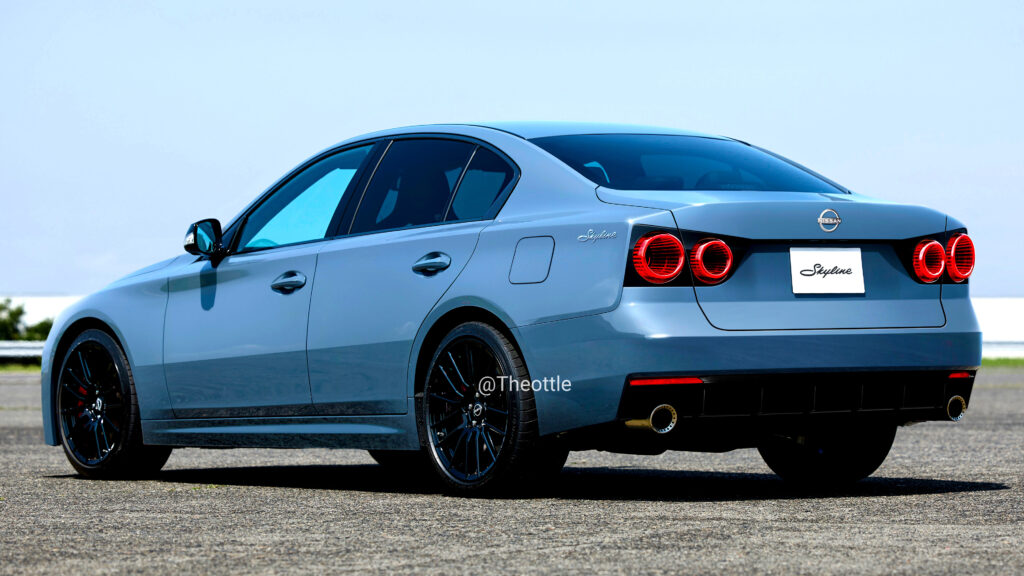


Nissan CEO Ivan Espinosa stood inside the company’s Yokohama headquarters earlier this month and did something the brand hasn’t done convincingly in over a decade: he gave enthusiasts a reason to pay attention. Two teaser images of a new Skyline. A confirmed Infiniti Q50 twin for America, with a timeline of roughly one year.
That’s the pitch. Whether Nissan can actually deliver is the question that hangs over everything the company does right now.
The new Skyline, expected to debut in Japan before arriving in the U.S. as a reborn Q50 around 2027, represents the most significant product bet Nissan and its luxury brand have made since the original G35 landed in 2002. The V37-generation Q50 it replaces was discontinued stateside in 2024 after years of neglect. Outdated tech, a cabin that couldn’t keep pace with German rivals, and a general sense that nobody in Yokohama was paying attention.
Now they claim to be paying attention. Multiple reports, including Japan’s Best Car magazine, indicate the new Skyline will pack the 3.0-liter twin-turbocharged VR30DDTT V6 already proven in the Nissan Z and the outgoing Skyline 400R. Output figures circulating suggest 400 to 450 horsepower in top trims, paired with rear-wheel drive and available all-wheel drive.
The real bombshell: a six-speed manual transmission is reportedly on the options list. In 2027. In a luxury sport sedan. That’s either a stroke of brilliance or a niche footnote, depending on how serious Nissan is about volume.
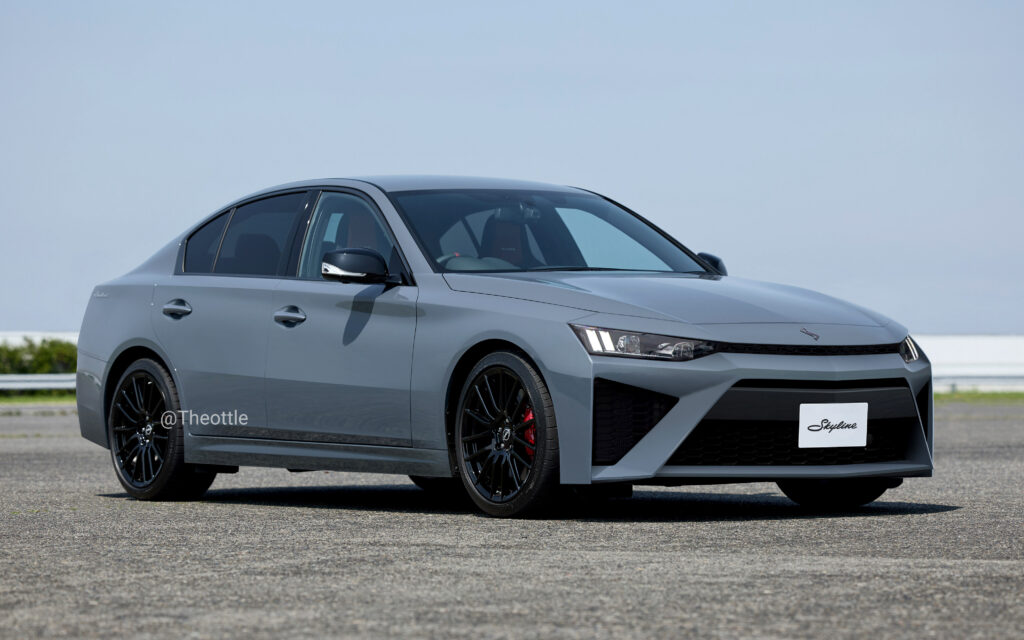
Rendering artist Steve R. Neill, whose pre-launch predictions nailed both the Toyota Supra and Ferrari Purosangue, has produced images suggesting a far more aggressive car than the one it replaces. Slim LED headlights, a lower athletic stance, sculpted bodywork drawing from Nissan’s Hyper Force and Vision Qe concepts, and the return of the Skyline’s signature circular taillights. That last detail alone will move the needle with the faithful.
But the faithful don’t pay the bills. The Q50 needs to compete with the BMW 3 Series, Cadillac CT5, and Lexus IS in showrooms where brand perception matters as much as horsepower. The previous car’s interior was its Achilles’ heel, and reports point to a fully modernized digital cockpit, larger displays, and upgraded materials.
There’s a caveat buried in the excitement. Several sources suggest the new Skyline may ride on an evolved version of the platform underpinning the V37, architecture that traces its DNA back to the V35 series from 2001. A quarter-century-old skeletal structure wearing a new suit.
Given Nissan’s well-documented financial distress, this isn’t surprising. It is, however, a calculated risk. A modern body and powertrain can mask old bones, but chassis dynamics don’t lie, and the competition has moved on.
Best Car also floated the possibility of an e-Power hybrid variant for Japan, where a gasoline engine serves strictly as a generator while an electric motor drives the wheels. Whether hybridization reaches the American Q50 remains unclear.
Espinosa also confirmed a new GT-R is in the pipeline, suggesting Nissan is attempting a full-spectrum enthusiast revival rather than a one-off halo play. The strategy is unmistakable: heritage as leverage, emotion as currency.
Nissan has spent the last five years lurching from crisis to restructuring to crisis again. The Skyline name still carries weight in a catalog where almost nothing else generates passion. If this car delivers on the promise of a twin-turbo V6, a manual gearbox, rear-drive dynamics, and a cabin that doesn’t embarrass itself next to a 3 Series, it won’t just be a good sedan.
It’ll be proof that Nissan still knows what made people care in the first place. That’s a big if. Nissan has earned every ounce of skepticism it gets.
Share this Story