
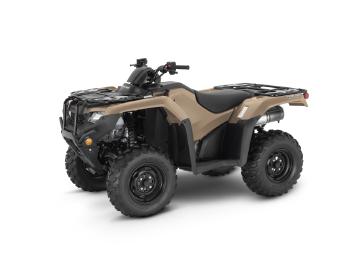


Five models, zero electrification, and every single one built in North Carolina. Honda’s 2027 FourTrax ATV lineup, announced April 28, is a deliberate stake in the ground for the internal combustion utility quad. It’s a segment some manufacturers have been quietly abandoning in favor of side-by-sides and battery-powered platforms.
The returning roster spans the compact Recon with its air-cooled 229cc single all the way up to the Rubicon 700 4×4 Automatic, Honda’s biggest rec-utility quad. In between sit the Rancher, Foreman 4×4, and Foreman Rubicon, each offered in multiple configurations with options for two- or four-wheel drive, manual or automatic DCT transmissions, electric power steering, and independent rear suspension.
Pricing starts at $6,299 for the base Rancher, with the Foreman Rubicon DCT EPS Deluxe topping out at $10,999. The Recon and Rubicon 700 prices remain TBA. Availability is staggered: Rancher models arrive in May, the Foreman in June, the Foreman Rubicon in July, and the Rubicon 700 in August, with the little Recon following in October.
None of this is revolutionary, and that appears to be exactly the point.
Honda hasn’t redesigned these machines. There are no new engine platforms, no hybrid drivetrains, no connected-vehicle tech announcements. The color palette swaps are modest — Sandstone Beige joins the Rancher options, Matte Silver appears on the Rubicon 700.
TrueTimber Atera Camo is available on select trims for a $500 premium. This is a continuity play, pure and simple.
The “Made in the USA” messaging is louder than usual. Honda hammered it repeatedly: planned in Georgia, developed in Ohio, assembled at the Swepsonville, North Carolina, plant. With tariff uncertainty hanging over imported powersports products and political pressure on manufacturers to show domestic production credentials, Honda’s 45-year American manufacturing history in this segment is a card worth playing hard.
The traditional ATV market has been losing ground to side-by-sides for over a decade. Polaris, Can-Am, and even Honda’s own Pioneer and Talon lineups have eaten into four-wheeler sales as buyers migrate toward enclosed cabs, dump beds, and passenger capacity. Can-Am went further last year, making noise about electric utility vehicles. Polaris has pushed its Ranger XP Kinetic.
Honda? Honda is still selling shaft-driven quads with air-cooled singles to ranchers who need to check fence lines.
There’s something stubborn about it. Also something smart. The utility ATV buyer — the actual rancher, the actual landowner, the person who needs a machine that starts every morning in January and doesn’t require charging infrastructure — isn’t shopping for disruption. They’re shopping for a tool that won’t quit.
Honda has owned that buyer for decades, and this lineup renewal says they have no intention of ceding that ground.
Colin Miller, Honda’s Manager of Experiential Marketing, framed it predictably: “We’re continuing that tradition — offering a range of capable, dependable ATVs that combine proven engineering with the versatility and durability our customers expect.” Translation: we’re not chasing trends.
The staggered rollout stretching from May through October is worth noting from a dealer perspective. It keeps Honda product flowing into showrooms across the prime selling season rather than dumping everything at once. That’s a quiet logistical advantage that keeps floor traffic coming back.
Whether this lineup survives another generation without some form of electrification or a real technological refresh is the bigger question Honda isn’t answering yet. The company has publicly announced plans for battery-electric powersports products but has offered zero specifics on the ATV side.
For now, the FourTrax family rolls on unchanged in a changing world. Sometimes the most interesting thing a manufacturer can do is refuse to blink.


Share this Story