
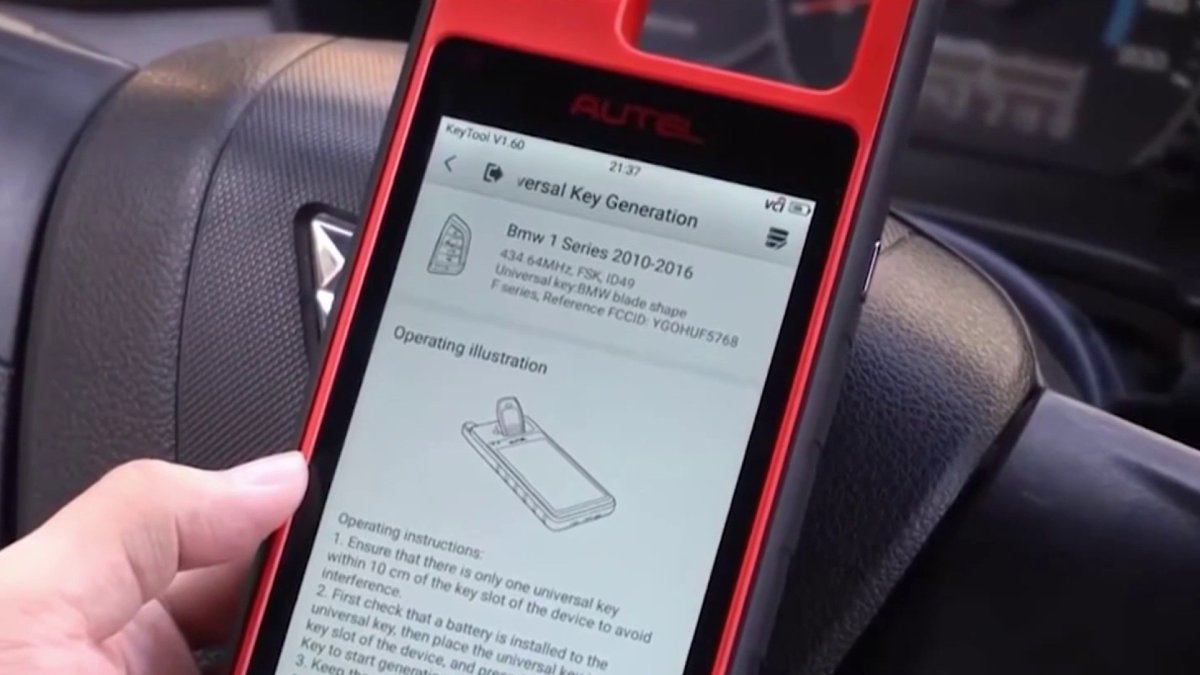


Six men, 117 stolen vehicles, and a $535 gadget anyone can buy online. That’s the math behind an international car theft ring that treated Northwest D.C. like a personal dealership throughout 2025.
Federal and local prosecutors unsealed indictments last week against Jacob Hernandez, 29, of Los Angeles; Dustin Wetzel, 23, of Woodbridge, Virginia; James Young, 23, of Hyattsville, Maryland; Khobe David, 24, of Upper Marlboro, Maryland; Chance Clark, 25, of Waldorf, Maryland; and a sixth defendant still at large. All face conspiracy charges for possessing, selling, and transporting stolen motor vehicles.
The tool of the trade was an Autel MaxiIM KM100X, a legitimate key programmer designed for locksmiths and dealerships. It looks like a chunky smartphone. It costs less than a set of good tires. And according to its own manufacturer, it can generate a working key for more than 700 vehicle models in under sixty seconds.
No broken glass. No hotwiring. No Hollywood theatrics.
Interim D.C. Police Chief Jeffery Carroll said the 117 confirmed thefts represent roughly 20 percent of all motor vehicle thefts in the District so far this year. One ring, one-fifth of the city’s car crime. Carroll added that investigators believe the suspects are connected to additional cases still being worked.
The operation was disturbingly efficient. Crews hit neighborhoods at night, reprogrammed blank key fobs on the spot, and drove the cars to a garage in the Navy Yard neighborhood. Corvettes, Camaros, Honda Civics — none of it mattered as long as it had a keyless ignition.
There, plates were swapped, VINs obscured, and GPS tracking disabled. The vehicles were then loaded into shipping containers labeled as “furniture” on customs manifests and sent overseas, primarily to Africa. Stolen American cars fetch premium prices on a black market swollen by high tariffs.
Some cars never left the country. Prosecutors say vehicles were also resold in Maryland and Pennsylvania.
U.S. Attorney for D.C. Jeanine Pirro, the former Fox News personality, made the announcement with characteristic flair, spelling out A-U-T-E-L for the cameras and declaring, “The car is gone in 60 seconds. Welcome to the new world of car theft.” She then called for a registry or licensing requirement for anyone purchasing key programming devices. The same official who once built a cable career championing deregulation now wants the government tracking tool purchases.
Pirro’s registry idea isn’t new territory. Canada banned the Flipper Zero, a similar electronic device used to clone key fobs, two years ago in a frantic attempt to curb its own car theft epidemic. The results have been mixed at best, largely because the underlying vulnerability isn’t the tool — it’s the cars themselves.
That’s the uncomfortable truth automakers would rather not discuss. Keyless entry and push-button start systems were sold to consumers as convenience and security upgrades. They are convenient. They are not secure.
A half-decade of escalating electronic theft has proven that. The fix requires manufacturers to harden their vehicles’ onboard computers against reprogramming, and the industry has moved at a glacial pace.
Police, meanwhile, offered their own solution: buy a steering wheel club. The kind your uncle used in 1994.
Autel did not respond to requests for comment. The company markets the KM100X to legitimate automotive professionals, and there is nothing illegal about the device itself. But the same capability that lets a technician make you a replacement key in a parking lot lets a thief do exactly the same thing at 3 a.m.
The six defendants face federal conspiracy charges. A yearlong joint investigation between federal and D.C. law enforcement produced the indictments. One suspect remains on the run.
One hundred seventeen families walked outside to an empty parking spot. The device that made it possible is still in stock and shipping free.


Share this Story