
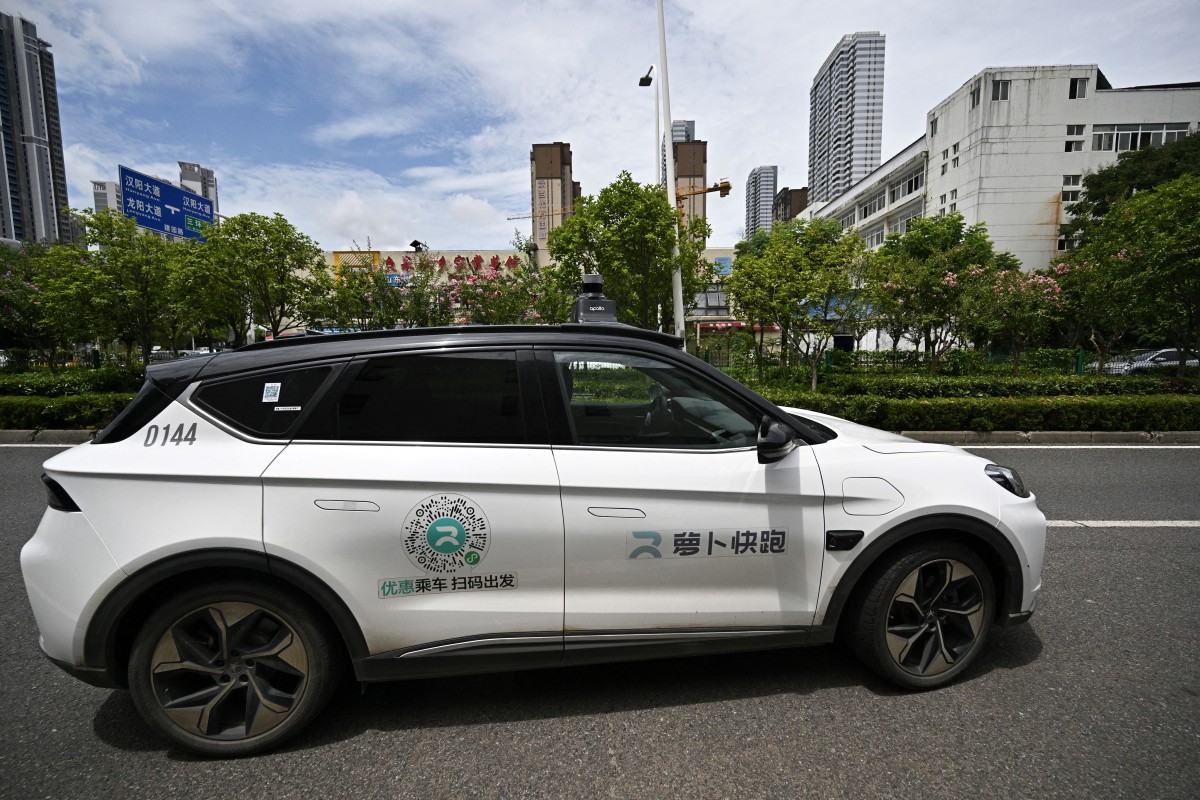


At least 100 Baidu Apollo Go robotaxis stopped dead in the middle of Wuhan’s busy roads Tuesday night, stranding passengers and snarling traffic across the central Chinese city. Some riders sat trapped inside the frozen vehicles for nearly two hours before police could reach them.
Wuhan traffic police confirmed receiving multiple reports of Apollo Go cars that had simply ceased to function mid-route. Doors could be opened manually, but several passengers refused to exit because of the heavy traffic swirling around them. They called police instead, waiting for officers to navigate the chaos their own rides had created.
Baidu, which has said nothing publicly about the incident, is one of China’s most aggressive autonomous vehicle operators. Apollo Go runs commercial robotaxi services in multiple major cities and has been expanding into overseas markets, including the Middle East.
Video verified by Reuters and posted on Douyin showed the stalled vehicles sitting like boulders in flowing streams of traffic, drivers swerving around them. Local police attributed the mass shutdown to a “system failure” and said the cause remains under investigation. No injuries were reported.
That phrase — “system failure” — does a lot of heavy lifting. It covers everything from a cloud-side software crash to a fleet-wide communications breakdown, and until Baidu explains what actually happened, the public is left to fill in the blanks. A hundred vehicles failing simultaneously isn’t a single-car glitch. It suggests a centralized point of failure, which is exactly the kind of vulnerability critics of networked autonomous fleets have been warning about for years.
This isn’t China’s first robotaxi scare. Last August, an Apollo Go vehicle carrying a passenger drove into a construction pit in Chongqing. In May 2025, a Pony.ai robotaxi caught fire on a Beijing road. Neither incident produced injuries, but each one chipped away at the careful narrative that China’s autonomous driving industry has been constructing: that these vehicles are safer, more predictable, and more reliable than human drivers.
The Wuhan incident also echoes what happened in San Francisco late last year, when a widespread power outage turned Waymo’s fleet into stationary obstacles. The parallels are uncomfortable for every company in this space. Whether it’s Baidu in Wuhan or Waymo in San Francisco, the failure mode looks the same: vehicles that can’t drive become vehicles that can’t get out of the way.
Chinese social media lit up with fresh skepticism. The timing is particularly awkward for Baidu and its competitors — Pony.ai and WeRide — as they push to scale operations and enter new international markets. Regulatory goodwill is the oxygen these companies breathe, and incidents like this consume it fast.
The core tension in autonomous driving has always been the gap between the technology’s promise and its edge cases. Proponents point to millions of miles driven without serious injury. Skeptics point to moments like Tuesday night, when a fleet designed to move people instead held them hostage on darkened streets.
No one was hurt in Wuhan. That fact will anchor Baidu’s eventual response, whenever it comes. But “no one was hurt” is a low bar for a technology sold on the premise of being fundamentally better than the status quo. A hundred cars freezing simultaneously on public roads isn’t an edge case. It’s a systemic event, and it demands a systemic explanation.
Baidu’s silence, now stretching past 24 hours, isn’t helping. In an industry where public trust is the product as much as the ride, saying nothing says plenty.

Share this Story