
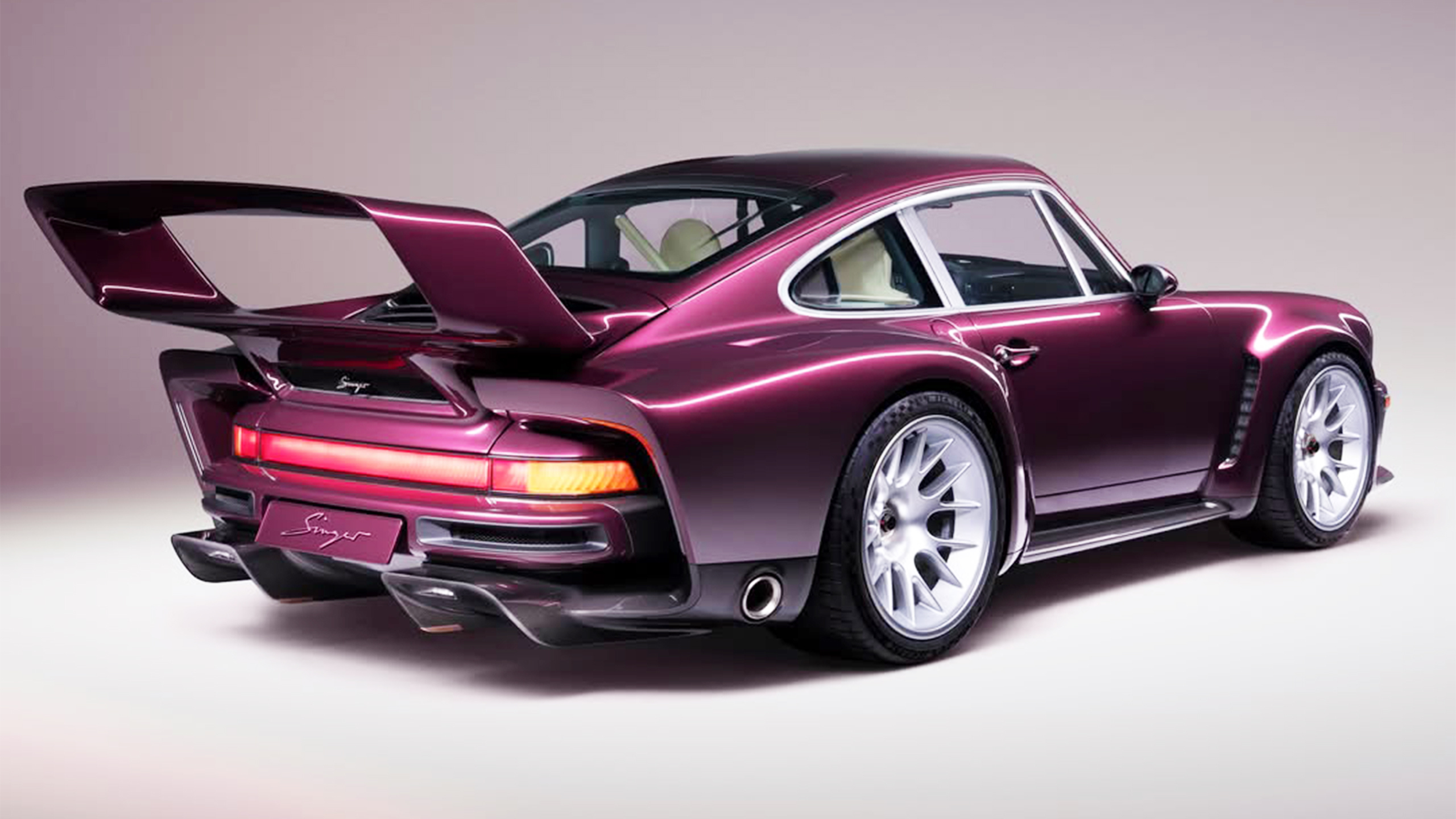


Singer Vehicle Design just rolled out another DLS Turbo that makes Porsche’s own factory efforts look almost restrained. This one wears a color called Amethyst, a deep eggplant finish draped over bespoke carbon fiber bodywork that bears only a passing resemblance to the 964 buried underneath.
The price? Singer doesn’t say. It never does. That silence is part of the brand’s currency.
Every DLS Turbo starts life as a donor 964, stripped to nothing, its chassis reinforced before Singer begins layering on the carbon fiber panels, custom lighting, and the kind of obsessive detailing that makes Swiss watchmakers look lazy. The front end gets a unique bumper, carbon splitter, and LED headlights. The rear is where things get aggressive: massively widened quarter panels, a substantial wing, and a carbon fiber diffuser that wouldn’t look out of place on a GT3 Cup car.
This particular build rides on center-locking magnesium wheels, a detail the owner specifically requested. Every DLS Turbo is a bespoke commission, so no two are alike. Singer delivers on that promise with a consistency that borders on fanatical.
Inside, the cabin is trimmed in Bone leather with tartan fabric accents in purple, green, and blue scattered across the seats, door panels, and dashboard. Carbon fiber bucket seats hold you in place. Behind them, an X-shaped cross brace has been wrapped in matching leather, because apparently no surface in a Singer goes unfinished.
The heart of the thing is a twin-turbocharged 3.8-liter flat-six producing 700 horsepower and 553 pound-feet of torque. Those numbers nearly match the new hybridized 992 Turbo S. But the DLS Turbo does it without electric assistance, without all-wheel drive, and with a six-speed manual gearbox. Rear-wheel drive only.
That last detail is the one that separates Singer from what Porsche itself is willing to sell you. Stuttgart has moved toward turbocharging, hybridization, dual-clutch transmissions, and all-wheel-drive safety nets. Singer takes the opposite approach: more power, fewer electronic intermediaries, and the kind of mechanical purity that Porsche abandoned years ago in the name of lap times and broader market appeal.
The DLS Turbo is Singer’s interpretation of the 934/5, the turbocharged race car Porsche campaigned in the late 1970s. The 934/5 was brutal, direct, and not particularly interested in being friendly. The DLS Turbo carries that spirit forward while wrapping it in materials and craftsmanship that would make a Hermès atelier nod in approval.
Singer has carved out a strange and lucrative niche. It builds cars for people who love what Porsche was but not necessarily what Porsche has become. The 964 is the canvas, and the client’s imagination and bank account set the boundaries.
Based on what keeps rolling out of the shop, those boundaries don’t appear to exist. A recent Singer build reportedly carried options alone that cost $65,000 more than a new 911 GT3. The DLS Turbo sits well above that tier.
Porsche tolerates all of this, at least publicly. Singer doesn’t use the Porsche name, and the donor cars have already been sold once. But every DLS Turbo that surfaces is a quiet rebuke to the direction the factory has chosen, and a reminder that there’s a deep-pocketed clientele willing to pay whatever it costs to get the 911 they actually want.
Share this Story