
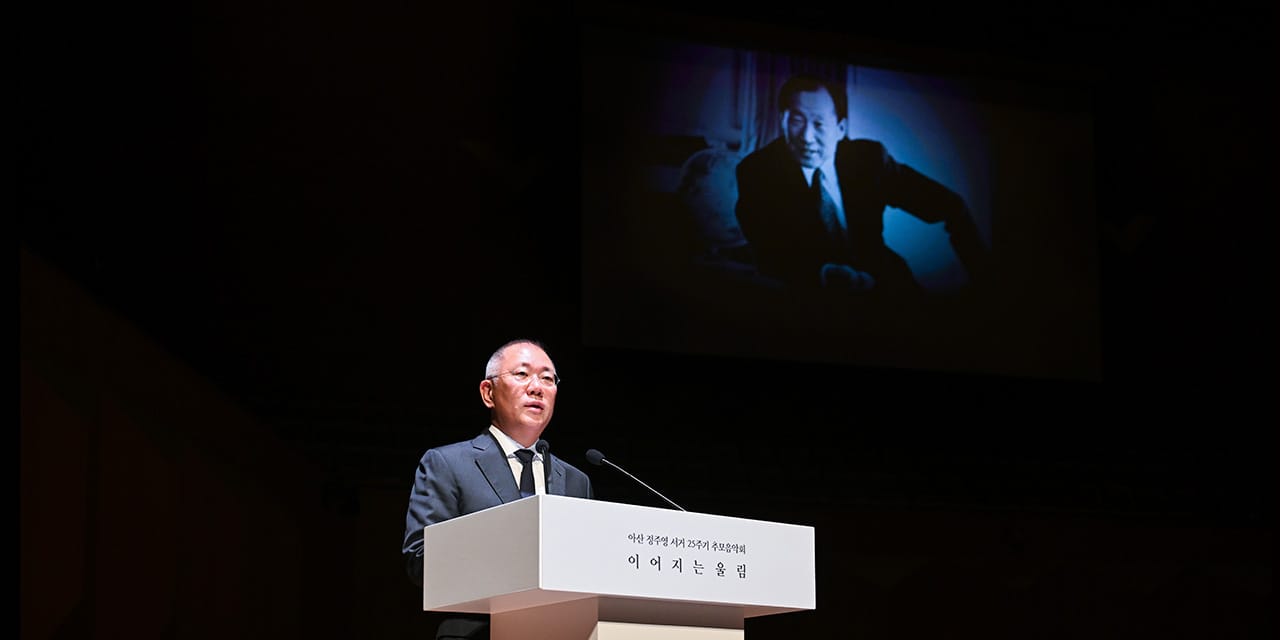


Four of South Korea’s most celebrated pianists — Sunwook Kim, Yekwon Sunwoo, Seong-jin Cho, and Yunchan Lim — shared a stage at Seoul Arts Center on February 25, performing on four grand pianos in a tribute to a man who started as a dock laborer and built one of the world’s largest automakers.
Hyundai Motor Group organized the concert to mark the 25th anniversary of founding chairman Ju-yung Chung’s death. More than 2,500 people attended, including South Korea’s First Lady Kim Hea Kyung, government officials, business leaders, and Hyundai employees. Executive Chair Euisun Chung, the founder’s grandson, delivered the memorial address.
“My grandfather’s beliefs and all his challenges began with ‘people,'” Euisun Chung told the audience. “He had faith in the potential of people and achieved innovation for them.”
Then he added something more revealing: “If I had asked my grandfather about this concert, he would have said, ‘Look! Why are you hesitating? Just do it!'”
That line — throwaway to some, loaded to anyone who knows the current pressures on Hyundai Motor Group — landed in a room full of people aware the company faces tariff headwinds, an EV transition that demands enormous capital, and intensifying competition from Chinese automakers. Euisun Chung acknowledged as much, referencing “many difficulties and challenges both inside and outside our organization” before pledging to carry forward his grandfather’s spirit.
The concert, themed “Resonance That Continues,” was planned years ago in collaboration with pianist and conductor Sunwook Kim. It opened with Kim and Cho performing Schubert’s “Fantasy in F Minor for Four Hands,” followed by Sunwoo and Lim tackling Rachmaninoff’s “Suite No. 2 for Two Pianos.” The finale brought all four pianists together for Wagner’s “Tannhäuser Overture” and Liszt’s “Hexameron” — a deliberate symbol, per the Group, of individual challenges expanding into collective resonance through collaboration.
Ju-yung Chung’s biography reads like a screenplay that would be rejected as implausible. Born the eldest son of an impoverished farming family, he lost a rice shop to Japanese colonial rationing, lost an auto repair shop to fire, and lost a construction firm’s assets to the Korean War. He rebuilt every time.
Hyundai Motor Company was founded in 1967, and Chung insisted on developing proprietary vehicles rather than assembling foreign designs — producing the Pony, Korea’s first mass-market car built on homegrown technology.
His construction feats were equally audacious. He won the $930 million Jubail Industrial Port contract in Saudi Arabia — roughly 20 percent of Korea’s annual government budget at the time — against established global firms. He also helped Seoul land the 1988 Olympics when the city entered the bid with an estimated three or four votes out of 82.
Last year, Automotive News recognized three generations of the Chung family with its Centennial Award, crediting them with reshaping South Korea “from the ashes of the Korean War into the global manufacturing powerhouse and automotive heavyweight known worldwide today.”
The memorial concert was not just nostalgia. Hyundai announced the following day that it will establish a new innovation hub in Korea focused on robotics, AI, and hydrogen energy — ambitions that would have been as improbable-sounding in Ju-yung Chung’s era as a shipyard in Ulsan once was.
Pianist Sunwook Kim put it simply: “Music endures longer than words, and sharing the weight and spirit of his life with the audience made the experience even more meaningful.”
Twenty-five years after his death, the founder’s most lasting export may not be any single vehicle. It is the institutional stubbornness — call it optimism, call it recklessness — that a company can will itself into being world-class by refusing to accept that it cannot.


Share this Story