
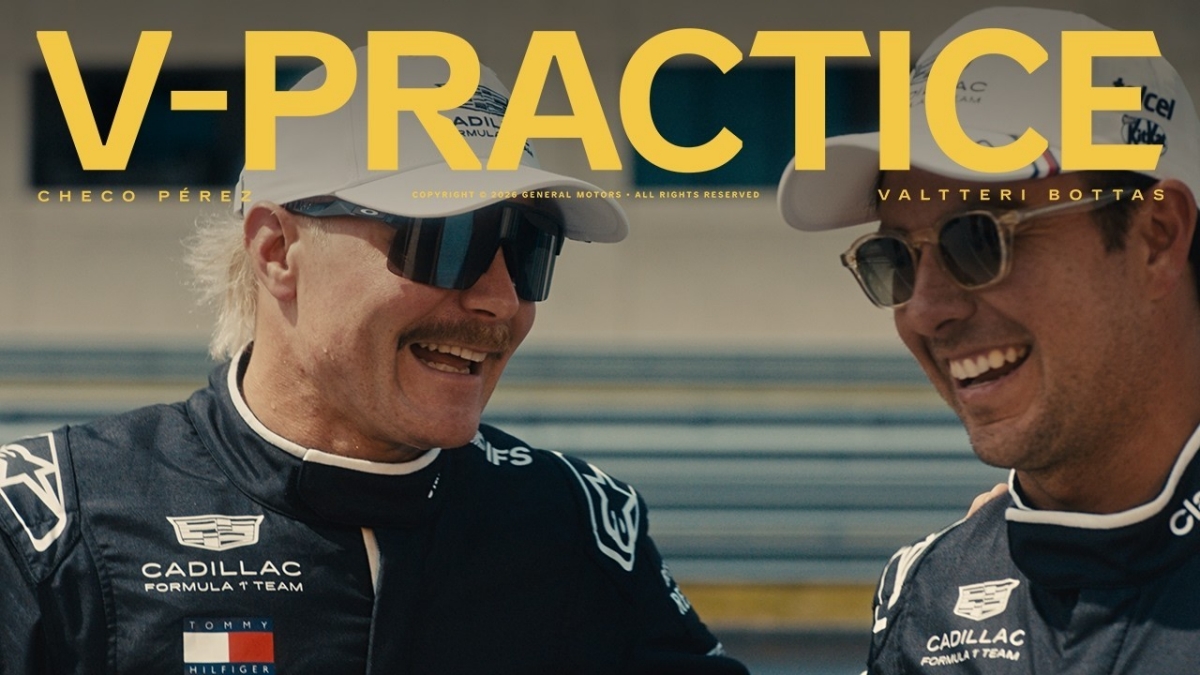


General Motors spent roughly $1 billion to buy its way onto the Formula 1 grid. Now it’s putting Valtteri Bottas and Sergio Pérez in an electric crossover on a slalom course in Miami and calling it content.
Cadillac’s latest marketing push is a YouTube video featuring its two F1 drivers competing head-to-head in a pair of V-Series vehicles — the all-electric OPTIQ-V SUV and the supercharged CT5-V Blackwing sedan. Closed course, stopwatch, trash talk. The press release practically vibrates with exclamation energy while saying almost nothing.
Strip away the breathless copy and you’re looking at the clearest signal yet of why GM really joined Formula 1. It was never just about racing. It was about having two globally recognized drivers available to star in product videos for Cadillac’s showroom lineup.
Bottas, the steady Finn with 10 grand prix wins, and Pérez, the Mexican veteran whose career has been defined by consistency and commercial appeal in key markets. Neither is the fastest driver on the 2026 grid. Both are extraordinarily marketable, and both signed knowing their job extends well beyond Sunday afternoons.
That the OPTIQ-V — a luxury electric SUV starting around $55,000 — gets top billing over the CT5-V Blackwing is no accident. Cadillac needs to move electric inventory. The Blackwing, beloved by enthusiasts, is a niche product running on borrowed time as GM phases out internal combustion.
The OPTIQ-V is the future Cadillac is betting on. Having F1 drivers validate it on a precision course is the kind of halo marketing that Ferrari and Mercedes have weaponized for decades.
But Ferrari and Mercedes earned their F1 credibility over generations. Cadillac is building a car from scratch for 2026 while simultaneously trying to cash in on a racing program that hasn’t turned a competitive lap yet. The team has no heritage, no results, and no data to suggest where it will land in the pecking order. What it does have is two photogenic drivers willing to film content in a parking lot.
This is the modern F1 playbook, and it works. McLaren sells lifestyle merchandise. Red Bull sells energy drinks through racing. Mercedes used its dominance to rebrand AMG as a global performance icon.
Cadillac is attempting the same maneuver at full speed, conflating the prestige of Formula 1 with a product lineup that, until very recently, competed more directly with Lincoln than with BMW.
The V-Series brand has genuine credibility among the people who actually drive these cars hard. The CT5-V Blackwing is one of the best performance sedans ever built in America, full stop. The OPTIQ-V is newer and less proven but shows promise. Neither needs an F1 driver to validate it on a cone course.
What the video really reveals is the machinery behind GM’s F1 entry. Every sponsorship dollar, every driver appearance, every carefully staged “competition” is designed to reposition Cadillac as a global luxury-performance brand worthy of standing alongside the European establishment. The racing is almost secondary.
Bottas and Pérez will eventually have to deliver results on track. The car will have to be competitive or the whole exercise becomes a very expensive embarrassment. But for now, the real race is happening in marketing departments and YouTube analytics dashboards, where two F1 drivers doing donuts in an electric SUV counts as a win.
GM didn’t spend a billion dollars to go racing. It spent a billion dollars to make you believe Cadillac belongs in the same sentence as Ferrari. The slalom cones are just a prop.
Share this Story