
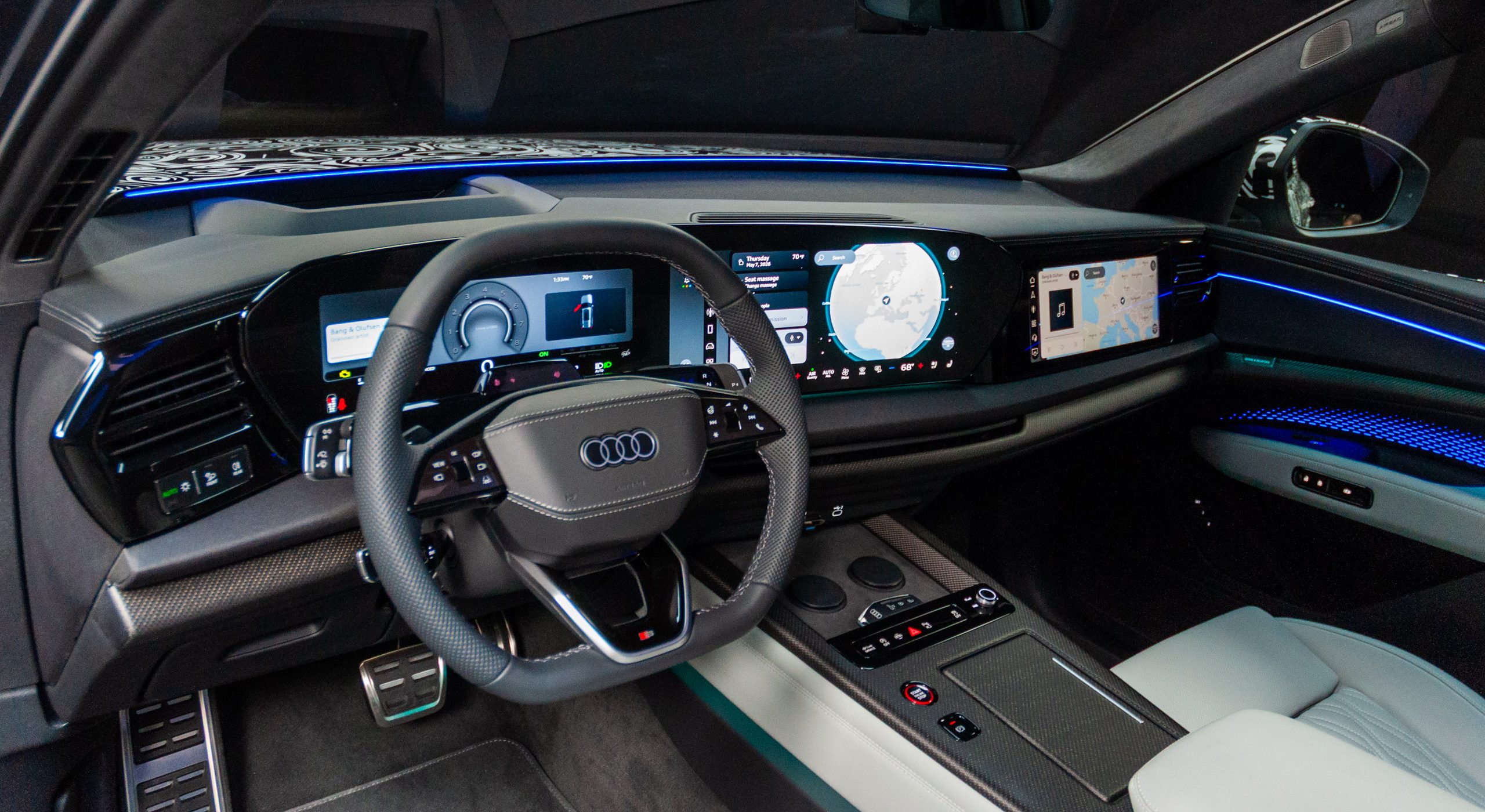


Audi just showed its hand, and it’s holding a 40-ounce Stanley mug. The 2027 Q9 three-row SUV — the largest production Audi ever built — had its interior revealed Monday, and the message couldn’t be louder: this truck was designed for American families first, German engineering pride second.
The Q9 drops into a fight that Mercedes-Benz and BMW have owned for years. The GLS-Class just got a facelift. The X7 is about to be reborn.
Audi has never had an answer at this size, and the hole in its lineup has cost it dearly in a segment where six-figure three-row luxury SUVs print money. So Audi went big. Not just physically — though the Q9 is long, wide, and tall enough to match its Stuttgart and Munich rivals — but in the details that actually move metal in American suburbs.
Cup holders fit Stanley tumblers, front and rear. That sounds trivial until you remember that cup holder size has killed deals on dealer lots since the Lexus RX first landed in 1998. Audi knows this.
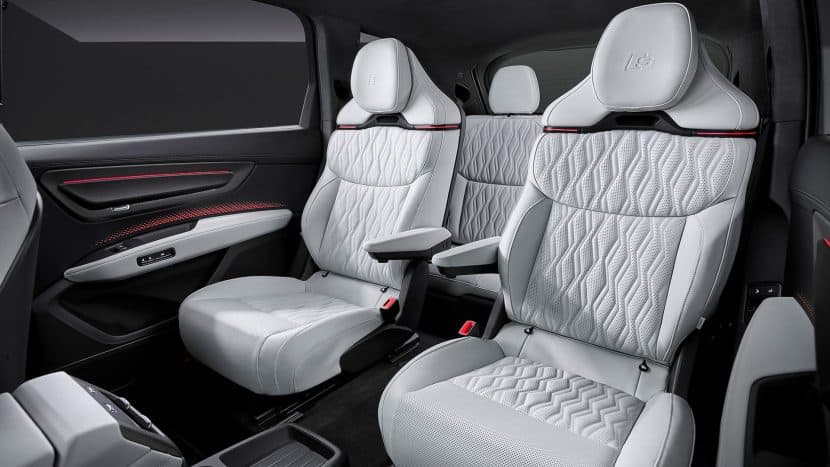
The rear doors open a full 90 degrees. Three car seat tether points span the second-row bench. The outboard seats slide and tilt forward so you can access the third row without unstrapping an empty child seat.
These are not engineering afterthoughts. These are conquest features aimed squarely at parents cross-shopping a BMW X7 and finding excuses to stay.
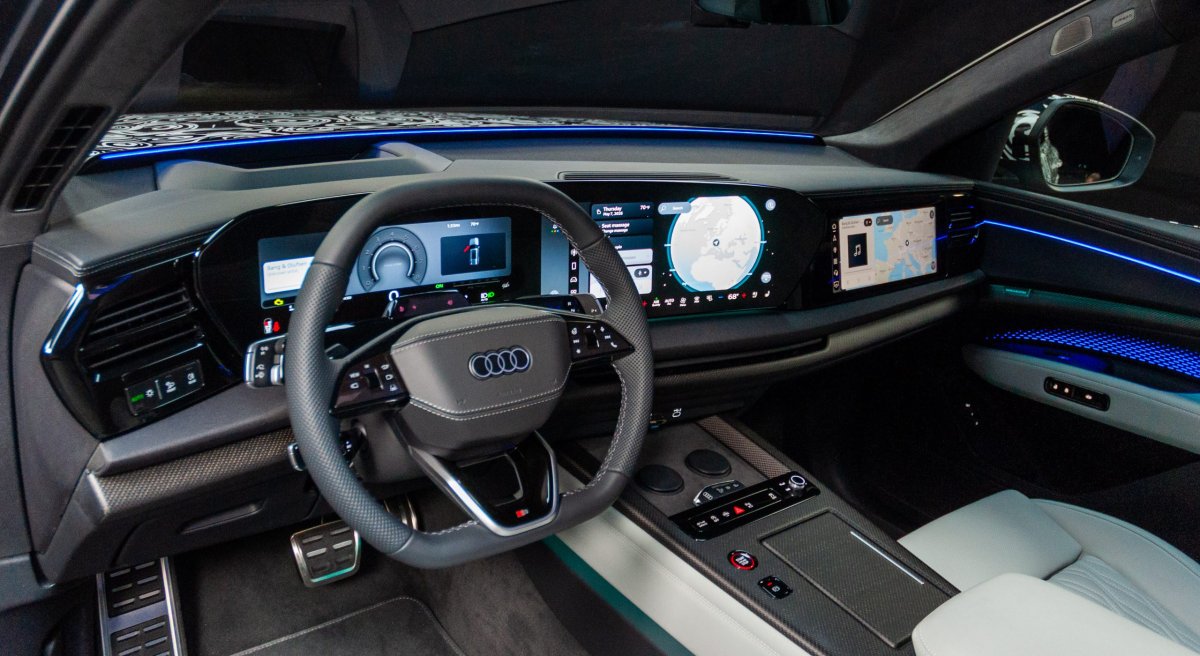
The third row is genuinely adult-sized. A 5-foot-10 frame fits behind a 6-foot-5 passenger in the second row, which puts the Q9 in rare air for the segment. Cargo space behind the third row looks substantial even before folding anything down.
Inside, Audi appears to have listened to the criticism that’s dogged its recent cabins. Piano black plastic is gone. Trim runs from open-pore wood to carbon fiber weave, and most plastic surfaces are matte — a quiet admission that the fingerprint-magnet era was a mistake.
Stitched leather covers the dashboard. A wool-like cloth hides speakers for the available Bang & Olufsen 4D system, which pushes sound through 22 speakers and two seat-mounted actuators that vibrate bass frequencies directly into your body.
The triple-screen layout borrows from the A6 E-Tron, curving a digital gauge cluster and center touchscreen under one piece of glass. A passenger display handles YouTube, web browsing, and Bluetooth headphone pairing. There is a real volume knob, which shouldn’t feel like a victory in 2025, but it does.
Climate and vent controls still live in the touchscreen, though, so the physical-button rehabilitation isn’t complete.
The doors are fully electronic — no mechanical handles inside. A capacitor backup ensures each door can open even with total power loss, which Audi positions as superior to the mechanical backup Porsche uses in the Cayenne Electric.
A panoramic glass roof spans 16 square feet and can be optioned with polymer-dispersed liquid crystal tech to turn sections opaque on command, blocking 99.5 percent of UV rays. Eighty-four embedded LEDs can turn it into a light show.
Two cooled wireless chargers deliver up to 100 watts each with MagSafe compatibility. Audi’s single-stalk control unit — combining gear selector, turn signals, and wipers — carries over and remains one of the best-engineered interfaces in any modern car.
The exterior stays under wraps until the July 28 unveiling. U.S. arrivals are expected by late 2025.
Audi management has acknowledged recent missteps publicly, and the Q9 is clearly the first correction. It isn’t a concept exercise or a technology demonstrator. It’s a family truck built to poach customers from two entrenched competitors by out-practicalizing them at every touchpoint.
Whether that’s enough to crack the GLS-X7 duopoly depends on pricing and powertrain details still to come. But the interior alone signals an Audi that has stopped designing for auto shows and started designing for school pickup lines.


Share this Story